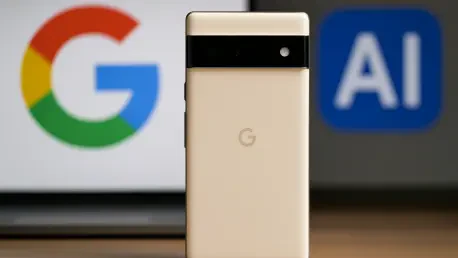

A significant schism is forming within one of technology’s most devoted fanbases, pitting Google’s ambitious vision for an AI-powered future directly against the streamlined user experience that originally built its Pixel smartphone empire. What was once heralded as the purest form of Android, celebrated for its clean and uncluttered interface, is now facing a wave of criticism from a vocal segment of its user base. These users argue that the relentless integration of Artificial Intelligence has become obtrusive, adding unnecessary complexity to simple tasks and fundamentally undermining the core principles that made the Pixel brand so appealing. This growing discontent, bubbling up in community forums and online discussions, has sparked a critical debate about the direction of the Pixel line and whether its all-in-on-AI strategy is inadvertently alienating its most loyal advocates, potentially damaging the very identity it worked so hard to create over the years.
A Widening Chasm Between Innovation and Usability
The undercurrent of user frustration recently broke the surface in a widely circulated Reddit post that captured the collective exasperation of many. The original poster, presumably using a recent Pixel model, expressed an intense level of annoyance, stating they “can’t stand this phone anymore.” The core of the complaint centered on the feeling that AI is being aggressively “forced down their throats,” cluttering the once-pristine interface with what they described as “unnecessary layers.” This sentiment was not just a vague feeling; it was backed by specific examples of degraded usability. Tapping the Google search widget, a simple and direct action, now launches a full-screen AI interface, a jarring change that disrupts workflow. Similarly, the previously straightforward process of editing a screenshot has been complicated by the insertion of additional AI-powered options, adding friction to a task that was once second nature. The user’s wistful preference for the older Pixel 7 model underscored a belief that the software had not evolved but regressed in its relentless pursuit of AI integration.
This perspective was quickly validated and expanded upon by a chorus of other users, each providing their own concrete examples of how the new AI-heavy system has led to a decline in efficiency. One pointed out that taking a screenshot of text in a foreign language used to immediately present a convenient, one-tap “Translate” button, a perfect example of intuitive design. In the new system, this same action has become significantly more cumbersome. A user must now tap a three-dot menu, select the “Lens” option, and then hunt for a small “Translate” icon within that separate interface. This change epitomizes the central complaint: AI is adding extra steps to actions that were previously instantaneous, directly contradicting the principles of a streamlined user interface. Another user offered a compelling comparison, noting that their non-Pixel device also incorporates AI, but does so in a helpful, unobtrusive manner, appearing only when needed rather than being constantly “shoved in my face,” suggesting a more elegant implementation is possible.
A Divisive Strategy with Nuanced Reception
However, it is crucial to note that this mounting frustration is not a universal sentiment among all Pixel owners, revealing a complex and divided user base. In the same discussions where complaints flourish, a contrasting opinion emerges from users who remain unfazed by the software changes. One such user claimed they simply ignore the new AI features or do not notice their presence during daily use, suggesting that the intrusiveness of the AI may be subjective and highly dependent on individual usage habits and workflows. This indicates that for a portion of the audience, the AI integrations are either not disruptive or are easily sidestepped. Furthermore, this nuance highlights a critical point in the debate: the issue for many is not the existence of AI technology itself, but rather the heavy-handedness of its implementation and its overarching impact on the operating system’s established design philosophy, which has long been a key selling point for the brand.
In fact, the very same users who criticize the platform’s new direction often actively appreciate and use certain AI-powered tools, proving that the technology can be a positive addition when implemented thoughtfully. Features like Circle to Search, which allows for quick information gathering by simply circling an object on the screen, have been widely praised for their utility. Likewise, the photo-editing tool Magic Eraser continues to be a standout feature that demonstrates the practical power of computational photography. Even the Gemini assistant, despite its central role in the controversial UI overhaul, is seen by some as a genuinely helpful and powerful tool. This duality shows that Google is capable of creating beloved AI features. The core tension arises from the company’s decision to weave AI into the fundamental fabric of the operating system in a way that feels mandatory and disruptive, rather than offering these powerful tools as optional, context-aware enhancements that empower the user without getting in the way.
The Long-Term Consequences for the Pixel Brand
Beyond the immediate impact on user experience, this determined AI-first approach signals a profound strategic pivot for the Pixel brand, one that risks alienating its foundational audience. The Pixel 9 was identified by many as the device that began to truly “center the smartphone experience around AI,” marking a significant departure from the brand’s original identity. That identity was built on providing a “clean and uncluttered interface” that served as the gold standard for the Android operating system. The recent shift toward a “Gemini-centric” ecosystem is perceived by critics as a dilution of that pure Android experience, replacing elegant simplicity with what they see as AI-driven clutter. This has led some long-time enthusiasts and technically inclined users to suggest drastic workarounds, from attempting to disable the bulk of the AI features to replacing the stock operating system entirely with an open-source alternative like GrapheneOS, a clear sign of their desire to revert to a simpler software foundation.
This singular focus on software innovation, particularly AI, appeared to create another significant problem: a perceived stagnation in hardware development. While a distinct software experience was the Pixel’s original defining characteristic, Google’s strategy leaned so heavily into AI that many felt hardware improvements had taken a back seat. With the initial, industry-wide enthusiasm around artificial intelligence beginning to cool, a reliance on software features as the primary differentiator became an increasingly risky strategy. The core challenge this created for Google was the need to rebalance its priorities. To maintain its competitive edge and avoid losing momentum, the company was tasked with delivering notable hardware innovations in its subsequent releases. It had to prove that the brand’s appeal extended beyond a controversial and divisive software strategy, reaffirming that the Pixel was a leader in both intelligent software and cutting-edge hardware design.