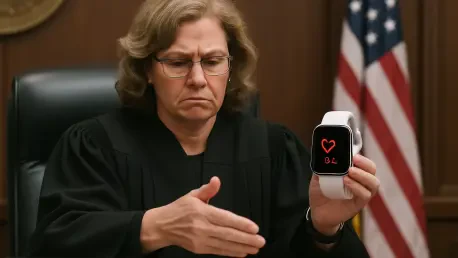

The tech world is currently fixated on a pivotal moment in the wearable industry as a long-standing legal battle between Apple and Masimo reaches a significant turning point. Oscar Vail, a seasoned technology expert with a deep understanding of the intersection between consumer electronics and medical innovation, joins us to unpack the implications of the International Trade Commission’s latest decision. This conversation explores the technical restoration of blood oxygen monitoring on the Apple Watch, the friction caused by multi-device workarounds, the massive financial stakes of patent litigation, and the operational hurdles companies face when their core health features are caught in legal crossfire.
Now that the International Trade Commission has declined to reinstate the import ban, how will the restoration of on-device blood oxygen tracking change the user experience, and what technical steps must be taken to re-enable this feature across the Series 9 and Ultra 2 models?
The restoration of native blood oxygen tracking is a momentous victory for the user experience because it eliminates the friction of a fragmented health ecosystem. For months, owners of the Series 9 and Ultra 2 felt deprived of a feature they specifically paid for, forced to deal with a version of the device that felt incomplete. To re-enable this, Apple must essentially reverse the software-level lockout that was implemented to comply with the initial December 2023 ban. This involves pushing a firmware update that reactivates the sensor’s communication with the watch’s display, moving past the inferior workaround that kept this data trapped on the iPhone. When users can once again see their vitals directly on their wrists in real-time, it restores the sense of immediacy and reliability that defines a high-end wearable.
High-stakes patent litigation often lasts for years and involves hundreds of millions of dollars in potential judgments. What are the broader implications of these prolonged legal battles for innovation in the wearable market, and how do companies balance legal risks with aggressive feature expansion?
These prolonged battles, like the six-year campaign Masimo has waged against Apple, create a stifling atmosphere where innovation is often held hostage by legal maneuvering. When a company is staring down a $634 million judgment, as is the case in one of the separate rulings involving these parties, the financial risk begins to dictate the product roadmap more than consumer needs do. Companies are forced to play a high-stakes game of “feature chicken,” where they must decide if a new sensor is worth the risk of a total import ban or a multi-year court fight. We see this tension in the way Apple describes the campaign as “relentless,” suggesting that the emotional and operational drain of these disputes can be just as damaging as the monetary fines. Ultimately, the market suffers because manufacturers may become hesitant to implement life-saving tech if they fear it will trigger a decade of litigation.
Users previously had to rely on a workaround that displayed health metrics on a paired phone rather than the watch itself. Why is native, on-device data visualization critical for medical monitoring, and what are the specific drawbacks when manufacturers are forced to split functionality across multiple devices?
Native visualization is the heartbeat of wearable health tech because, in a medical context, seconds and accessibility matter. When Apple was forced to split the functionality, making users check their iPhones to see blood oxygen stats, it fundamentally broke the “glanceable” utility that makes a smartwatch valuable. This workaround was inherently inferior because it added a physical and cognitive layer of effort to what should be a passive, seamless monitoring experience. Splitting features across devices creates a sensory disconnect; you feel the haptic on your wrist but have to reach into your pocket to understand what your body is telling you. This fragmentation not only frustrates the consumer but also diminishes the perceived reliability of the device as a serious medical tool.
With the possibility of further appeals to the Federal Circuit and outstanding multi-million dollar judgments, what operational challenges do tech companies face when hardware features remain in legal limbo? How does this uncertainty impact long-term product roadmaps and consumer trust in health-tracking reliability?
Operating in legal limbo is an logistical nightmare because it forces a company to maintain two versions of the same product: one that is fully functional and one that is legally “sanitized.” This creates massive complexity in the supply chain and retail environments, especially when dealing with flagship products like the Ultra 2. When a judge’s decision can suddenly toggle a feature on or off, consumer trust begins to erode as the device no longer feels like a stable health companion. Looking toward the future, such as the separate judgment looming in November 2025, the uncertainty makes it incredibly difficult for engineers to commit to hardware designs that might be banned before they even hit the shelves. It turns a product launch into a gamble, where the final feature set is determined by a courtroom rather than a laboratory.
What is your forecast for the future of health-tracking technology in consumer wearables?
My forecast is that we will see an even more aggressive push toward “medical-grade” certification for consumer devices, despite the legal minefields. While the “relentless” litigation we’ve seen might suggest a slowdown, the victory at the ITC proves that the demand for integrated health features is strong enough to weather years of legal storms. We are moving toward a world where the wearable is no longer just a companion to the phone, but a standalone diagnostic hub capable of sophisticated monitoring that once required a hospital visit. As these companies navigate the fallout of the $634 million judgments and potential appeals to the Federal Circuit, the ultimate winner will be the consumer who gains access to more robust, non-infringing ways to track their own survival. The era of the “smartwatch” is ending, and the era of the “wrist-worn clinic” is just beginning.