
Market availability for the co-developed suite will initially focus on the United States, Canada, and the United Kingdom before expanding to other regions in early 2024. This strategic alignment between two of the most influential players in consumer electronics marks a significant departure from the traditional, fragmented smart home landscape. For years, the industry has struggled with a patchwork of devices from different manufacturers that rarely work in perfect harmony, often leading to consumer frustration and technical instability. By integrating LG’s extensive history in home appliance manufacturing with Apple’s sophisticated software ecosystem, this partnership introduces a new era of home automation where devices are no longer just compatible, but fundamentally connected. The resulting Apple Home collection is not merely an addition to an existing product line; it is a meticulously engineered ecosystem designed to elevate the standard of domestic living. This collaboration sets a benchmark for how industry giants can merge their core strengths to create a more intuitive, reliable, and fundamentally private home environment for modern households.
A Unified Approach to Hardware and Software
From Compatibility: A New Engineering Standard
Traditionally, smart home devices are developed in isolation by a manufacturer and later updated with software patches to support third-party platforms like Apple Home. This project breaks that mold by involving engineers from both companies in the earliest stages of product planning. By working in tandem from the start, the teams synchronized hardware specifications with software architecture to ensure a level of performance that post-market updates cannot match. This approach addresses common performance bottlenecks such as latency and inconsistent connectivity, which often plague devices that are retrofitted for compatibility. The consensus between the two giants is that a truly connected home should require less manual intervention and offer more predictable behavior. This synchronized development process represents a fundamental shift toward a holistic design philosophy, where the interaction between the physical device and the digital interface is considered a single, inseparable experience rather than two distinct components working in parallel.
Co-Development: Seamless System Integration
The synergy between these co-developed solutions is most evident in how the devices communicate within the home environment. Rather than functioning as isolated silos, the accessories in this collection are designed to operate as a cohesive unit that responds to the specific needs of the resident. A prime example of this deep integration is the implementation of the “Good Morning” scene, which can be triggered by a single voice command or a scheduled event. In this scenario, the LG Smart Thermostat adjusts the home’s climate while the LG Indoor Cam physically tilts its lens downward, providing residents with an immediate visual confirmation of their privacy as they start their day. This level of synchronization aims to eliminate the friction typically associated with managing multiple smart devices from different manufacturers. By aligning their technical roadmaps, LG and Apple have ensured that the user experience is fluid and automated, reducing the cognitive load on the homeowner and making the technology a natural extension of the domestic routine rather than a complex system to be managed.
Innovative Security and Access Solutions
Advanced Monitoring: Comprehensive Vision and Control
The security sector of the new collection introduces three distinct camera models designed to provide comprehensive property coverage. The LG Indoor Cam Plug-In features an expansive 160-degree field of view, which allows it to monitor large rooms with minimal blind spots. For exterior protection, the LG Outdoor Cam Plug-In delivers high-fidelity surveillance with 2.5K resolution and low-light color night vision, ensuring that detail is preserved even in challenging environmental conditions. Additionally, the LG Floodlight Cam integrates dual adaptive floodlights that respond to detected movement, combining powerful illumination with high-definition recording to deter unauthorized activity. These monitoring tools are not just passive recording devices; they are equipped with advanced sensors that work in harmony with the Apple Home ecosystem to provide real-time alerts and actionable insights. By focusing on both visual clarity and physical privacy features, such as the mechanical tilt on the indoor model, the partnership addresses the dual consumer demand for robust security and the preservation of personal space within the home.
Entryway Management: Next-Generation Access Protocols
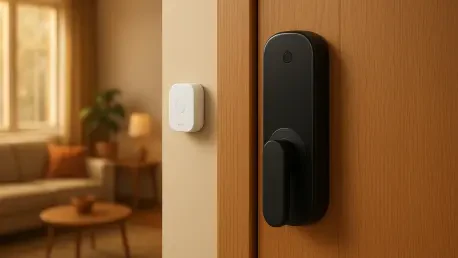
Entryway management is redefined through the introduction of the LG Video Doorbell Wired and the Smart Deadbolt Lock. The doorbell addresses common visibility issues by utilizing a dual-camera system: a 2.5K front-facing camera captures visitors’ faces in high detail, while a Full HD bottom-facing camera monitors packages and the area directly in front of the door. This system uses local intelligence to distinguish between people, pets, vehicles, and deliveries, providing more accurate notifications to the user. Complementing this is the LG Smart Deadbolt Lock, which leverages Ultra-Wideband technology to facilitate hands-free entry. Using “home key” technology on an iPhone or Apple Watch, the lock recognizes an authorized user’s approach and unlocks automatically, eliminating the need for physical keys or manual app interaction. While the system prioritizes this seamless proximity-based experience, it maintains redundancy through NFC, PIN codes, and physical key backups, ensuring that the homeowner always has a reliable method of entry while benefiting from the latest advancements in secure, encrypted access protocols.
Environmental Intelligence and Data Protection
Climate Efficiency: Intelligent Thermal Management
In the realm of environmental management, the LG Smart Thermostat and Temperature Sensor introduce a concept known as “Adaptive Temperature.” This system utilizes intelligent location tracking to optimize heating and cooling based on the actual presence of residents. When the home is empty, the system automatically shifts to energy-saving modes to reduce environmental impact and utility costs. As residents approach the property, the thermostat pre-adjusts the climate to ensure comfort upon arrival. This proactive approach to energy management is supported by sensory data that tracks temperature fluctuations in specific rooms, allowing for a more granular control of the home’s atmosphere. Furthermore, all data processed by these environmental tools is secured through a privacy-first architecture. Every piece of sensory information and video footage is protected by end-to-end encryption within the Apple Home framework. This ensures that sensitive usage patterns and domestic data remain accessible only to the primary user, fostering a high degree of trust in the system’s ability to manage the home’s climate without compromising personal privacy.
Strategic Integration: Future Considerations for Smart Living
The successful launch of the Apple Home collection established a new standard for how hardware reliability and software sophistication converged in the consumer market. By prioritizing deep-level co-development over simple compatibility, LG and Apple addressed the most persistent challenges in the smart home sector, including complex setup processes and fragmented device management. Homeowners were advised to ensure their local network infrastructure supported the high bandwidth required for 2.5K video streaming and that an Apple home hub, such as an Apple TV 4K or HomePod, was correctly configured to act as the central nervous system for these accessories. This collaborative effort demonstrated that the future of domestic technology relied on a unified vision that balanced automation with stringent data protection. As the industry moved forward, the integration of ultra-wideband technology and end-to-end encryption became the benchmark for all subsequent developments. Consumers who adopted these solutions found that a well-integrated environment significantly enhanced daily efficiency and provided a more secure, private way to interact with the modern digital home.