
The persistent hum of a robotic companion dutifully mapping and cleaning a home has transitioned from a futuristic novelty into a common household sound, yet the question of whether this technology has truly mastered its domain remains a subject of intense debate. For years, the promise of a fully autonomous, set-it-and-forget-it cleaning solution has been just over the horizon. Now, as new models push the boundaries of what is possible, a critical examination is necessary to determine if the latest generation of devices has finally delivered on that long-awaited promise, perfecting the automated experience and justifying the significant investment they command.
Evaluating the Present to Envision the Future
The objective of this review is to provide a comprehensive analysis of the current landscape of robot vacuum technology. By establishing a clear set of performance benchmarks, it is possible to assess whether the industry has successfully addressed long-standing limitations and evolved beyond incremental upgrades. This evaluation presents a curated look at seven key areas of improvement that were considered essential for the technology to mature. The central question is whether the 2026 class of robot vacuums has overcome previous shortcomings to offer a genuinely seamless and reliable cleaning system, making them a worthwhile addition to the modern smart home.
This analysis moves beyond a simple recitation of features to explore the practical realities of living with these devices. It weighs the convenience of automation against the frustrations of operational quirks, providing a balanced perspective on their current value proposition. Ultimately, this review aims to determine if now is the time to invest or if consumers would be better served by waiting for the next wave of innovation to perfect the automated cleaning experience once and for all.
The Current State of Robotic Cleaning
Robot vacuum technology has undergone a remarkable transformation over the last decade. Early devices were little more than “bump-and-go” gadgets, relying on rudimentary sensors to bounce aimlessly around a room until their batteries ran out. In stark contrast, today’s flagship models are sophisticated cleaning systems equipped with an impressive array of advanced technologies. LiDAR (Light Detection and Ranging) sensors create detailed, interactive maps of the home, allowing for systematic and efficient cleaning patterns. This navigational prowess is further enhanced by AI-powered computer vision, which enables robots to identify and avoid common household obstacles like shoes, cables, and pet waste.
Moreover, the functionality of these devices has expanded far beyond simple vacuuming. Mopping capabilities are now a standard feature on most premium models, with many incorporating advanced systems like sonic scrubbing or rotating mop pads to tackle stubborn grime. Perhaps the most significant quality-of-life improvement has been the advent of the self-emptying station. These docks not only recharge the robot but also automatically empty its dustbin and, in many cases, wash and dry its mopping pads, reducing manual intervention to a minimum. This suite of features establishes the high-tech baseline against which all future progress must be measured.
A Seven-Point Wishlist for the Robot Vacuums of 2026
Evaluating the performance of current technology requires a breakdown into critical areas that have historically been ripe for improvement. The first of these is the user experience, which is often dictated by the companion app. Unfortunately, many manufacturers have succumbed to “feature-creep,” creating convoluted interfaces more complex than an automobile’s menu system. The ideal app prioritizes simplicity with a prominent “Clean” button for effortless operation, while tucking granular settings away for power users. Similarly, while obstacle avoidance has improved with AI vision, it remains a hit-or-miss affair. Even top-tier models can inelegantly bump into furniture, push chairs around, or get tangled in cables, eroding user trust. A truly intelligent robot should navigate with balletic precision, moving confidently around objects rather than colliding with them.
Another fundamental challenge lies in physical design. The circular shape of most robots is inherently poor at cleaning 90-degree corners and straight edges. While some brands have introduced innovative solutions like motorized, extendable arms, a more integrated approach combining a D-shaped body with a next-generation side brush is needed for genuinely effective edge cleaning. Furthermore, the reliance on disposable bags in self-emptying stations feels like a step backward. Drawing inspiration from the stick vacuum market, the industry should fully embrace bagless, cyclonic-style docks as the standard, eliminating a costly and unnecessary consumable.
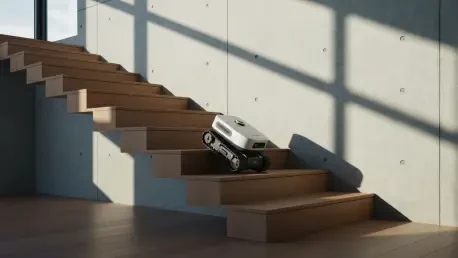
Finally, three major advancements are transforming the category. The ability to navigate raised thresholds, once a significant point of failure, has seen marked improvement, with many robots now dynamically adjusting motor torque to conquer these obstacles. The most ambitious leap forward has been the introduction of stair-climbing capabilities. Though first-generation models are expensive and not without quirks, their ability to autonomously clean multiple floors is a revolutionary development. Complementing this is the simple yet practical addition of intelligent off-peak charging. This software feature, inspired by the electric vehicle industry, allows users to schedule charging for times when electricity is cheaper, delivering tangible energy savings without compromising convenience.
Current Strengths vs. Future Necessities
The modern robot vacuum presents a study in contrasts, where remarkable strengths are often counterbalanced by significant weaknesses. The primary advantage is, of course, automation. The ability to schedule daily cleanings and benefit from self-maintaining docks offers a level of convenience that is genuinely transformative for busy households. The integration of advanced mapping and AI-powered object recognition represents a huge leap in intelligence, allowing these devices to operate with a degree of autonomy that was once pure science fiction.
However, these strengths are frequently undermined by persistent flaws that detract from the user experience. The promise of automation is diminished when a convoluted app requires constant tinkering with obscure settings. The intelligence of LiDAR and AI vision seems less impressive when the robot still gets stuck in a tight corner or repeatedly bumps into the same chair leg. Furthermore, the convenience of a self-emptying station is tempered by the ongoing expense and environmental impact of proprietary disposable bags. These inconsistencies highlight a critical gap: the industry has prioritized adding new features over perfecting core functions, leaving the technology in a state of being highly advanced yet not fully reliable.
Summary of Findings and Industry Recommendations
An assessment of the current market reveals that while robot vacuum technology has made extraordinary strides, it has not yet reached its full potential. The introduction of stair-climbing models marks a pivotal moment, fundamentally expanding the utility of these devices for a huge segment of the population. Likewise, improvements in navigating thresholds and the adoption of smart-charging features demonstrate a welcome focus on practical problem-solving. These advancements are undeniably impressive and signal a vibrant and innovative industry.
Despite this progress, a recurring theme is the need for refinement over revolution. The industry’s pursuit of headline-grabbing features often comes at the expense of perfecting the fundamentals. True success lies not in adding more settings to a bloated app, but in creating a system so intelligent it requires almost no user input at all. The goal should be flawless obstacle avoidance, not just identification, and comprehensive edge-to-edge cleaning, not just coverage of open spaces. To truly justify the premium cost of flagship models, manufacturers must shift their focus from feature-creep to delivering a polished, reliable, and truly autonomous cleaning experience.
A Look Ahead: Who Should Invest Now and What to Expect
The trajectory of the robot vacuum market is clearly pointed toward greater autonomy and intelligence. The arrival of the first commercially available stair-climbing robots is a game-changer, offering a solution to a problem that has long limited the technology’s appeal. For consumers in multi-level homes who have been waiting for a single device to handle their entire space, the current generation of premium robots represents a compelling, if expensive, investment. The convenience offered by this new capability is significant enough to potentially outweigh any first-generation performance quirks.
For those in single-story homes or with a low tolerance for operational inconsistencies, the decision is less clear. While current models offer undeniable convenience, they still harbor frustrations in software complexity and navigational reliability that can mar the experience. This review has concluded that while the technology is more capable than ever before, a more prudent approach for many consumers may be to wait for these groundbreaking features to mature and for the industry to dedicate more resources toward perfecting the core functions that define a truly seamless cleaning experience.