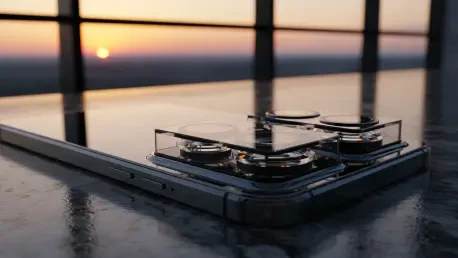

Walking through a crowded city square today, one no longer sees bulky DSLR cameras hanging from necks, but rather a sea of sleek glass rectangles capturing every nuance of light with startling precision. The modern smartphone has evolved into a sophisticated optical instrument that rivals professional gear, creating a high-stakes environment where every millimeter of glass and every line of code counts. At the forefront of this evolution stand two titans: the Samsung Galaxy S26 Ultra and the Vivo X300 Pro. These devices represent the pinnacle of current mobile engineering, yet they take fundamentally different paths toward the goal of photographic perfection. One leans into the boundless potential of artificial intelligence and high-speed silicon, while the other doubles down on the traditional laws of physics, utilizing massive sensors and legendary German optics to reclaim the crown of image quality.
The Battle of the Mobile Photography Heavyweights
The global smartphone market has shifted from a race of processing speeds to an all-out war of optical engineering and computational intelligence. While most users remain content with a clear snapshot for social media, enthusiasts and professionals are witnessing a fascinating divergence in how the world’s top manufacturers define a “perfect” photo. The Samsung Galaxy S26 Ultra and the Vivo X300 Pro represent two polar opposite philosophies: one relies on the magic of artificial intelligence and high-speed processing, while the other bets on the raw power of massive glass and professional-grade sensors. This isn’t just a comparison of two phones; it is a showdown between the “smartest” camera ever made and the most “capable” hardware ever fitted into a pocket.
Samsung has long maintained its position as the safe, reliable choice for those who want a device that does everything well. The Galaxy S26 Ultra arrives with a refined design that emphasizes a “jack-of-all-trades” versatility, offering a quad-camera system that feels at home in a boardroom or a stadium. On the other side of the ring, Vivo has emerged as the specialist’s favorite. By prioritizing the physical size of the sensors over the sheer number of lenses, the X300 Pro targets a demographic that values depth, texture, and light sensitivity over software-based “tricks.” This clash of ideologies has forced both companies to innovate at a breakneck pace, resulting in two devices that push the limits of what is possible within the slim confines of a mobile chassis.
The competition between these two brands also reflects a broader geopolitical and technological struggle for dominance in the premium segment. Samsung leverages its massive internal supply chain and proprietary sensor technology, while Vivo utilizes strategic partnerships with optical giants like Zeiss to bring a classic photographic feel to the digital era. As mobile creators seek “DSLR-like” results, the stakes have moved beyond mere megapixels. The focus now lies on dynamic range, color accuracy, and the ability to capture usable images in near-total darkness. In this arena, the winner is determined not just by a spec sheet, but by how the final image resonates with the human eye.
Why the Hardware vs. Software Debate Matters Today
For years, Samsung has dominated the flagship space by offering a reliable, do-it-all system that balances hardware with sophisticated software. However, as sensor technology hits physical limits within slim phone bodies, brands like Vivo are challenging the status quo by prioritizing light-gathering over post-processing. For the consumer, this choice matters because it dictates how memories are captured—whether through the lens of hyper-realistic professional optics or through the convenience of AI-enhanced perfection. As social media demands higher quality and mobile creators seek professional results, the gap between these two approaches has never been more significant.
The fundamental debate centers on whether the camera should record the world as it is or as it “should” look. Samsung’s approach often favors the latter, using powerful algorithms to brighten shadows, sharpen edges, and saturate colors to create an image that is instantly shareable and aesthetically pleasing. While this is incredibly convenient, it can sometimes lead to a “processed” look that loses the subtle nuances of reality. Vivo, conversely, treats the smartphone like a miniature version of a professional camera. By using larger sensors that naturally capture more information, the device requires less software intervention, resulting in photos that feel more organic and have a natural depth-of-field that AI often struggles to replicate perfectly.
Furthermore, the hardware vs. software debate has profound implications for the longevity of the device. Software-heavy systems like Samsung’s can be updated and improved over time through firmware patches, potentially keeping the camera feeling “fresh” for several years. Hardware-centric designs like the Vivo X300 Pro, however, offer a higher baseline of quality that is not dependent on the latest algorithm. A large sensor will always be a large sensor, and the physical advantages it provides in low light or high-contrast situations are permanent. As users hold onto their phones longer, the question of which strategy provides the best long-term value becomes a critical part of the purchasing decision.
Breaking Down the Optical Specs and Sensor Tech
The primary difference between these two titans lies in how they manage light and resolution across their various lenses. Samsung pushes the envelope with its 200 MP ISOCELL HP2 sensor, featuring an impressively fast f/1.4 aperture designed for rapid-fire snapshots and better low-light performance. This high resolution allows for incredible detail in well-lit environments and enables advanced pixel-binning techniques that combine multiple pixels into one for improved night photography. Vivo counters this with a 50 MP sensor that, while lower in resolution, features a physically larger 1/1.28″ surface area and larger individual pixels. This allows the Vivo X300 Pro to capture deeper color data and natural depth-of-field without relying heavily on software-driven bokeh.
In the ultra-wide category, Samsung maintains a slight technical lead that demonstrates its commitment to consistency. Both devices utilize 50 MP sensors, but Samsung’s slightly larger sensor and wider f/1.9 aperture provide a marginal edge in edge-to-edge clarity and noise reduction during night shoots. While ultra-wide lenses often suffer from distortion and soft corners, Samsung’s optical engineering ensures that the transition from the main lens to the wide lens feels seamless. This remains one of the few areas where Samsung’s hardware specifications appear objectively superior in terms of pure glass and pixel size, making it a favorite for landscape photographers who demand uniform quality across the entire frame.
The most dramatic disparity occurs in zoom capabilities, where the two companies have taken diametrically opposed paths. Samsung employs a dual-telephoto strategy, using a 10 MP 3x lens for portraits and a 50 MP 5x periscope lens for distance. This provides a versatile range of optical zoom levels. Vivo simplifies this by using a singular, massive 200 MP periscope sensor with a 1/1.4″ size—nearly double the size of Samsung’s telephoto hardware. By using high-resolution in-sensor cropping, Vivo aims to deliver cleaner images at 10x or 20x zoom than Samsung can achieve with its smaller dedicated lenses. This “brute force” hardware approach in the telephoto range allows the X300 Pro to maintain incredible detail and low noise even when the subject is hundreds of feet away.
Expert Perspectives on AI and Color Science
To truly understand which camera wins, one must look at the “brain” behind the lens and the artistic intent of the manufacturer. Samsung’s strategy centers on “Galaxy AI,” a suite of tools that bridge the gap between hardware limitations and professional results. Experts note that Samsung’s processor is geared toward “fixing” the photo in real-time—removing reflections, sharpening distant objects, and balancing shadows automatically. This predictive image processing uses neural networks trained on millions of photos to identify the subject and apply the most pleasing settings instantly. It is a system designed for the user who wants a perfect result every time they press the shutter, regardless of the environment.
Vivo’s partnership with Zeiss brings a different flavor to mobile photography, focusing on the soul of the image rather than just the math. Rather than letting AI dictate the look of the photo, Vivo offers distinct color profiles—vibrant for social media and “Zeiss Natural” for those who want their photos to look like they were taken with a professional camera. This approach prioritizes the purity of the light and the accuracy of the color, appealing to photographers who prefer to edit their own shots or value a more cinematic look. The Zeiss T* coating on the lenses also helps to eliminate ghosting and flare, a common issue in mobile photography that software struggles to correct without introducing artifacts.
Moreover, the difference in color science reflects the target audience’s lifestyle. Samsung’s vibrant, high-contrast look is tailor-made for the era of short-form video and instant social sharing, where an image needs to “pop” to grab attention. Vivo’s more muted, realistic tones are aimed at the “purist” who sees mobile photography as an extension of traditional art. Experts argue that while Samsung’s AI is more “intelligent” in its ability to manipulate an image, Vivo’s color science is more “authentic” in its preservation of the original scene. This distinction highlights that “better” is often a subjective term, depending on whether the user values convenience or creative control.
Choosing the Right Camera for Your Lifestyle
Deciding between these two powerhouses required a clear understanding of personal photography styles and technical needs. The Galaxy S26 Ultra stood out as the ultimate tool for the “jack-of-all-trades” user who demanded versatility above all else. Its ability to handle close-up portraits, wide-angle cityscapes, and long-range zoom shots with the help of seamless AI intervention made it a reliable companion for everyday life. Furthermore, the aggressive trade-in programs and deep integration into a broader tech ecosystem provided a high-value proposition for those who sought productivity tools alongside their camera. It functioned as a pocket-sized creative studio that worked tirelessly to ensure no shot was ever wasted.
The Vivo X300 Pro emerged as the “purist’s” choice, appealing to those for whom image quality was a non-negotiable priority. By leaning on massive sensors and Zeiss-certified optics, it provided a physical advantage that software-based solutions struggled to match. The natural background blur and superior light sensitivity of its telephoto lens offered a level of depth and texture that felt closer to a professional rig than a standard smartphone. For the mobile photographer who treated their phone as their primary camera, the Vivo offered a higher ceiling for creative potential, proving that sometimes, there really was no substitute for “big glass” and ample sensor surface.
Ultimately, the choice reflected a broader shift in how individuals interacted with digital imagery. Those who preferred the speed and intelligence of a system that anticipated their needs found the Samsung to be the superior device. Conversely, those who sought a more tactile and authentic photographic experience gravitated toward the Vivo. Both manufacturers successfully pushed the boundaries of their respective philosophies, ensuring that no matter the choice, the quality of mobile photography reached an unprecedented peak. The competition underscored the fact that while technology could bridge many gaps, the fundamental laws of optics remained a powerful force in the quest for the perfect image.