
Oscar Vail is a seasoned technology strategist and a leading voice in the evolution of consumer electronics, specifically focusing on how emerging hardware can push the boundaries of mobile photography. With a career spanning years of analyzing open-source projects and high-end robotics, Oscar has a unique ability to spot the moment a niche gadget transitions into a professional necessity. His expertise is particularly relevant today as we explore the convergence of professional imaging sensors and smartphone ergonomics, where the line between a mobile phone and a dedicated cinema camera continues to blur.
This discussion explores the intersection of hardware innovation and user experience, specifically focusing on the recent trend of high-tech “smart cases” for the iPhone 17 series. We delve into the technical requirements for integrating external displays, the physical trade-offs of adding professional-grade storage to a mobile device, and the shifting priorities of modern content creators.
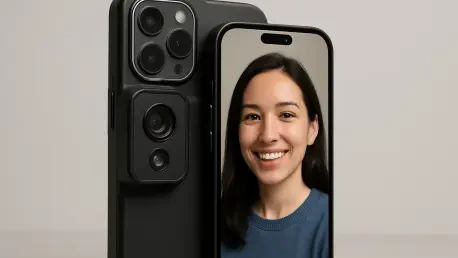
The iPhone 17 series features an 18MP selfie camera, yet the rear lenses offer 48MP resolution and Night Mode. How does a secondary rear touchscreen change the workflow for creators, and what specific steps are required to navigate this hardware interface using settings like AssistiveTouch?
The shift from a standard 18MP selfie to a 48MP capture fundamentally changes the quality floor for solo creators. When you use a rear-mounted touchscreen, you are finally able to utilize the full optical power of the 48MP main and ultra-wide lenses, alongside the sophisticated processing of Night Mode, without flying blind. To make this work, the hardware acts as an adaptive tool rather than a standard peripheral, which necessitates a trip into the Accessibility menu to toggle on AssistiveTouch. This specific step is vital because it allows the phone to recognize the case’s inputs via the USB-C connection, enabling you to navigate the interface and trigger the shutter using the dedicated Camera Control cutout. It turns the back of your phone into a functional dashboard, ensuring that the high-resolution sensor is perfectly framed for every shot.
Adding a display and microSD slot effectively doubles a device’s thickness and eliminates wireless charging compatibility. What are the day-to-day portability trade-offs of this bulk, and how should users balance the loss of wireless charging against the benefit of 2TB of expanded storage?
There is no denying that doubling the thickness of an iPhone 17 Pro makes it a “hefty piece of kit” that feels significantly more industrial in the hand. For the average user, losing the convenience of wireless charging is a major drawback, as it forces a return to cable-only power management. However, for a power user, the trade-off is often justified by the inclusion of a microSD slot that supports up to 2TB of extra space. This allows you to offload massive files without carrying a separate, dangling external drive, which can be even more cumbersome than a thick case. You have to weigh the sensory experience of a bulkier phone against the tactical advantage of having an almost bottomless digital locker for your media.
USB-C accessories that enable 4K/120fps ProRes video often function as adaptive tools rather than requiring standalone apps. How does this direct hardware connection impact device responsiveness, and what technical hurdles might users face when trying to frame high-bitrate footage using a rear-mounted screen?
The beauty of a direct USB-C connection is that it provides a high-bandwidth pathway that results in minimal lag, which is absolutely essential when monitoring 4K/120fps ProRes video. Because the hardware doesn’t rely on a third-party app to mirror the display, the responsiveness feels native and snappy, almost as if the screen were part of the phone’s original chassis. The main technical hurdle is actually ergonomic; trying to maintain a steady grip while interacting with a secondary screen on a thickened device can be challenging for those used to the slim profile of a “naked” iPhone. You are essentially managing a high-bitrate data stream while physically adjusting to a new center of gravity, which requires a bit of practice to master.
Newer front-facing sensors utilize automatic subject framing, yet there is a growing interest in using 48MP main lenses for self-portraits. In what scenarios does the extra detail justify a more cumbersome setup, and how do professional creators typically evaluate the trade-off between image quality and device weight?
While the 18MP Center Stage camera is fantastic for casual video calls and quick snaps, it cannot match the raw data and “binned” 24MP or full 48MP output of the main rear sensor. Professional creators justify the extra weight when the final output is intended for large-format displays or high-end commercial work where every pixel of detail in the skin or background counts. They evaluate this trade-off by looking at the production value; if the project demands the shallow depth of field of the main lens or the superior low-light performance of the larger sensor, they will gladly carry a heavier device. For a quick TikTok, the standard front camera wins on convenience, but for a cinematic vlog, the “cumbersome” 48MP setup is the clear professional choice.
Acquiring specialized hardware through crowdfunding platforms can lead to unpredictable design compromises or shipping delays. What benchmarks should be used to judge the reliability of high-tech cases, and how do factors like material finishes and early-bird pricing influence the long-term adoption of such niche peripherals?
When looking at a Kickstarter project, the primary benchmark for reliability is the physical build quality of early samples and the manufacturer’s history with previous launches. Early-bird pricing, such as the $79 entry point for the Selfix case, acts as a low-risk incentive for enthusiasts to test the waters before the general public. Material choices, like the Onyx Black or Satin White finishes, are important for long-term durability, but the real test is how the integrated electronics handle the heat generated by the phone during long filming sessions. Niche adoption eventually depends on whether the hardware survives the “honeymoon phase” and remains functional after months of daily use and software updates.
What is your forecast for mobile camera accessories?
I believe we are on the verge of a “modular era” where the smartphone acts merely as the processing brain for a much larger ecosystem of professional attachments. We will see more cases that don’t just protect the phone, but add specific hardware capabilities like physical dials, secondary e-ink displays for scripts, and even integrated cooling systems for high-bitrate recording. As mobile sensors continue to rival dedicated cameras, the accessories surrounding them will become more specialized and robust, catering to a generation of creators who want a full studio in their pocket. Ultimately, the successful accessories will be the ones that offer “pro” features like 2TB storage and 48MP monitoring while maintaining a design that still feels, at its core, like a phone.