
Providing seamless digital connectivity for over 65,000 fans simultaneously sharing, streaming, and communicating in a single stadium presents one of the most formidable challenges in the modern telecommunications industry. At Super Bowl LX, held at Levi’s Stadium, this high-stakes test of network prowess became a public spectacle, and the results, according to network intelligence firm Ookla, were not even close. A comprehensive analysis of performance data from the January event reveals a decisive victory for Verizon, which outpaced its rivals across every key metric, offering a powerful demonstration of its network’s peak capability.
The High-Stakes Battle for 5G Supremacy
The U.S. wireless market remains a fiercely contested arena, primarily dominated by the triad of Verizon, AT&T, and T-Mobile. Each company vies for market share not just through pricing and service plans but through tangible demonstrations of network superiority. The advent of 5G has intensified this rivalry, introducing new technological frontiers like C-band and millimeter-wave (mmWave) spectrum that promise unprecedented speeds and responsiveness. C-band offers a balanced blend of coverage and capacity, while mmWave delivers lightning-fast speeds over shorter distances, making it ideal for dense urban areas and crowded venues.
In this competitive environment, high-profile events like the Super Bowl serve as the ultimate proving ground. These gatherings create extreme network stress conditions, and a carrier’s ability to deliver a flawless experience is a powerful marketing tool. Success translates directly into brand reputation, validating massive capital investments in infrastructure and spectrum. Consequently, these events become meticulously planned technological showdowns where failure to perform can have lasting negative implications.
Setting the Stage: The Super Bowl LX Network Showdown
The Race to Conquer Congestion: Carrier Strategies and Stadium Upgrades
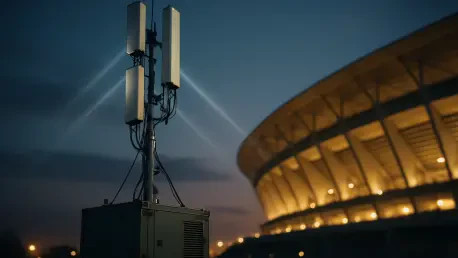
Anticipating the immense data demand of Super Bowl LX, all three major carriers engaged in extensive, proactive network upgrades in and around Levi’s Stadium. This was not merely a matter of boosting existing signals; it was a strategic deployment of advanced, permanent, and temporary infrastructure designed to handle a massive, concentrated user load. Verizon leveraged its multi-year partnership with the NFL to outfit the venue with a dense array of mmWave and C-band 5G antennas, a strategy that proved critical to its success.
This arms race for capacity extended beyond a single carrier. AT&T executed its “Turbo Live” program, deploying a combination of permanent small cells and temporary mobile assets like Cells on Wheels (CoWs) to bolster its network. T-Mobile also made significant infrastructure enhancements, contributing to a vastly improved mobile experience for all attendees compared to a typical day. The foundation for these upgrades was Levi’s Stadium’s own forward-looking investment in a 5G-ready Distributed Antenna System (DAS), completed in 2024 in preparation for both the Super Bowl and the FIFA World Cup.
By the Numbers: How Verizon’s Performance Dominated the Field
The quantitative results from Ookla’s testing leave no room for ambiguity. Verizon delivered a staggering median download speed of 1464.38 Mbps inside the stadium, a figure that dramatically outpaced both AT&T’s 796.61 Mbps and T-Mobile’s 768.01 Mbps. The scale of the temporary enhancements becomes clear when comparing these numbers to performance in June 2025, when T-Mobile clocked in at just 132.61 Mbps at the same location.
Verizon’s dominance continued in upload speeds, a crucial metric for fans sharing videos and photos. It recorded a median upload of 244.06 Mbps, more than double T-Mobile’s 101.04 Mbps and substantially ahead of AT&T’s 79.71 Mbps. In the equally important measure of network responsiveness, Verizon achieved the lowest median multi-server latency at just 17 milliseconds (ms), compared to AT&T’s 24 ms and T-Mobile’s 34 ms. To put this showcase performance in perspective, the typical median download speed for all carriers combined in the surrounding San Jose area during the latter half of 2025 was a mere 167.57 Mbps, with a latency of 41 ms, highlighting the specialized and powerful nature of the Super Bowl network deployment.
The Stadium Challenge: Overcoming the Ultimate Network Stress Test
The technical difficulty of providing reliable, high-speed connectivity to 65,000 simultaneous users within the confines of a stadium cannot be overstated. In a typical environment, cellular networks are designed to serve users spread across a wide area. A stadium, however, concentrates that demand into a single, high-density zone, creating a perfect storm for network congestion, signal interference, and overwhelmed backhaul systems that connect the cell sites to the core network.
To combat these issues, carriers deploy a multi-pronged strategy. Permanent solutions include the installation of hundreds of small cells and DAS nodes throughout the venue, from seating areas to concourses, which break the stadium into smaller coverage zones to manage traffic more effectively. For a massive event like the Super Bowl, this permanent infrastructure is augmented with temporary mobile assets, such as CoWs and Cells on Light Trucks (COLTs), which are strategically positioned outside the stadium to add significant, localized capacity and ensure the network can handle the unprecedented surge in data traffic.
Spectrum and Strategy: The Regulatory Playbook for 5G Deployment
The advanced 5G capabilities showcased at Super Bowl LX were built upon a foundation of federally auctioned radio spectrum. The availability of high-capacity mmWave and mid-band C-band spectrum, acquired by carriers for billions of dollars, is the essential raw material that enables such high-speed, low-latency performance. These auctions represent a critical component of national telecommunications policy, directly influencing the pace and quality of 5G deployment across the country.
Beyond acquiring the spectrum, deploying the necessary infrastructure in major venues requires complex public-private partnerships. Carriers must negotiate agreements with stadium owners, local municipalities, and utility providers to install permanent antennas, fiber optic cables, and power systems. Furthermore, an event like the Super Bowl is designated a National Special Security Event, meaning all communications infrastructure must meet stringent compliance and security standards to ensure operational integrity and support the needs of public safety agencies, creating another layer of regulatory and logistical complexity.
Beyond the Big Game: What Verizon’s Win Means for the Future of 5G
The decisive performance victory at Super Bowl LX provides Verizon with a significant reputational and marketing advantage. In a market where claims of speed and reliability are constant, demonstrating superior performance under the most demanding real-world conditions offers tangible proof of network capability. This success is particularly noteworthy as it serves as a powerful validation of the company’s substantial, and sometimes criticized, investment in mmWave technology. While its short range has limited its widespread applicability, this event proved its undeniable value in high-density environments like stadiums, airports, and urban cores.
This win arrives at a pivotal moment in the competitive landscape. While Ookla had recognized T-Mobile for having the fastest overall network in the second half of 2025, a separate study by RootMetrics during the same period had given the edge to Verizon. This high-profile victory helps bolster Verizon’s claims of network leadership and sets a new performance benchmark. It also provides positive momentum as the company moves forward under its new CEO, Dan Schulman, who is expected to pursue a strategic shift toward a more balanced network approach.
The Final Score: A Decisive Victory in the Network Wars
In the end, the data from Super Bowl LX painted a clear picture: Verizon delivered a superior mobile experience, winning across every significant performance metric. The carrier’s strategic investments in its NFL partnership and its focused deployment of a multi-spectrum 5G network paid off, resulting in a commanding lead over its rivals on one of the world’s biggest stages.
While this performance was the result of a highly specialized and temporary network buildout, it served as a powerful showcase of the network’s ultimate potential. It demonstrated what is technologically possible when infrastructure is densified and optimized for an extreme use case. Such real-world stress tests remain a vital battleground in the ongoing 5G competition, offering a glimpse into the future of wireless connectivity and proving which carriers can deliver when the pressure is at its highest.