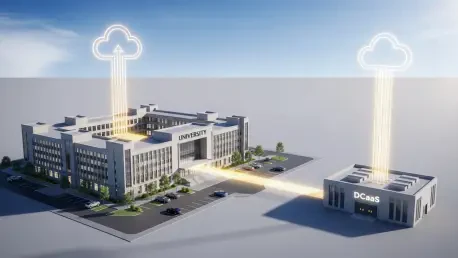

Higher education IT departments are navigating a complex landscape, caught between the institutional push for cloud-based agility and the persistent need to support specialized, legacy systems that are not cloud-ready. Many colleges and universities find themselves managing aging on-premise data centers that are both costly to maintain and ill-suited for modern demands. This creates a significant challenge: how to modernize infrastructure, control budgets, and support unique academic and research workloads that cannot easily migrate to public cloud platforms. Data Center as a Service (DCaaS) emerges as a pragmatic and strategic solution, offering a middle ground that bridges the gap between traditional data centers and fully virtualized cloud services. It provides a modern infrastructure model that allows educational institutions to outsource the complexities of physical facility and hardware management without relinquishing the critical control they need over their unique application environments, charting a course toward a more flexible and efficient future.
Understanding the DcaaS Model
Defining the Service
At its core, Data Center as a Service is a comprehensive subscription-based offering where a third-party provider manages the complete physical infrastructure stack. This includes providing secure physical space, conditioned power, advanced cooling, and the core hardware components like servers, storage arrays, and networking equipment. The DCaaS provider assumes the significant operational burdens of initial hardware procurement, professional installation, ongoing maintenance, and ensuring high service availability through redundant systems. This model effectively abstracts the entire physical layer of the data center, converting what would be large, unpredictable capital expenditures into a smooth, predictable operating expense. For a university, this means no longer having to worry about the lifecycle management of individual servers or the immense costs associated with upgrading facility-level systems such as uninterruptible power supplies or cooling plants. The institution receives a ready-to-use hardware platform, managed by experts, allowing its IT team to focus on higher-level tasks.
The crucial distinction of the DCaaS model lies in its clearly defined service boundary, which is drawn precisely at the hardware and networking layer. While the provider is responsible for the health and availability of the physical infrastructure, the university’s IT department retains complete control and sole responsibility for installing, configuring, managing, and maintaining its own operating systems, applications, and data. This separation of duties provides the best of both worlds: the operational relief of outsourcing complex hardware management combined with the direct software environment control that an on-premise data center affords. This level of autonomy is essential for supporting custom-developed research applications, legacy enterprise systems, or software with specific OS dependencies that are not compatible with more prescriptive public cloud environments. By leveraging DCaaS, IT teams can offload the mundane yet critical work of “keeping the lights on” while preserving the architectural freedom necessary to support the diverse and specialized needs of their academic community.
Differentiating DCaaS from Other Infrastructure Models
DCaaS is frequently confused with colocation, but the two services address fundamentally different needs and provide distinct levels of value. Colocation is essentially a real estate agreement where an institution rents physical space, power, and cooling within a provider’s secure facility. However, the university remains fully responsible for purchasing, shipping, installing, and maintaining all of its own server, storage, and networking hardware. This model solves the problem of owning and operating a physical building but fails to alleviate the significant capital investment and operational overhead associated with the hardware lifecycle. In stark contrast, DCaaS abstracts away the entire hardware layer. It is a true service model that converts the capital-intensive and complex cycle of equipment selection, procurement, and management into a single, predictable subscription fee. It moves the institution away from owning depreciating assets and toward consuming infrastructure as a utility, aligning costs directly with usage and avoiding the financial burden of hardware ownership.
On the other end of the infrastructure spectrum are fully virtualized services like Infrastructure as a Service (IaaS) and Platform as a Service (PaaS). These public cloud offerings provide unparalleled, near-instantaneous scalability and are built on a highly-automated, shared-hardware model, making them ideal for templated, general-purpose applications with minimal hardware dependencies. Their primary limitation, however, is that they are often not a viable fit for the specialized, research-intensive, or legacy applications common in higher education. These workloads may have stringent requirements for dedicated, non-virtualized hardware, specific processor architectures, or direct-attached storage that cannot be met in a shared, multi-tenant cloud environment. DCaaS expertly fills this void. It provides dedicated, physical hardware resources that can be tailored to these unique needs, offering a private, high-performance environment that combines the operational benefits of a service model with the dedicated control of an on-premise deployment, making it the perfect home for workloads that are not cloud-native.
The Strategic Business Case for Higher Education
Enabling a Hybrid Infrastructure Strategy
In today’s complex IT environment, a one-size-fits-all approach is no longer viable. DCaaS is therefore positioned not as a complete replacement for all other infrastructure models but as a vital and strategic component within a diversified, hybrid IT portfolio. It functions as a critical bridge, enabling institutions to pursue a forward-thinking cloud strategy without leaving essential legacy systems behind. This model allows IT leaders to confidently migrate suitable, cloud-native applications to scalable IaaS and PaaS platforms while simultaneously providing a modern, efficient, and professionally managed home for those critical systems that are not yet ready for the public cloud. This dual-track approach allows universities to reap the benefits of cloud computing where it makes sense, while ensuring stable, high-performance operation for specialized research computing clusters, unique database applications, and legacy enterprise resource planning (ERP) systems that are foundational to the institution’s operations, all without the burden of managing a physical data center.
The implementation of a DCaaS solution as part of a hybrid strategy provides a clear and practical path for decommissioning aging, inefficient, and often space-constrained on-campus data centers. Many university data centers were built decades ago and no longer meet modern standards for power density, cooling efficiency, or physical security. Maintaining and upgrading these facilities represents a significant and ongoing drain on capital budgets. By migrating workloads to a DCaaS provider, a university can completely exit the data center operations business. This move not only eliminates future capital expenditures on facility infrastructure but also mitigates significant risks associated with power outages, cooling failures, and physical security breaches. It allows the institution to repurpose valuable campus real estate for its core academic and research missions while entrusting its critical IT infrastructure to a specialized provider that operates at a scale and level of sophistication that most individual universities cannot achieve on their own.
Driving Financial and Operational Efficiency
One of the most compelling and immediate benefits of adopting DCaaS is the avoidance of massive, recurring capital investments. Owning and operating a data center requires continual and extremely costly upgrades to critical facility components that go far beyond just servers and storage. This includes aging HVAC and computer room air conditioning (CRAC) units, large-scale generators for backup power, and entire rooms of uninterruptible power supply (UPS) batteries that require regular, expensive replacement. These large, cyclical capital expenditures are difficult to budget for and divert funds that could be better used for academic programs or research initiatives. DCaaS completely eliminates these financial burdens by converting them into a predictable and manageable operating expense. This shift from a CAPEX to an OPEX model simplifies budget planning and allows for more transparent cost allocation across university departments, providing much-needed financial agility and predictability in an environment of tight budgets.
Beyond the direct financial savings, DCaaS drives significant operational efficiency by optimizing the use of valuable human resources. A great deal of an IT department’s time in a traditional data center is consumed by repetitive, labor-intensive tasks such as racking and stacking servers, running cables, managing inventory, and replacing failed hardware components. By outsourcing this physical-layer work to a specialized DCaaS provider, a university frees up its skilled IT staff from these mundane responsibilities. This strategic reallocation of personnel allows talented engineers and administrators to be redeployed from simply “keeping the lights on” to working on higher-value, mission-aligned projects. Staff can instead focus on initiatives that directly support the institution’s core academic and research goals, such as developing new applications for students, providing advanced support for faculty research projects, or improving cybersecurity defenses, ultimately transforming the IT department from a back-office cost center into a strategic enabler of institutional innovation.
A Future-Focused Foundation
The strategic adoption of Data Center as a Service provided a robust and flexible foundation that fundamentally reshaped how university IT departments operated and delivered value. By transitioning away from the capital-intensive model of owning and managing physical data centers, these institutions found they could pivot their financial and human resources toward initiatives that more directly supported their core missions of education and research. This shift was not merely a cost-saving measure; it was a strategic realignment that enhanced operational resilience, increased agility, and fostered innovation. The predictable, utility-based cost model of DCaaS brought much-needed clarity to IT budgeting, while the ability to scale resources up or down in response to changing needs offered a level of flexibility that was impossible to achieve with a fixed, on-premise facility. Ultimately, by embracing this middle-ground solution, universities successfully navigated the complexities of modernization, creating a sustainable and future-focused technology infrastructure that was better equipped to serve the evolving needs of students, faculty, and researchers.