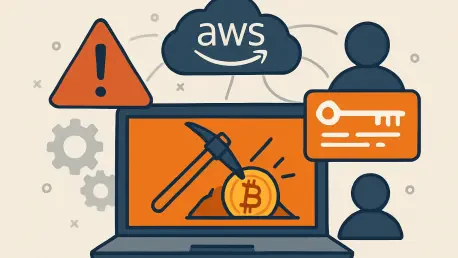

With a sharp eye on the ever-evolving landscapes of quantum computing and robotics, technology expert Oscar Vail has consistently been at the forefront of major industry advancements. Today, we sit down with Oscar to dissect a recent, sophisticated cryptomining attack that targeted AWS customers. This conversation will explore the anatomy of the breach, from the initial compromise of high-privilege credentials to the rapid, dual-pronged deployment of malicious infrastructure across both virtual servers and serverless containers. We’ll delve into the clever persistence techniques attackers used to frustrate response efforts and discuss the fundamental security principles that AWS advocates as the most potent defense against such incursions.
The report states attackers used stolen high-privilege IAM credentials to gain initial access. How are these credentials typically compromised, and can you describe the first few critical actions an attacker takes within minutes to entrench themselves in a new AWS environment?
It’s a chillingly common scenario. Those high-privilege IAM credentials are the keys to the kingdom, and they’re often lost through simple human error—think of a developer accidentally committing an access key to a public code repository, or a successful phishing attack against a key employee. Once the attackers have that key, the clock starts ticking, and they move with incredible speed. We’re talking about a complete takeover in minutes. Their first action isn’t to start mining; it’s to get the lay of the land. They immediately enumerate service quotas and permissions to see just how much damage they can do. It’s a rapid, automated reconnaissance. In this case, within moments of that initial access, they were already launching dozens of ECS clusters and massive EC2 auto-scaling groups, all configured to expand aggressively and maximize their illicit computational power.
Attackers launched both GPU-heavy EC2 auto-scaling groups and malicious Fargate containers. Could you elaborate on the technical differences between these two methods and explain the strategic advantage of using both simultaneously for a large-scale cryptomining operation?
This is what makes this attack so interesting; it showcases a dual-pronged strategy. On the one hand, you have the EC2 instances. These are virtual servers, and the attackers specifically targeted high-performance GPU instances. This is the brute-force approach, designed for raw, heavy-duty computational power, which is exactly what you need for efficient cryptomining. On the other hand, you have AWS Fargate, which is a serverless container service. Here, their method was more surgical. They simply deployed malicious container images that were already hosted on Docker Hub. The strategic genius of using both is diversification and speed. The Fargate containers can be spun up incredibly quickly with minimal setup, while the powerful EC2 instances provide the mining muscle. It’s like having both a swarm of fast-moving drones and a fleet of heavy bombers; it overwhelms the environment and makes the operation resilient and incredibly difficult to contain.
The article notes attackers used instance termination protection and created new IAM users. What specific operational challenges do these tactics create for a security team during incident response, and what are some early warning signs that these persistence techniques are in use?
These tactics are deliberately designed to cause chaos and frustration for any response team. Enabling instance termination protection is a direct countermeasure to the first thing a security engineer would do: try to shut down the malicious machines. It’s like trying to pull a plug that’s been bolted to the wall; it forces the team to go through extra, time-consuming steps to regain control. Simultaneously, creating new IAM users is their insurance policy. Even if the original compromised account is discovered and locked down, the attackers have already created backdoors for themselves. It’s a classic persistence technique. The early warning signs are often subtle but clear if you know what to look for: an alert for a new IAM user being created outside of normal processes, an engineer reporting they can’t terminate an instance, or the sudden appearance of publicly accessible Lambda functions that nobody authorized. These are the digital tripwires that indicate a much deeper problem.
AWS urges a shift to temporary credentials and least-privilege access. Can you walk us through the practical steps and potential hurdles an organization faces when transitioning from using long-term access keys to a more secure, temporary credential-based system?
Transitioning away from long-term access keys is one of the most impactful security improvements an organization can make, but it’s not a simple flip of a switch. The first practical step is a thorough audit to even find all the long-term keys floating around in your environment—in code, in configuration files, on developer laptops. The next step is to replace them with IAM roles that grant temporary, time-limited credentials. The hurdles are both technical and cultural. Technically, you may have legacy applications where those static keys are hardcoded, requiring significant engineering effort to refactor. Culturally, developers might be used to the convenience of a key that never expires. You have to re-educate your teams to embrace a new workflow built around assuming roles and requesting temporary access. It’s a fundamental shift from a static, permissive model to a dynamic, just-in-time security posture.
Do you have any advice for our readers?
Absolutely. The key takeaway from this incident is that strong foundational security, or “IAM hygiene,” is not optional; it’s your primary defense. Focus on three core principles. First, aggressively eliminate long-term access keys wherever possible and switch to temporary credentials. A stolen key that expires in an hour is an inconvenience; a stolen key that never expires is a catastrophe. Second, enforce multi-factor authentication (MFA) for all users, without exception. It is the single most effective barrier against credential compromise. And finally, live and breathe the principle of least privilege. Ensure every user and service has only the bare minimum permissions required to perform their function. These aren’t complex, esoteric solutions; they are the fundamental building blocks of a secure cloud environment.