
Addressing the physical bottleneck of qubit control, IBM’s new cooling subsystem offers twelve times the wiring area of the original Quantum System 1 to accommodate complex future processors. As researchers push toward the boundaries of superconducting qubit technology, the demand for stable, ultra-cold environments has reached an unprecedented peak. Unlike the standard atmospheric conditions of conventional data centers, quantum processing units require thermal stability that mirrors the vacuum of space, often dipping below 20 millikelvins. This engineering feat is no longer just a laboratory curiosity; it has become a necessary infrastructure requirement for the next generation of supercomputing. The evolution of these cryogenic systems signifies a shift from bespoke, artisanal designs to a standardized, modular approach that can be replicated and expanded. By focusing on the structural limitations of earlier refrigerators, engineers have now paved the way for larger, more integrated hardware stacks that can support hundreds, if not thousands, of logical qubits without succumbing to thermal noise or physical congestion in the cooling chamber.
Evolution of the Cryogenic Architecture
Modular Design: Expanding the Frozen Frontier
The transition toward a modular framework is encapsulated in the Starling project, which establishes a clear roadmap for achieving fault-tolerant quantum computing by 2029. This initiative focuses on creating an environment that can scale alongside the increasing complexity of quantum logic, moving beyond the limitations of single-unit dilution refrigerators. The new modular units are designed to function as interconnected blocks, allowing for a shared ultra-cold environment that can grow horizontally. Each block is engineered to house multiple quantum processing units, effectively creating a unified supercomputer that can be expanded by adding more cryostats. This architecture eliminates the need to redesign the entire cooling system every time the qubit count increases, providing a flexible foundation for industrial-grade applications. By standardizing the physical dimensions and thermal interfaces of these modules, developers can focus on the underlying computational logic rather than the mechanical constraints of the refrigeration hardware.
The efficiency of these modular units is further enhanced by their ability to reach operational temperatures with remarkable speed compared to previous generations. A typical unit can now descend to the temperature of liquid helium in less than five days, eventually stabilizing at a final operating state of 15 millikelvins. This rapid deployment capability is crucial for maintaining uptime in commercial quantum environments, where downtime for maintenance or upgrades can be prohibitively expensive. The modularity also allows for a high degree of redundancy; if one cooling module requires servicing, the interconnected nature of the system ensures that the remaining modules can maintain the thermal integrity of the processing environment. This shift toward a more resilient and scalable infrastructure marks a significant milestone in the journey from laboratory experiments to reliable, always-on quantum data centers. The goal is to move from 2026 to 2029 with a system that can accommodate at least 200 logical qubits within this expanded cryogenic framework.
Thermal Management: The Path to Absolute Zero
Maintaining the delicate state of superconducting qubits requires a level of thermal isolation that is difficult to achieve at scale. Qubits are notoriously sensitive to thermal noise, which can cause decoherence and lead to computational errors. To mitigate this risk, the new cooling subsystem employs advanced vibration-damping techniques and multi-layered insulation to create a perfectly still and frozen environment. These innovations ensure that the heat generated by the control electronics and the surrounding environment does not penetrate the core of the quantum processor. The design also incorporates specialized heat exchangers that optimize the flow of coolant, ensuring that every component within the module remains at a consistent temperature. This level of precision is necessary to support the high-fidelity operations required for error correction. Without such rigorous thermal management, the pursuit of fault tolerance would remain stuck in the research phase, unable to overcome the physical realities of heat dissipation.
As the industry moves toward 2027 and beyond, the integration of these cooling systems with high-density control electronics becomes even more critical. The challenge lies in bringing thousands of control wires into the cryogenic chamber without introducing heat leaks that could compromise the system’s performance. IBM’s approach involves the use of specialized superconducting cables that minimize thermal conduction while maximizing signal integrity. By treating the cooling system and the control hardware as a single, integrated platform, engineers can optimize the thermal load and ensure that the processor remains isolated from external disturbances. This holistic view of the quantum environment allows for more efficient scaling, as each new module is designed to handle a specific thermal budget. The result is a robust infrastructure that can support the rapid growth of quantum hardware, providing the stability needed for complex algorithms to run successfully over extended periods, thus bringing the vision of practical quantum utility closer to reality.
Engineering the Interconnected Quantum Fabric
Structural Isolation: Shielding the Sensitive Qubit
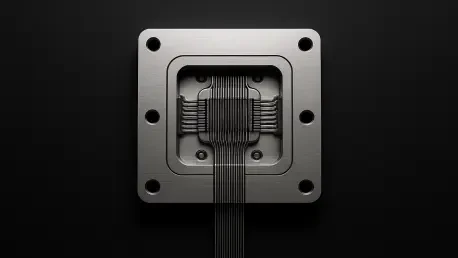
Protecting the integrity of quantum data requires more than just cold temperatures; it demands a comprehensive approach to physical and electromagnetic isolation. The latest cryogenic modules are equipped with advanced shielding that utilizes electromagnetic interference gaskets to block out disruptive radio waves. These shields are critical because even the smallest amount of stray radiation can interact with the qubits, leading to data loss or “noise” that ruins a calculation. Inside the vacuum-sealed modules, layers of specialized insulation act as a heat shield, reflecting thermal energy back toward the outer walls. This structural design ensures that the innermost core remains undisturbed by the chaos of the outside world. By providing twelve times more wiring space than earlier models, these systems also solve the physical congestion problems that once plagued high-qubit-count processors. This extra room allows for more organized cable management, which in turn reduces the risk of thermal bridges and signal interference.
Furthermore, the physical layout of these modules is designed to facilitate easy access for maintenance while maintaining a strict vacuum seal. The use of precision-engineered seals and specialized materials ensures that the internal environment remains pure and free from contaminants. This attention to detail extends to the mounting systems for the quantum chips themselves, which are designed to absorb any mechanical vibrations from the cooling pumps. The synergy between structural engineering and cryogenic performance is what allows these systems to support the high density of components required for next-generation computing. As we look toward the 2028 development cycle, the focus will likely shift toward even more compact and efficient shielding materials that can provide the same level of protection in a smaller footprint. This ongoing refinement of the physical environment is a key driver in the push for more reliable quantum hardware, ensuring that the qubits can perform their complex operations in a state of near-perfect isolation.
High-Density Connectivity: Solving the Wiring Paradox
A major hurdle in scaling quantum systems has been the difficulty of connecting multiple chips without sacrificing the ultra-cold environment. IBM’s solution involves a sophisticated array of “L-couplers” and superconducting cables that allow quantum information to travel up to a meter between different modules. This breakthrough is essential for building a truly multi-chip architecture, where individual processors can be interconnected to form a larger, more powerful machine. These couplers are designed to maintain signal coherence across the gap between modules, ensuring that the quantum states are not disrupted during transit. This capability transforms the quantum computer from a collection of isolated chips into a unified, scalable system. It also allows for a modular approach to hardware upgrades, where individual components can be swapped out or improved without necessitating a complete overhaul of the cooling infrastructure or the entire system’s wiring.
The dense control lines required by modern processors also present a significant thermal challenge, as each wire acts as a potential path for heat to enter the cryogenic chamber. To address this, the new subsystem utilizes innovative cooling interfaces that pull heat away from the wiring before it can reach the quantum processing units. This “wiring paradox”—the need for more connections vs. the need for less heat—is managed through a combination of material science and strategic physical placement. By optimizing the path that signals take through the cooling stages, engineers have managed to increase the connectivity density without increasing the thermal load. This balance is vital for the 2029 goal of supporting 200 logical qubits, as the sheer volume of data required to control such a system would overwhelm traditional cooling setups. The development of these high-density interconnects ensures that the physical infrastructure can keep pace with the rapid advancements in quantum processor design and overall system complexity.
Transitioning to Industrial-Grade Quantum Systems
Strategic Partnerships: The Role of Specialized Vendors
The shift toward industrial-scale quantum computing is being accelerated by deep collaborations between technology giants and specialized cryogenic vendors. By partnering with companies like Bluefors, IBM has been able to source high-performance cooling engines that are specifically optimized for quantum workloads. This “co-design” strategy allows the primary developers to focus on the intricate details of qubit logic and error correction, while the cryogenic experts handle the complexities of ultra-low temperature refrigeration. This division of labor is essential for moving the technology out of the research lab and into the commercial sector. Rather than building every component from scratch, the industry is moving toward a standardized supply chain that can produce reliable, high-quality hardware at scale. This collaborative ecosystem is a hallmark of a maturing industry, where specialized knowledge is leveraged to solve the “thousands of little engineering feats” required for a functional quantum supercomputer.
This transition also involves a move toward more integrated software and hardware stacks, where the cooling system is monitored and controlled by the same platform that manages the quantum calculations. By treating the entire machine as a single entity, engineers can optimize performance in real-time, adjusting cooling parameters based on the specific demands of the workload. This level of integration is necessary for maintaining the strict thermal limits required for fault tolerance, especially as the systems become more complex. As we progress from 2026 into the latter half of the decade, these partnerships will likely expand to include a wider range of specialized component manufacturers, from cable suppliers to material scientists. The goal is to create a robust and reliable platform that can support the needs of a growing quantum economy. By fostering a collaborative environment, the industry is ensuring that the necessary infrastructure is in place to support the next era of supercomputing, turning the promise of quantum utility into a tangible reality.
Future Projections: From Nighthawk to Full Error Correction
The current testing of “Nighthawk” processors within these connected cryogenic units represented a significant step toward proving the viability of the modular design. These processors were integrated into the new cooling subsystem to demonstrate that multi-chip connectivity could be achieved without compromising thermal stability. The successful operation of these units provided the empirical data needed to refine the blueprints for the even larger systems planned for the 2028-2029 timeframe. The focus during these trials was on maintaining high gate fidelities while scaling the number of physical qubits, a task that required perfect synchronization between the cooling hardware and the control electronics. These efforts laid the groundwork for the eventual transition to logical qubits, where multiple physical qubits work together to correct errors in real-time. This progression from experimental chips to functional error-correcting systems is the core of the current development strategy.
In the years leading up to the 2029 Starling objective, the emphasis remained on perfecting the thermal and structural foundations that supported the hardware. Engineers worked to increase the density of physical qubits within each module, aiming for thousands of units per cryostat to achieve the necessary stability for large-scale utility. The move toward this era of supercomputing was characterized by a relentless focus on reducing noise and improving signal integrity across the entire system. By the time the 200-logical-qubit goal was approached, the modular cooling infrastructure had matured into a reliable and standardized platform. The transition from scientific theory to industrial reality was completed as these systems began to solve practical problems in chemistry, materials science, and cryptography. This period of rapid advancement demonstrated that the path to fault-tolerant computing was not just a matter of better chips, but of building a complete, integrated environment capable of supporting the most sensitive technology ever created.