
The storage landscape has reached a point where single-drive capacities now rival the entire rack arrays of just a few years ago, fundamentally redefining our understanding of data density. This shift is epitomized by the DapuStor Roealsen6 R6060, a powerhouse that pushes the boundaries of solid-state engineering. It is not merely an incremental update; it represents a philosophical shift toward extreme consolidation. As data centers grapple with the explosive growth of unstructured data, this drive emerges as a pivotal solution for petabyte-scale architectures.
Evolution of Ultra-High-Density Enterprise Storage
Modern storage technology has transitioned from maximizing individual drive speeds to a primary focus on massive density and space efficiency. The R6060 is the result of years of refinement in controller logic and NAND stacking, allowing a single unit to hold an unprecedented amount of information. By integrating more bits per cell and optimizing the physical layout, manufacturers have enabled a level of consolidation that was previously deemed impossible for a standard data center environment.
This evolution is critical in a landscape where physical floor space and power capacity are the most expensive assets. Rather than populating dozens of racks with lower-capacity drives, organizations can now achieve the same storage volume with a fraction of the hardware. This shift toward petabyte-scale consolidation is not just about convenience; it is a necessary adaptation to the massive data demands of modern artificial intelligence and global content distribution.
Architectural Innovation and Technical Specifications
Record-Breaking Capacity: The E1.L Form Factor
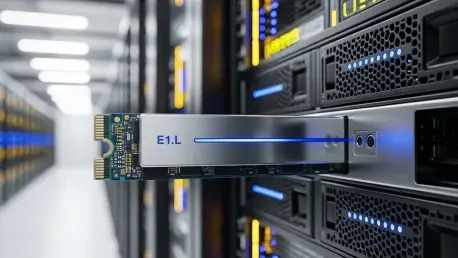
Achieving a 245.76TB capacity milestone within the physical constraints of the E1.L “ruler” form factor is a feat of engineering that doubles previous industry standards. This density is managed through sophisticated spatial arrangement, ensuring that the sheer volume of NAND chips does not compromise the structural integrity or connectivity of the drive. By packing nearly 256TB into a single slot, the R6060 reduces the physical complexity of storage arrays, allowing for a more streamlined and manageable hardware stack.
PCIe Gen5 Performance: The 16-Channel Controller
The integration of a PCIe Gen5 interface paired with a 16-channel controller provides the necessary bandwidth to move data at exceptional speeds. This architecture allows for massive parallelization, enabling random read performance that reaches 2.1 million IOPS. Such high-speed retrieval is essential when a single drive holds so much data; without this throughput, the massive capacity would become a bottleneck, trapping data behind insufficient lanes of communication.
Enterprise QLC NAND Integration: Efficiency and Endurance
Utilizing enterprise-grade QLC (eQLC) memory allows for the extreme density required to reach these capacity levels, though it necessitates specific design choices. While QLC is often associated with lower endurance, the eQLC used here is paired with advanced wear-leveling algorithms to ensure reliability in read-intensive environments. The trade-off is clear: the drive prioritizes storage volume and read speed over rapid write cycles, making it a specialized tool rather than a general-purpose replacement.
Emerging Trends in Data Center Storage Consolidation
The industry is currently witnessing a move toward “four-drive petabyte” architectures, where a staggering amount of data lives on a minimal number of physical devices. This trend reflects a broader prioritization of capacity and energy efficiency over symmetrical performance. By reducing the number of active components, data centers can lower the total cost of ownership through reduced power consumption, simplified cabling, and a smaller overall footprint.
Real-World Applications and Deployment Scenarios
In practical use, the R6060 excels in environments where data is written once and read many times, such as content delivery networks (CDNs) or deep-learning training sets. Large-scale data analytics platforms also benefit from the ability to keep massive datasets “hot” and accessible rather than relegated to slow archival tiers. For enterprises running Ubuntu, Windows Server, or VMware ESXi, the drive provides a dense pool of storage that can support thousands of virtual machines or massive containerized workloads without the latency of traditional mechanical storage.
Technical Challenges and Performance Limitations
Despite its strengths, the R6060 faces inherent constraints due to its QLC architecture and limited onboard DRAM. Sequential and random write speeds are notably lower than read speeds, as the complexity of writing to high-density cells requires more time and management. Thermal management also remains a consideration; however, the E1.L form factor is designed to utilize air cooling effectively, maintaining stability even under the sustained stress of intensive data retrieval tasks.
Future Outlook for High-Density Solid-State Drives
The trajectory of NAND technology suggests that even higher densities are on the horizon, potentially reaching half-petabyte drives in the coming years. Improvements in write efficiency and controller intelligence will likely mitigate current performance gaps, making these high-density units more versatile. As consolidation continues, the long-term impact on data center design will be profound, leading to hyper-efficient facilities that require less physical space for exponentially more data.
Final Assessment of the DapuStor Roealsen6 R6060
The DapuStor Roealsen6 R6060 proved to be a transformative asset for specific enterprise workloads that demanded extreme density above all else. It successfully demonstrated that petabyte-scale storage could be simplified and condensed without sacrificing the rapid read access required by modern applications. By leaning into the strengths of eQLC and PCIe Gen5, the drive established a new benchmark for the industry.
Looking forward, the success of this technology suggested that organizations must continue to evaluate their workloads to match the specific performance profiles of high-density storage. While it was not a universal solution for every task, its impact on the roadmap for data center efficiency was undeniable. The drive paved the way for a future where physical storage constraints no longer limited the scale of digital innovation.