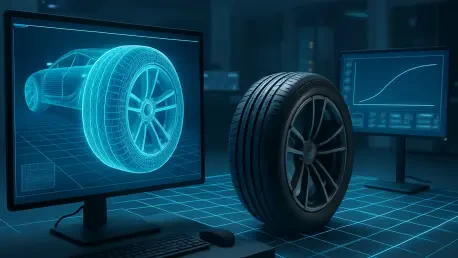

Diving into the world of automotive innovation, I’m thrilled to sit down with Oscar Vail, a technology expert whose groundbreaking work in virtual tire development is reshaping how the industry approaches simulation and testing. With a deep-rooted passion for cutting-edge solutions, Oscar has been instrumental in advancing tools like CDTire, a tire modeling software that’s revolutionizing the way manufacturers design and test tires. Today, we’ll explore the complexities of simulating tire behavior, the impact of virtual testing on efficiency and sustainability, and what the future holds for this transformative technology.
How do tires pose unique challenges in simulation compared to other vehicle components?
Tires are incredibly complex because they’re under constant stress and exhibit non-linear behavior. When you drive, heat builds up, altering the tire’s properties in real time. That dynamic interaction with the road, combined with factors like deformation and material response, makes accurate simulation a tough nut to crack. On top of that, you’ve got to balance precision with speed—nobody wants a simulation that takes days to run. It’s a juggling act between capturing thermal effects and dynamic forces while keeping computational demands manageable.
What’s the secret behind CDTire’s ability to deliver both accuracy and efficiency in simulations?
CDTire isn’t just one model; it’s a family of models tailored for different needs—think carcass, sidewall, and tread simulations. Each is designed to hit the sweet spot between detail and speed, depending on the application. Some models are built for real-time analysis, which is critical for quick feedback during development. By fine-tuning these models, we ensure they’re realistic without bogging down the system, making them practical for everything from early design stages to full vehicle simulations.
In what ways is CDTire shaping the future of virtual tire development for the automotive industry?
CDTire is a game-changer because it lets manufacturers test and refine driving behavior virtually, long before a physical prototype hits the road. It accounts for complex variables like heat buildup and material stress, giving insights into comfort, durability, and dynamics early on. Beyond that, it acts as a bridge between tire makers and car manufacturers, providing a common platform to share data and adapt designs. This collaboration speeds up the process and ensures tires are optimized for specific vehicles right from the start.
How extensively is CDTire being adopted across the industry, and what impact is it having?
It’s pretty widespread—most major vehicle and tire manufacturers are on board. CDTire’s ability to run virtual test drives in simulators means companies can cut back on costly real-world testing and prototype production. This shift not only saves time and money but also reduces the environmental footprint of development. While physical testing isn’t gone for good, we’re seeing a lot more reliance on virtual tools for the bulk of the process, especially in the early and middle stages.
What’s the long-term vision for integrating CDTire into tire testing workflows?
The ultimate goal is to move as much testing as possible into the virtual realm. Imagine professional test drivers evaluating tires on simulators using virtual prototypes instead of pounding pavement on test tracks. We’d reserve real-world testing for final approval of prototypes, ensuring everything lines up with expectations. This approach would streamline development, reduce costs, and let us iterate faster while still maintaining the high standards needed for safety and performance.
How does CDTire support engineers throughout the entire tire development journey?
CDTire covers nearly every analysis scenario an engineer might encounter. It excels at modeling carcass dynamics and how tires interact with detailed 3D road surfaces, offering predictions that hold up even beyond the input data’s range. The software crunches numbers on wheel hub forces, torques, and road contact pressures, giving a full picture of how a tire behaves under various conditions. This comprehensive approach means engineers can tackle everything from initial concepts to fine-tuning with confidence.
What are some standout features in the latest version of CDTire that excite you?
The latest iteration, CDTire3D, is a multi-physics powerhouse. It simulates temperature changes within the tire and even models internal air dynamics, which play a big role in performance. We’ve also introduced tire wear calculations and a flexible rim model, allowing us to analyze the tire and rim as a single unit. This holistic view opens up new possibilities for understanding how the entire wheel assembly behaves under stress, which is critical for optimizing design and durability.
How does CDTire address comfort challenges, particularly in electric vehicles?
Comfort is a huge focus, especially with electric vehicles where certain issues stand out. CDTire models internal air vibrations that travel through the chassis, causing things like steering wheel shake or dashboard noise—stuff passengers definitely notice. In electric vehicles, these vibrations are more pronounced because there’s no engine noise to mask them. By simulating these effects, we help manufacturers tweak designs to minimize discomfort, ensuring a smoother, quieter ride for everyone on board.
Can you explain how CDTire contributes to boosting the range of electric vehicles?
Absolutely. One key factor for electric vehicle efficiency is rolling resistance, which comes from energy losses as the tire rolls. CDTire simulates this under various driving conditions, factoring in internal friction and temperature effects to predict real-world performance. Lower rolling resistance means better energy efficiency, directly extending range—a big deal for EV drivers, especially on short trips with cold tires where efficiency often dips below ideal levels. This simulation helps design tires that maximize range in everyday scenarios.
What’s your forecast for the future of virtual tire technologies like CDTire?
I see virtual tire technologies continuing to transform the industry, pushing boundaries in efficiency and sustainability. We’re already planning initiatives like a dedicated spin-off to bring these tools directly to market, ensuring they have real-world impact. The future will likely involve even tighter integration with vehicle systems, more advanced real-time simulations, and a deeper focus on eco-friendly designs. My forecast is that within a decade, virtual testing will dominate tire development, with physical testing becoming the exception rather than the rule.