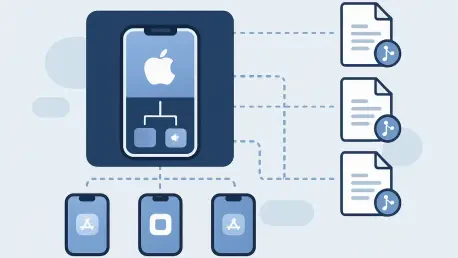

Transitioning from source-based dependencies to binary XCFrameworks is one of the most effective strategies for reducing clean build times in large iOS environments. This architectural pivot has become the cornerstone of modern enterprise mobile strategy as organizations move away from massive, monolithic codebases that once slowed development cycles to a crawl. In the current high-velocity software market, a single flagship application is frequently the result of dozens of independent repositories, each housing specialized app targets, modular frameworks, shared utility libraries, or comprehensive design systems. This decentralized model is not merely a technical preference but a structural necessity driven by the requirements for granular access control, improved code modularity, and the empowerment of autonomous teams to innovate within discrete components without compromising the stability of the primary application. As the count of interconnected repositories rises, the inherent complexity of managing strict versioning, ensuring build consistency across various environments, and orchestrating sophisticated continuous integration pipelines increases exponentially, necessitating a disciplined and highly automated approach to infrastructure.
Leveraging Native Dependency Management
The Dominance of Swift Package Manager (SPM)
The industry consensus has firmly established Swift Package Manager as the definitive standard for managing dependencies within the Apple development ecosystem. Since its deep integration into the Xcode user interface, this tool has effectively marginalized older methodologies such as Git submodules or the manual embedding of third-party frameworks. The primary strength of this manager lies in its manifest-driven architecture, where a single configuration file defines the entire dependency graph, build targets, and platform requirements. For enterprises managing a vast multi-repo landscape, this manifest provides a declarative source of truth that simplifies the onboarding of new developers and ensures that every machine in the fleet is operating on identical logic. By leveraging the first-party nature of the tool, teams avoid the friction associated with external installers or third-party runtime environments, resulting in a more predictable and stable development lifecycle that integrates seamlessly with Apple’s evolving compiler technologies.
In a large-scale multi-repo environment, the manager enables teams to declare internal libraries using direct Git URLs, facilitating a highly streamlined workflow that supports both development agility and production stability. When a project points to a private repository and specifies a semantic version range or a specific tag, the development environment automatically handles the cloning of the dependency and the integration of its source code into the overarching build graph. This mechanism is significantly more robust than legacy Git submodules, which are frequently criticized for being tedious to maintain and prone to synchronization errors during complex merge operations. The manager’s sophisticated ability to resolve dependency graphs automatically ensures that if multiple internal libraries depend on the same utility, the system can identify and resolve version conflicts or alert the engineering team immediately, thereby preventing the “dependency hell” that historically plagued large-scale software projects.
Advanced Distribution and Private Hosting
While the standard Git-based approach is highly effective for many organizations, enterprise-scale operations frequently require the sophisticated hosting capabilities offered by Swift Package Registries. Although the manager initially relied on decentralized Git references, the formalization of registry support has provided a more professional path for artifact distribution. This shift is critical for large corporations because it enables the hosting of packages via standard internet protocols through established artifact management platforms, such as JFrog Artifactory or similar enterprise-grade solutions. By moving away from raw Git clones, organizations can achieve a higher degree of control over their internal software supply chain, ensuring that every piece of code consumed by the main application has been vetted, indexed, and stored in a highly available and performant central repository that serves as the backbone of the mobile infrastructure.
Utilizing a private registry offers profound advantages over traditional Git references, particularly when evaluating the performance and stability of a large ecosystem. Fetching a versioned archive from a registry is substantially faster than performing a full Git clone, especially for repositories that have accumulated years of commit history and metadata. This optimization reduces the time required for both developer machines and automated build agents to prepare the environment. Furthermore, registries provide a vital layer of abstraction between the source code repository and the actual distribution point, allowing maintainers to manage “frozen” releases effectively without worrying about accidental branch deletions or history rewrites. This configuration also facilitates more granular security controls, as access to the registry can be managed independently of the source code permissions, ensuring that only authorized services and personnel can pull specific compiled artifacts for production use.
Optimizing Performance and Logistics
The Role of Binary Artifacts and XCFrameworks
In an environment where an application depends on dozens of internal libraries, requiring every developer and continuous integration runner to recompile every line of source code during a clean build is fundamentally inefficient. This is where the strategic adoption of XCFrameworks becomes a transformative move for large-scale engineering teams. By pre-compiling stable libraries into this multi-architecture format, organizations can distribute high-performance binaries that support both physical devices and simulators without the overhead of local compilation. This optimization dramatically lowers the barrier to entry for new feature development, as developers no longer need to wait for the entire corporate codebase to compile before testing a minor UI change. The focus shifts from managing compilation logs to delivering user value, while the underlying infrastructure handles the heavy lifting of maintaining binary compatibility across different hardware architectures.
The integration of binary targets within the native package manager allows a manifest to point directly to remote archives containing these XCFrameworks, creating a seamless experience for the end consumer. This strategy is particularly favored in large organizations for its dual benefit of optimizing build performance and protecting sensitive intellectual property. Automated pipelines can be configured to skip the compilation of stable core libraries, downloading the pre-built artifacts instead, which significantly reduces the time to first feedback on pull requests. However, because binary artifacts can obscure the underlying code during the debugging process, many high-performing teams adopt a hybrid approach. In this model, libraries undergoing active development are integrated as source code to allow for step-through debugging and rapid iteration, while mature, core utilities that rarely change are consumed as optimized binaries to keep the overall ecosystem running as lean and fast as possible.
Navigating Legacy Integration and Migrations
Even as the industry moves toward a unified first-party toolchain, many established enterprises must contend with legacy codebases that remain integrated via older managers like CocoaPods. For nearly a decade, these systems served as the primary way to manage shared code, but their architecture—reliant on a central registry and a specific external runtime environment—is increasingly viewed as a bottleneck that hinders modern automation. The transition away from these legacy systems is not just a matter of technical debt but a strategic imperative to ensure long-term maintainability. Organizations are now faced with the critical task of deciding whether to continue proxying these legacy specifications through internal mirrors or to commit to a full-scale migration to more modern tools that align with Apple’s current architectural recommendations and security standards.
The prevailing trend in 2026 involves a total migration toward first-party solutions for all new internal development, while older components are systematically evaluated for modernization. Some teams choose to wrap legacy pods in compatibility layers or “shims” that allow them to be consumed by newer package managers, providing a bridge between the past and the future. For those who must maintain private repositories within legacy systems, the workflow is often kept alive through rigorous automation, but the clear consensus among mobile architects is that the future of the platform is rooted in a pure Swift ecosystem. Successfully managing this transition requires a multi-year roadmap where dependencies are prioritized based on their impact on build times and developer productivity. By slowly phasing out the complexities of external managers, organizations can reduce the surface area for build failures and ensure that their infrastructure remains compatible with the next generation of development tools.
Operational Excellence and Strategy
CI/CD Orchestration and Multi-Repo Coordination
The ultimate validation of a multi-repo strategy occurs within the continuous integration and deployment pipeline, where the coordination of dozens of independent repositories is tested at scale. When a low-level library responsible for core networking or data persistence is updated, the change can trigger a ripple effect across every application in the company’s portfolio. Effective orchestration in this environment relies on secure credential management and the use of automated triggers that link repository activities together. When a library maintainer tags a new release, the automation platform should ideally initiate “canary” builds in downstream applications to verify that the changes do not introduce regressions. This level of interconnectedness ensures that the decentralized nature of the codebase does not lead to a fragmented or broken user experience, as issues are caught early in the integration phase rather than at release time.
To prevent the phenomenon of version drift, where various applications inadvertently use different versions of the same shared library, modern engineering teams rely on automated synchronization bots. These specialized tools monitor the release tags of internal libraries and automatically generate pull requests across the application landscape to update the resolved dependency files. This proactive approach ensures that the entire organization moves forward on the same technological foundation, preventing the accumulation of technical debt caused by teams lagging behind on critical security patches or performance updates. By automating the mundane task of version bumping, organizations free their engineers to focus on creative problem-solving while the infrastructure ensures that the dependency graph remains healthy and up to date. This level of operational excellence transforms the multi-repo model from a potential source of friction into a powerful engine for organizational velocity and software reliability.
Choosing the Right Repository Model
The long-standing debate between adopting a monorepo or a multi-repo structure continues to influence enterprise architecture, yet a clear preference for a hybrid model has emerged as the most sustainable path for large-scale operations. While a monorepo offers the simplicity of atomic commits and a single version history, it often struggles to scale with the organizational needs of a company employing hundreds of mobile developers. In contrast, the multi-repo approach aligns perfectly with the principles of domain-driven design, where specific repositories are mapped to specific business domains or technical layers. This alignment allows a dedicated design systems team to iterate on visual components in their own isolated environment, tagging releases when the work meets their quality standards, while product teams consume those updates according to their own release schedules.
This structural separation provides a balance between the need for organization-wide consistency and the requirement for team-level autonomy. A primary application repository typically acts as the orchestrator, pulling in these external packages and defining the unique business logic that differentiates the product. Meanwhile, shared repositories house the cross-cutting concerns like authentication, analytics, and networking that are used across the entire mobile fleet. If a particular module grows too complex or its history becomes intertwined with another, architects can leverage modern tooling to merge or split these repositories without disrupting the broader organization. By standardizing on native dependency managers, automating the lifecycle of binary artifacts, and enforcing strict semantic versioning, enterprises can overcome the inherent challenges of distributed development. This disciplined approach results in a modular architecture that empowers teams to move with the speed of a startup while maintaining the stability and security required by a global enterprise.
Advancing Ecosystem Maturity
The journey toward a refined multi-repo architecture in the iOS space reached a critical milestone as industry leaders moved beyond simple code sharing to sophisticated dependency orchestration. Organizations that prioritized the shift to the native package manager and binary distribution through private registries observed a marked increase in developer satisfaction and a reduction in infrastructure costs. The legacy of manual framework management was largely replaced by automated pipelines that handled the complex negotiations of versioning and architecture support. This transition highlighted the importance of viewing mobile infrastructure as a first-class product that required constant investment and modernization to keep pace with the evolving demands of the global market.
Strategic decisions made regarding the balance between source code transparency and binary performance became the defining factor in achieving high team velocity. The implementation of automated bots to manage version drift and the adoption of hybrid repository models allowed large engineering departments to maintain a coherent technical vision across disparate teams. As the development ecosystem continued to mature, the focus shifted toward enhancing security protocols within the supply chain and optimizing the feedback loop for every code change. The result was a robust, scalable environment where modularity served as the foundation for innovation, ensuring that the final integrated applications were as stable as they were feature-rich.