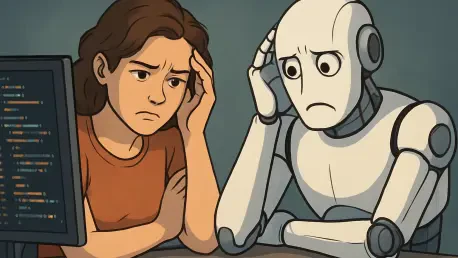

Imagine diving into a piece of program code that looks perfectly fine at first glance, only to realize it’s a deceptive puzzle that trips up even the sharpest minds in software development. This isn’t just a human frustration—it’s a challenge that artificial intelligence, specifically large language models (LLMs), wrestles with too. A groundbreaking study from Saarland University and the Max Planck Institute for Software Systems, recently accepted for the International Conference on Software Engineering, has uncovered a fascinating parallel: both human developers and AI tools stumble over the same kinds of misleading code snippets. These tiny traps, known as “atoms of confusion,” are syntactically correct but logically deceptive, leading to bugs and delays. What’s truly compelling about this research isn’t just the shared struggle, but the potential it unlocks for transforming how humans and machines collaborate in coding. This discovery isn’t merely academic; it’s a stepping stone to smarter, more intuitive tools that could redefine software creation.
Unveiling Shared Challenges
Decoding the Puzzle of Misleading Code
In the intricate world of programming, certain code patterns act like hidden landmines, waiting to derail even seasoned developers. These “atoms of confusion” might appear straightforward, but their subtle ambiguities or unexpected logic often sow chaos, resulting in errors that waste time and resources. The recent study took a deep dive into this phenomenon by examining how human programmers react when faced with such deceptive snippets. Using advanced neuroscience tools like electroencephalography (EEG), researchers captured brain signals that spike when the mind encounters something unexpected or difficult. Eye-tracking technology further revealed where attention fixated as participants puzzled over these tricky segments. What emerged was a vivid picture of cognitive strain—clear evidence of the mental hurdles these code patterns create. This wasn’t just about documenting frustration; it was about understanding the human experience of confusion at a granular level to see if machines echo the same struggle.
Mirror Struggles in Artificial Intelligence
Turning the lens to artificial intelligence, the study explored whether LLMs—models often relied upon for code generation and analysis—face similar stumbling blocks with these deceptive patterns. By measuring a metric called perplexity, which indicates how uncertain a model is when predicting sequences of code, researchers uncovered a surprising alignment. When humans showed heightened brain activity signaling confusion, LLMs registered corresponding spikes in perplexity, suggesting they too were thrown off by the same ambiguous logic. This isn’t a mere coincidence but a profound insight into how closely AI can mimic human challenges in technical domains. Unlike humans, these models lack consciousness, yet their behavioral parallels hint at a deeper symmetry in processing complex information. This finding sparks curiosity about whether such overlaps could be harnessed to create AI tools that don’t just perform tasks but resonate with human thought processes in nuanced ways.
Bridging Minds and Machines
Building Tools from Shared Struggles
The alignment between human cognitive responses and AI uncertainty isn’t just an intriguing discovery—it’s a blueprint for innovation in software development. By mapping where both humans and machines falter, the researchers crafted an algorithm capable of detecting confusing code with over 60% accuracy compared to manually annotated patterns. Even more impressively, this tool identified over 150 previously undocumented patterns that trigger confusion, broadening the scope of what developers need to watch out for. Imagine the impact of integrating such an algorithm into everyday coding environments: AI assistants could flag problematic snippets before they lead to costly errors, streamlining debugging and enhancing code quality. This isn’t about replacing human expertise but amplifying it with machine precision. The potential for reducing frustration and boosting productivity makes this development a game-changer, hinting at a future where coding tools are as intuitive as they are powerful.
Enhancing Collaboration Through Understanding
Beyond the immediate practical applications, this research lays the groundwork for a deeper synergy between humans and AI in technical fields. If machines can reflect human-like confusion in tasks as specialized as coding, there’s an opportunity to design systems that anticipate and adapt to human limitations. Picture a debugging tool that doesn’t just highlight syntax errors but warns of logical traps before a developer even notices them. Such advancements could transform workflows, making collaboration with AI feel less like working with a cold algorithm and more like partnering with a perceptive teammate. Moreover, this study’s interdisciplinary approach—blending neuroscience with computational metrics—sets a precedent for how diverse fields can unite to tackle shared challenges. It’s a reminder that technology’s greatest potential often lies in understanding the human experience, using those insights to build tools that don’t just function but truly complement how people think and work.
Envisioning a Seamless Tech Future
Looking ahead, the implications of this research ripple far beyond coding alone. The observed parallels between human brain activity and AI behavior suggest a broader trend toward human-machine alignment, where technology doesn’t just assist but mirrors human cognitive patterns in meaningful ways. This could influence not only software development but also fields like education, design, and even healthcare, where understanding nuanced challenges is key. Consider AI tutors that detect confusion in students or design tools that preempt user errors—the possibilities are vast. However, achieving this vision requires continued exploration into how these alignments manifest across contexts. The success of the algorithm in spotting confusing code is just the beginning; refining such tools to be even more accurate and context-aware will be crucial. As this field evolves, the focus must remain on creating systems that enhance human potential, ensuring that technology serves as a bridge rather than a barrier.
Reflecting on a Groundbreaking Path
Lessons from a Unified Challenge
Looking back, the journey of this study from Saarland University and the Max Planck Institute for Software Systems marked a significant milestone in blending human cognition with artificial intelligence. The meticulous tracking of brain signals and eye movements alongside AI perplexity metrics painted a vivid picture of shared struggles with deceptive code. It wasn’t merely about identifying a problem but uncovering a profound connection—humans and machines, despite their differences, grappled with the same logical traps in programming. This realization, captured through rigorous interdisciplinary methods, challenged assumptions about the boundaries between biological and computational processing. The resulting algorithm, with its ability to detect over 60% of confusing patterns and reveal new ones, stood as a testament to what’s possible when diverse fields converge on a common goal. This work redefined how technology could align with human needs, setting a benchmark for innovation.
Steps Toward a Collaborative Horizon
As the dust settled on this research, the next steps became clear for those shaping the future of software development. Prioritizing the integration of confusion-detecting algorithms into coding platforms should be a key focus, ensuring developers have tools that preempt errors before they escalate. Equally important is expanding research into other domains where human-AI alignment could yield breakthroughs, from user interface design to complex data analysis. Collaboration between neuroscientists, software engineers, and AI experts must deepen to refine these insights, creating systems that are not only efficient but empathetic to human challenges. Encouraging open dialogue across industries about these findings can spark new ideas, driving tools that evolve with user needs. Ultimately, the path forward lies in leveraging this shared understanding to craft a tech landscape where humans and machines don’t just coexist but thrive together, turning shared struggles into shared successes.