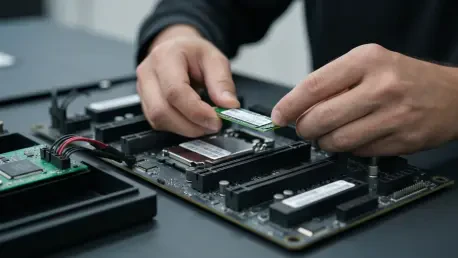

A peculiar and disruptive trend is quietly reshaping the computer storage market, one that defies conventional wisdom: high-capacity external solid-state drives (SSDs) are now frequently cheaper and faster than their internal SATA counterparts. This market inversion signals a potential extinction event for a once-dominant format, particularly the 4TB SATA SSD. For years, the SATA interface was the dependable workhorse, bridging the gap between slow mechanical hard drives and blazing-fast, but expensive, new technologies. This article will explore the convergence of unfavorable pricing, significant performance limitations, and evolving hardware standards that are collectively pushing high-capacity SATA SSDs toward obsolescence, forcing consumers and system builders to rethink their storage strategies.
From Revolutionary Upgrade to Legacy Tech: The SATA SSD’s Journey
To understand why the ground is shifting so dramatically, it’s essential to look back at the SATA SSD’s rise to prominence. When solid-state drives first entered the consumer market, they offered a revolutionary leap in performance over traditional spinning hard disk drives (HDDs). The SATA interface, already ubiquitous on motherboards, provided the perfect pathway for this new technology to gain mainstream adoption. For years, the formula was simple: an NVMe SSD for the operating system and critical applications, and a larger, more affordable SATA SSD for games and bulk data. This hierarchy was built on a clear value proposition where SATA offered “good enough” speed at a significantly lower cost per gigabyte. This historical context is crucial, as the very foundation of SATA’s relevance—its cost-effectiveness—is now crumbling.
The Core Conflict: An Unfavorable Market Position
The Price and Performance Paradox
The most glaring issue facing the 4TB SATA SSD is a complete breakdown of its value proposition. Consumers are now in the bizarre position of paying more for slower, less flexible technology. A prime example is the 4TB Crucial X9 Pro, an external SSD that delivers speeds up to 1050MB/s for around $280. In contrast, a 4TB Silicon Power internal SATA SSD, which is limited to speeds of around 550MB/s, costs more at approximately $300. This disparity makes the traditional internal format incredibly difficult to justify. The problem is magnified when compared to modern alternatives; a 4TB PCIe Gen4 NVMe SSD with speeds exceeding 7000MB/s can be found for only a moderate premium, positioning the SATA SSD in an uncompetitive no-man’s-land with no clear cost or performance advantage.
The Squeeze from External and NVMe Solutions
High-capacity SATA drives are now being squeezed from two sides. On one end, high-speed external SSDs have evolved from simple backup devices into viable, high-performance solutions for active storage. With USB 3.2 Gen 2 (10Gbps) becoming standard, these drives are more than fast enough to run game libraries or edit large media files directly, offering plug-and-play convenience that internal drives cannot match. On the other end, the rapidly falling prices of NVMe drives make them the obvious choice for any new system build or significant upgrade. For a builder, the small price jump from a 4TB SATA drive to a vastly superior 4TB NVMe SSD is an easy decision. This leaves the high-capacity SATA SSD without a clear target audience, as both convenience-focused users and performance-seekers have better options.
Supply Chain Pressures and Shifting Priorities
The root cause of this market inversion extends beyond simple competition into the complex dynamics of memory production. Key manufacturers like Micron and Samsung are strategically prioritizing the production of high-margin DRAM over NAND flash memory. This reallocation is tightening the global NAND supply, halting the aggressive, year-over-year price drops that consumers had grown accustomed to. Historical price data confirms that over the past year and a half, 4TB SATA SSDs have not seen the same price reductions as their NVMe and external counterparts. As NAND prices begin to creep up again, low-margin products like high-capacity SATA SSDs are the first to lose their pricing advantage, erasing their last remaining appeal as a budget-friendly option for bulk storage.
Future Outlook: A Shrinking Footprint
The future for high-capacity SATA SSDs looks bleak, not just because of market economics, but also due to physical hardware trends. Modern motherboards, especially in the increasingly popular small-form-factor (SFF) segment, are actively phasing out SATA ports. Designers are favoring the clean, cable-free aesthetic and superior performance of M.2 slots, often including three or four on a single board while reducing the number of SATA connectors. This shrinking physical footprint means that for many new builds, installing a SATA drive is becoming an inconvenience or, in some compact cases, an impossibility. As this trend continues, the SATA interface will be relegated to a legacy connection, making high-capacity drives built for it a niche product for upgrading older systems rather than a staple for new ones.
Navigating the Shift: A Guide for Consumers and Builders
The central takeaway for anyone in the market for storage is that the long-standing hierarchy has been upended. The high-capacity SATA SSD is no longer the default choice for affordable bulk storage. Based on this new reality, consumers and system builders should adopt the following strategies. For system upgrades, adding 4TB or more of storage via a high-speed external SSD connected via USB-C is now often the most cost-effective and convenient solution. For new PC builds, prioritizing motherboards with multiple M.2 slots is essential, as the marginal cost increase for a 4TB NVMe SSD over a SATA equivalent is almost always justified by the immense performance gains. A SATA SSD remains viable only in specific scenarios: upgrading an older computer lacking M.2 slots or filling unused SATA ports with a drive found on a deep discount.
Conclusion: The Inevitable Sunset of a Standard
The high-capacity SATA SSD faced a perfect storm of unfavorable pricing, superior competing technologies, and waning platform support. Its core purpose as a cost-effective solution for bulk storage was completely undermined by faster, more convenient, and often cheaper external drives, as well as increasingly affordable NVMe SSDs. This shift marked a significant milestone in the evolution of consumer storage, illustrating how quickly a foundational technology could become obsolete once its primary advantages were neutralized. The SATA SSD was a critical bridge from the mechanical era to our current age of instant-access storage, but its journey came to a close. Its demise was not a failure, but rather a sign of healthy and rapid technological progress.