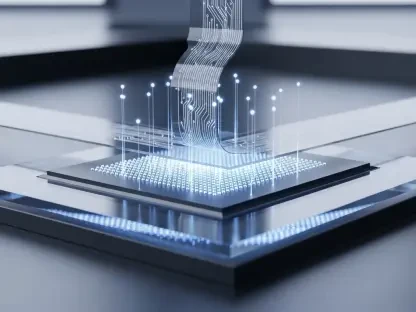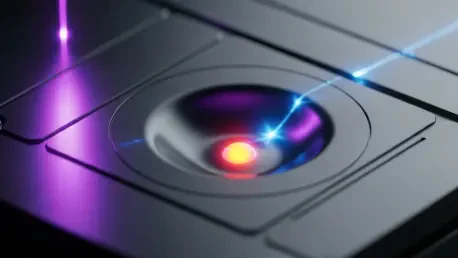

The quest for a perfectly reliable single-photon source has long been the “holy grail” of quantum optics, yet the stochastic nature of traditional semiconductor growth has consistently hampered progress. For years, the industry relied on the Stranski-Krastanov (S-K) method, a process that essentially waits for atoms to self-assemble into islands due to lattice strain. While functional, this legacy approach is increasingly viewed as a blunt instrument in an era requiring surgical precision. The emergence of low-density quantum dot fabrication signifies a departure from this randomness, moving toward a regime where “artificial atoms” are engineered with spatial and spectral exactness to meet the rigorous demands of modern quantum networking.
Beyond the mere existence of these nanostructures, the shift represents a fundamental re-evaluation of how we manage the interface between light and matter. In the broader technological landscape, the transition from traditional island growth to precision-engineered nanostructures is not just an incremental improvement; it is a necessary evolution. As we move from experimental physics toward the deployment of functional quantum repeaters and secure key distribution networks, the ability to control the environment of a single emitter becomes the deciding factor between a lab curiosity and a scalable commercial product.
Evolution of Semiconductor Quantum Dot Synthesis
The core principles of this emerging technology rest on the ability to isolate individual charge carriers—electrons and holes—within a three-dimensional confinement zone. Historically, this was achieved by layering materials like Indium Gallium Arsenide (InGaAs) over Gallium Arsenide (GaAs), allowing natural strain to create “dots.” However, this created a high-density “forest” of emitters, making it nearly impossible to trigger just one at a time. The new paradigm focuses on suppressing this density to allow for individual addressing, which is the foundational requirement for any quantum logic gate or secure communication channel.
This evolution is driven by the need for cleaner spectral lines and more predictable emission patterns. In the context of the current shift toward photonic integration, the emergence of low-density fabrication provides the missing link for on-chip quantum processing. By moving away from the crowded, noisy environments of traditional growth, researchers are finally able to harness the full potential of the quantum dot as a high-fidelity source of non-classical light, paving the way for a more robust quantum internet.
Key Mechanisms and Structural Advantages
Local Droplet Etching: The Precision Excavation Process
One of the most transformative features of this technology is the Local Droplet Etching (LDE) process, which flips the traditional growth logic on its head. Instead of building upward, the process begins by using metal droplets to “drill” nanometer-sized cavities into a semiconductor surface. These droplets act as localized catalysts, excavating symmetric holes that serve as perfectly shaped molds for the subsequent deposition of quantum dot material. This “fill-in” method ensures that the resulting dot is defined by the geometry of the hole rather than the random fluctuations of surface strain.
Elimination of the Wetting Layer
A primary advantage of this etched-cavity approach is the total elimination of the wetting layer—a residual crystal film that invariably forms in the Stranski-Krastanov process. This layer is a notorious source of electronic noise and mechanical strain, often acting as a parasitic reservoir that traps carriers and degrades the purity of photon emission. By removing this film, the LDE process creates a pristine environment for the quantum dot, ensuring that the emitter is decoupled from the surrounding matrix. This structural cleanliness is what allows for the ultra-low noise levels required for high-visibility quantum interference.
Recent Innovations in Fabrication Precision
The latest breakthroughs in this field have moved toward ultra-thin Indium Gallium Arsenide layers, some as thin as a single nanometer. This extreme thinning allows for unprecedented control over the energy levels of the quantum dot, effectively tuning the “color” of the emitted light with atomic precision. Unlike the stochastic nature of conventional methods, these engineered nanostructures exhibit high structural symmetry. This symmetry is not merely an aesthetic achievement; it is a functional requirement for minimizing fine structure splitting, which is the primary obstacle to generating perfectly entangled photon pairs.
Moreover, the industry is seeing a decisive shift toward “engineered” precision as a replacement for the hit-or-miss outcomes of the past. Modern fabrication setups now utilize real-time monitoring to adjust indium concentrations during the deposition phase. This allows for the creation of emitters that are identical across a single wafer, a feat that was previously unthinkable. This level of uniformity is essential for scaling, as it allows multiple quantum dots to be “tuned” to the same frequency, enabling them to work in concert within a larger photonic circuit.
Real-World Applications in Quantum Infrastructure
The practical impact of these high-symmetry emitters is most evident in the realm of quantum cryptography. Secure key distribution (QKD) relies on “on-demand” light sources that can fire a single photon at the exact moment a pulse is requested. Because these low-density dots are spatially isolated, they can be integrated into AlGaAs-based photonic circuits without the risk of “cross-talk” from neighboring emitters. This makes them ideal for the secure transmission of data over fiber-optic networks, where the purity and timing of the signal are paramount.
Furthermore, these dots are finding a home in the burgeoning field of photonic quantum computing. In these systems, light particles serve as the qubits themselves. The ability to integrate high-efficiency emitters directly into complex optical circuits allows for the creation of compact, chip-based quantum processors. These units can perform specific calculations—such as molecular modeling or complex optimization—far more efficiently than classical silicon-based chips, provided the light sources remain stable and fast.
Technical Hurdles and Scalability Constraints
Despite the clear advantages, the technology faces significant hurdles, particularly regarding the maintenance of precise indium concentrations across large-scale semiconductor wafers. Even a slight deviation in the atomic mix can shift the emission wavelength out of the desired range, rendering the dot useless for synchronized operations. Additionally, while the LDE process produces superior individual dots, the market obstacle remains the integration of these specialized growth techniques into standard high-volume semiconductor manufacturing pipelines.
Refining the spectral tuning of these dots also requires mitigating the fine structure splitting caused by residual internal strains. While the LDE process reduces these strains, it does not eliminate them entirely. Ongoing development efforts are focused on using external tuning methods, such as strain-tuning membranes or electric fields, to “nudge” the dots into perfect entanglement. These additional layers of complexity add to the cost and physical footprint of the final quantum devices, challenging the goal of seamless scalability.
Future Outlook for Integrated Photonic Circuits
The path forward for low-density fabrication lies in the transition from experimental physics to the creation of scalable, functional quantum networking components. We are likely to see a move toward hybrid integration, where these high-performance quantum dots are bonded onto different substrates, such as silicon or lithium niobate, to take advantage of various optical properties. This will facilitate the creation of high-speed modulators and detectors that can operate at the same 300-picosecond speeds as the emitters themselves.
Looking further ahead, the long-term impact of these high-symmetry “artificial atoms” will be measured by their role in the global quantum internet. As emission speeds continue to increase and the ability to generate entangled photons on-demand becomes a standardized industrial process, the architecture of our global communications will shift. We can expect a future where quantum-secured data is the norm, supported by a backbone of integrated photonic chips that rely on these precisely engineered nanostructures to function.
Summary of Technological Impact
The transition toward low-density quantum dot fabrication marked a pivotal moment in the semiconductor industry, effectively solving the “density problem” that had long stifled the progress of single-photon sources. By replacing random growth with the intentional geometry of local droplet etching, the research community achieved a 300-picosecond emission speed that was three times faster than previous benchmarks. This advancement, coupled with the elimination of the wetting layer, provided a cleaner, more efficient environment for photon generation. The resulting “artificial atoms” offered the high symmetry necessary for entanglement, proving that precision engineering could overcome the inherent limitations of traditional crystal growth.
In the final assessment, this technology proved to be a superior alternative to legacy fabrication methods for high-stakes quantum applications. The shift from a 1-nanosecond bottleneck to a sub-nanosecond regime opened new doors for data transmission rates in quantum cryptography. Moving forward, the focus was expected to shift toward the mass-integration of these emitters into hybridized photonic platforms. The success of these low-density structures established a definitive role for engineered nanostructures as the primary light sources for the next generation of secure, interconnected quantum systems.