
The immense potential of quantum computing has long been hampered by a seemingly simple yet profoundly difficult problem: the fragility and loss of the very particles used to carry quantum information. Researchers from the University of Illinois Urbana-Champaign have now unveiled a novel “emit-then-add” methodology that directly confronts the persistent challenge of photon loss in optical quantum systems. Detailed in npj Quantum Information, this protocol offers an ingenious way to construct highly entangled multi-photon states, known as photonic graph states, which are critical resources for advancing secure communication, precision sensing, and quantum computation. By leveraging existing quantum emitter technologies, this innovative approach charts a practical and scalable course toward generating complex quantum states that have long been considered experimentally infeasible, potentially accelerating the development of next-generation quantum technologies. Instead of fighting against the probabilistic nature of the quantum world, this new method embraces it, turning a fundamental limitation into a powerful asset for building the future of computing.
The Long-Standing Challenge in Quantum Photonics
The Inefficiency of Photon Generation and Detection
The primary obstacle to realizing large-scale photonic graph states has been the intrinsic inefficiency and loss inherent in optical platforms. The process of generating and manipulating quantum light involves several probabilistic steps that are difficult to control with perfect fidelity. A quantum emitter, such as a trapped ion or neutral atom, may not emit a photon precisely on command. Even when a photon is successfully emitted, it may not be captured and guided by the optical apparatus, and it can be lost during transmission through fibers or other components. Conventional methods that aim to generate all the necessary entangled photons simultaneously are thus highly susceptible to failure. The loss of even a single photon from the group can corrupt the delicate entanglement structure of the entire graph state, rendering the entire attempt useless. This creates a scalability issue where the probability of successfully creating a large, complex state decreases exponentially with the number of photons required, making such approaches impractical for building powerful quantum computers.
This compounding probability of failure has been a major bottleneck in the field of quantum photonics. Each step in the process carries its own probability of success, which is often less than one. For instance, the efficiency of collecting a photon from an emitter might be low, and the detectors themselves are not perfectly efficient. When attempting to create a multi-photon state, these individual probabilities multiply, leading to an extremely low overall success rate. Imagine trying to build a complex machine where each screw has a high chance of vanishing before it can be put in place; the larger and more complex the machine, the more certain it is that the construction will fail. This is the precise dilemma that has faced quantum engineers. This fundamental inefficiency has meant that while small-scale demonstrations of photonic entanglement are possible, scaling up to the thousands or millions of entangled photons needed for fault-tolerant quantum computing has remained a distant theoretical goal rather than a near-term engineering reality. The new protocol aims to break this cycle of diminishing returns by fundamentally changing the assembly process.
The Paradox of Destructive Measurement
Compounding the problem of photon loss is a fundamental tenet of quantum mechanics: measurement is inherently disruptive. To verify the presence of a photon and confirm its properties, it must be detected. However, the very act of detection is a destructive process that absorbs the photon and collapses its quantum state, effectively removing it from the system. This creates an intractable “catch-22” for building complex quantum states. It is impossible to non-invasively inspect a partially created state to find any “missing” photon slots and then fill them. This is a direct consequence of the no-cloning theorem and quantum measurement postulates, which forbid the duplication or non-disturbing observation of an unknown quantum state. This destructive nature has traditionally created a significant barrier, as one cannot build large, verified entangled states because the act of verification destroys the very constituent parts one is trying to assemble, making a reliable, step-by-step construction process seemingly impossible.
This measurement paradox has forced researchers into a corner, limiting them to all-or-nothing generation schemes. In these conventional approaches, the entire multi-photon entangled state must be created in a single, uninspected step. Only after the process is complete can the final state be measured to see if it was successful. Given the high probability of photon loss at various stages, the vast majority of these attempts result in failure. This is not only inefficient but also makes it incredibly difficult to diagnose and improve the system, as the specific point of failure remains unknown. Researchers are left with a system that works very rarely, without a clear path to improve its reliability. The inability to “check your work” as you go has been a profound limitation, preventing the deterministic construction of the large-scale, error-corrected quantum resources necessary for practical quantum applications. The “emit-then-add” protocol directly addresses this long-standing issue by cleverly integrating the destructive measurement into the construction process itself.
A Paradigm Shift with the “Emit-then-Add” Protocol
Reversing the Logic of Entanglement
The research led by Associate Professor Elizabeth Goldschmidt and Professor Eric Chitambar introduces a radical rethinking of this problem. Their “emit-then-add” protocol reverses the conventional logic entirely. Instead of generating a state and then dealing with the consequences of loss, it ensures that each individual component of the state is successfully present before it is incorporated into the larger entangled structure. The process is both sequential and heralded, meaning each step is announced and confirmed. First, a single photon is emitted from a quantum emitter. This photon is then guided to a detector. The successful detection of this photon “heralds” its existence, confirming it was not lost. Only upon this successful heralding event is the photon’s quantum information “added” to a growing entanglement record. This methodical approach ensures that the final graph state is constructed exclusively from verified, existing photons, thereby systematically and proactively mitigating the devastating impact of photon loss from the outset.
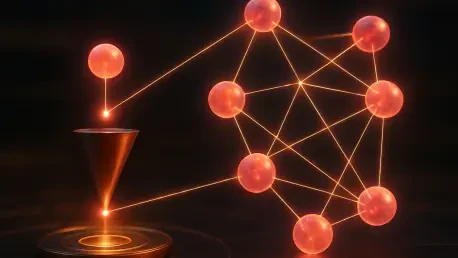
Central to this groundbreaking protocol is the novel concept of a “virtual graph state.” Unlike a traditional physical state where all entangled photons must coexist simultaneously in a shared optical system, the photons in a virtual graph state do not need to exist at the same time. The entanglement is instead established temporally, mediated by the long-lived quantum state of a stationary spin qubit within the quantum emitter. This effectively transforms the problem from a spatial one—gathering many fragile particles in one place at one time—to a temporal one of accumulating quantum information over time in a single, stable location. This shift is profound because it sidesteps the primary technological challenge of overcoming photon collection and transmission losses, which has plagued the field for decades. By building the state sequentially and storing the entanglement information virtually, the protocol becomes inherently robust to the very inefficiencies that made previous methods impractical for large-scale systems.
The Role of Spin Qubit Memory
The enabling mechanism behind the virtual graph state is the quantum emitter’s internal spin qubit, which functions as a sophisticated quantum memory. Each time a photon is emitted, it is generated in a way that its quantum state is entangled with the emitter’s spin state. When this photon is subsequently detected, a process known as a Bell-state measurement effectively projects the spin qubit into a new state that incorporates the information from the detected photon. The remarkable coherence times of these spin qubits—their ability to maintain a delicate quantum state for extended periods—allow them to act as a memory register. This memory “stitches” together the quantum information from each sequentially detected photon. As the process is repeated, the spin qubit becomes progressively entangled with the sequence of heralded photons, building a larger and more complex virtual entangled state piece by piece over time.
The final multi-photon entanglement is therefore not embodied in a fleeting collection of coexisting photons but is instead securely encoded in a non-classical, time-transcendent correlation held together by the emitter’s coherent spin state. This ingenious approach shifts the primary technological bottleneck away from the notoriously low probability of photon collection and toward the much more manageable challenge of maintaining the coherence of a single spin qubit. This is a significant advantage, as the technologies for controlling and preserving the quantum states of single atoms and ions are far more advanced and reliable than those for deterministically corralling multiple photons. In essence, the protocol trades the immense difficulty of a multi-body problem in photonics for a more tractable single-body problem in atomic physics, paving a much more realistic path toward scalable quantum information processing.
Practicality and Future Directions
Bridging Theory and Reality
A major strength of the Illinois protocol is its profound alignment with the realities of current experimental hardware. It cleverly sidesteps the need for advanced, currently unavailable technologies like quantum non-demolition (QND) measurements for photons, which would allow for measurement without destruction. By embracing destructive measurements as a constructive and essential tool, the researchers have developed a framework that is immediately accessible and can be implemented with existing quantum emitters. This pragmatic approach represents a crucial effort to bridge the often-wide gap between theoretical quantum information proposals, which frequently assume idealized, perfect components, and the practical limitations and imperfections of real-world laboratory implementations. It provides a blueprint that experimentalists can begin working on today, without waiting for future technological breakthroughs that may or may not materialize.
This immediate feasibility is particularly significant for leading quantum platforms like trapped ions and neutral atoms. These systems are powerful quantum processors in their own right but have historically been hindered by suboptimal photon collection efficiencies, making them inefficient sources for multi-photon states. The “emit-then-add” approach is inherently robust to such inefficiencies, as it only proceeds when a photon is successfully collected and detected. This makes it a highly compatible and promising technique for a wide range of experimental setups currently in operation around the world. The work from the University of Illinois Urbana-Champaign is a testament to a growing movement in the quantum sciences that prioritizes pragmatism and a deep understanding of hardware constraints. It demonstrates that the most impactful progress often comes not from imagining perfect devices, but from creatively working with the powerful, albeit imperfect, tools that are already available.
Paving the Way Forward
The research has established a clear pathway from foundational theory to near-term experimental validation and eventual technological deployment, with compelling and concrete use cases. In the realm of secure two-party computation, the protocol allows for the on-demand generation of small, verified graph states. These states can be used to execute secure protocols even in lossy environments, where maintaining a reliable quantum communication link is challenging. For measurement-based quantum computing—a leading architectural model where computation is driven by a sequence of measurements on a highly entangled resource state—these heralded graph states provide a scalable and reliable foundation. They can be used to implement quantum gates, develop more sophisticated fault-tolerant error correction codes, and enable distributed quantum sensing networks where shared entanglement enhances measurement precision beyond what is possible with classical methods.
Looking ahead, the research team is actively pursuing both experimental and theoretical tracks to build on this breakthrough. Efforts are underway to demonstrate the protocol using standard quantum hardware, with the goal of achieving a landmark practical realization of technologically relevant photonic graph states. This experimental work will be crucial for validating the protocol’s performance and identifying any unforeseen challenges in a real-world setting. Concurrently, theorists on the team are exploring the landscape for new quantum algorithms and communication protocols that could be uniquely enabled by this heralded, temporal form of entanglement. The research from the University of Illinois Urbana-Champaign has offered a sophisticated yet practical solution to a long-standing problem in quantum photonics. By transforming a fundamental limitation into a core feature, the team has unveiled a scalable and hardware-realistic path to constructing the complex photonic resources essential for the next generation of quantum technologies.