
In an era where high-performance GPUs are as much a geopolitical asset as a technological one, Nvidia has introduced a novel software solution aimed at a delicate balance: verifying chip usage without violating privacy or export regulations. To unpack the significance of this development, we sat down with Oscar Vail, a technology expert whose work at the intersection of quantum computing, robotics, and open-source projects gives him a unique perspective on the future of enterprise hardware. We explored how this opt-in software addresses compliance, enhances transparency through open-source principles, and provides a powerful new toolkit for data center operators looking to maximize their return on investment in a complex global market.
The article links this new software to smuggling discoveries and H20 export rules for China. Could you explain how tracking usage metrics like power spikes—without location data—addresses compliance concerns while also helping cloud providers optimize their return on investment?
It’s a very clever way to thread the needle between verification and privacy. By focusing on operational telemetry like power consumption and utilization, you can build a behavioral profile for a GPU. For example, a massive, sustained power spike is indicative of a heavy-duty AI training workload, which aligns with the intended use. This allows a company to verify that the chips are being used for their stated purpose, satisfying compliance and export control concerns without ever needing to know the physical coordinates of the hardware. For cloud providers, this same data is a goldmine. It lets them move beyond simple uptime monitoring to truly understanding performance, managing energy budgets with precision, and identifying underutilized assets. It transforms their GPU fleet from a static cost center into a dynamic, optimizable resource, which is the key to maximizing that all-important return on investment.
You mentioned that operators can stream node-level GPU telemetry to a portal. Could you walk us through the step-by-step process for a data center operator to implement this opt-in software and how it helps them visualize and pinpoint system bottlenecks?
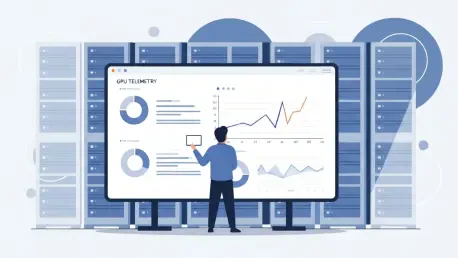
Certainly. The process starts with a deliberate choice, as this is an “opt-in” and “customer-installed” solution. An operator would first deploy the client tooling agent across their GPU infrastructure. Once installed, that agent begins collecting a rich stream of node-level telemetry—data on power draw, utilization, bandwidth, and more. This data is then streamed to a dedicated portal, which acts as a centralized dashboard. Imagine having a global overview of your entire GPU fleet right at your fingertips. From this portal, an operator can visualize performance in real-time. If a critical job is running slow, they can immediately see if a specific group of GPUs is being over-utilized or if there’s a bandwidth bottleneck starving the chips of data. It’s this ability to move from a high-level view down to the individual node that makes it so powerful for diagnosing and resolving issues that would otherwise be incredibly difficult to find.
Nvidia is making the client tooling agent open-source to enhance transparency. What practical benefits does this offer to customers, and can you share a specific example of how an enterprise might customize this tool to integrate into its own monitoring solutions?
Making the agent open-source is a significant gesture of trust. It allows anyone to inspect the code and confirm that it’s only collecting performance telemetry and not any sensitive data, which is crucial for building confidence. The practical benefit here is flexibility. Very few large enterprises rely on a single, off-the-shelf monitoring tool; they have complex, custom-built observability platforms. For example, a major financial institution could take this open-source agent and modify it to output data in a format that feeds directly into their existing, proprietary monitoring solution. This allows them to see GPU performance metrics alongside their server CPU loads, network traffic, and storage latency, all in one unified dashboard. They get all the benefits of Nvidia’s deep hardware insight without having to disrupt their established operational workflows.
The software is designed to provide real-time visibility and generate reports for auditing. Could you share a hypothetical scenario of how a manager could use these features to address a critical performance issue and then use the data to justify infrastructure upgrades?
Imagine a manager overseeing a cloud-based AI platform who notices that customer model-training times have been slipping. Using the real-time visibility portal, she can immediately investigate the GPU cluster. She might discover that while overall utilization seems fine, a handful of nodes are experiencing constant, sharp power spikes, indicating they are hitting their thermal or power limits and throttling performance. This is the bottleneck. She can take immediate action by re-routing demanding jobs to other clusters. Then, for the long-term fix, she uses the software to generate an audit report covering the last quarter. This report provides hard data showing a clear pattern of performance degradation linked to power constraints. She can take this report to her executives, not with a vague complaint about a slow system, but with concrete evidence to justify the budget for a necessary cooling system upgrade or a new fleet of more power-efficient GPUs.
What is your forecast for the future of GPU infrastructure management, particularly as these powerful chips become more widespread and subject to geopolitical scrutiny?
I believe we’re moving past the era where GPU management was just about keeping the hardware running. The future is about provable, transparent, and optimized utilization. As these chips become foundational to national economies and security, tools that can audit and verify their usage without compromising sovereignty will become standard. Geopolitical factors, like export controls, will drive demand for solutions that can guarantee compliance. I forecast that we’ll see a rapid evolution of sophisticated management platforms, likely with a strong open-source component, that provide enterprises with this deep, granular control. It will no longer be enough to just own a fleet of GPUs; you’ll need to demonstrate precisely how it’s being used, both for optimizing your return on investment and for satisfying an increasingly complex web of global regulations.