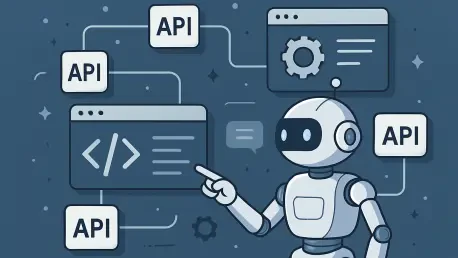

The most significant user adopting your platform might not be a developer with a keyboard, but rather an autonomous agent executing complex integration tasks while its human counterpart sleeps. This silent partner in the software development lifecycle (SDLC) represents a fundamental shift in who—or what—consumes Application Programming Interfaces. As artificial intelligence evolves from a simple assistant into a proactive teammate, organizations face a critical juncture: adapt their API design for this new machine audience or risk becoming invisible in an increasingly automated landscape. The platforms that thrive will be those that learn to speak the language of both humans and their autonomous agents with equal fluency.
Is Your API Speaking the Right Language for Its Non-Human Consumer
For decades, API design has been centered on the human developer experience. Documentation was crafted as a narrative, error messages were written for human interpretation, and a degree of creative problem-solving was expected from the user. However, this paradigm is being challenged by the rise of AI agents as primary API consumers. These agents lack human intuition; they cannot infer intent from ambiguous documentation or navigate inconsistencies in endpoint naming. An API that is not explicitly and structurally clear is, to an agent, effectively broken.
This new communication standard demands a departure from relying on context and interpretation. An agent’s interaction with an API is a binary event: it either succeeds based on predictable, machine-readable instructions, or it fails. Consequently, a vague error response or an undocumented field that a human developer might puzzle through becomes an insurmountable roadblock for an automated system. This failure doesn’t just halt the agent; it passes friction directly back to the human developer, undermining the very efficiency the agent was meant to provide.
From Casual Assistant to Autonomous Teammate
The journey into agent-driven development began with what many now call “vibe coding”—the informal, exploratory use of generative AI to produce code snippets, brainstorm solutions, and accelerate prototyping. This initial phase positioned AI as a helpful but passive assistant, a sophisticated form of autocomplete. While valuable, this represented only the first step in a much larger transformation of the development process.
The next evolutionary stage is already here, marked by the deployment of persistent, long-running “frontier agents.” These systems are not merely responding to prompts; they are assigned complex, multi-day objectives and given the autonomy to execute them. They are becoming active participants, capable of independently writing integration code, conducting security reviews, and managing operational tasks. This progression transforms AI from a passive tool that generates code into an active teammate that owns entire segments of the SDLC.
Designing APIs for a Dual Audience of Humans and Agents
Successfully navigating this new environment requires API providers to serve a dual audience with distinct and often conflicting needs. The user base has permanently split, and a one-size-fits-all approach is no longer viable. Platforms must now cater to both the creative, context-driven human developer and the literal, structure-dependent AI agent.
On one hand, human developers continue to rely on the rich, narrative-driven resources that facilitate learning and understanding. Comprehensive tutorials, contextual use cases, and well-written guides remain essential for enabling human creativity and problem-solving. On the other hand, AI agents demand absolute structure, radical consistency, and unambiguous, machine-readable information. For them, a well-formed OpenAPI specification is more valuable than the most eloquent tutorial. The new first impression of a platform is increasingly made not by a human reading a README file, but by an agent successfully receiving its first 200 OK response.
The Readiness Gap Between AI Adoption and API Design
A significant disconnect has emerged between the rapid adoption of AI in development workflows and the slower evolution of API design principles. While recent data shows that a staggering 89% of developers now incorporate generative AI into their work, a corresponding study reveals that only 24% of organizations are actively designing their APIs with AI agents as a primary target audience. This gap highlights a widespread vulnerability across the technology landscape.
This misalignment carries a substantial risk. Platforms that remain optimized solely for human consumption are creating inherent friction for the majority of their users who now leverage AI agents. As agent-driven development transitions from a novelty to the standard, these platforms may find themselves bypassed in favor of alternatives that offer a smoother, more predictable path for automation. In this new market, achieving an “AI-Ready” status confers a powerful first-mover advantage, creating a flywheel of adoption as developers and their agents gravitate toward the path of least resistance.
A Practical Blueprint for Building the AI-Ready API
Preparing for this agentic world requires making machine-readability a first-class principle, not an afterthought. This begins with enforcing radical consistency in naming conventions, endpoint structures, and data schemas to eliminate ambiguity. Strategic assets like OpenAPI specifications and other forms of metadata must be treated as core product deliverables, meticulously maintained to provide agents with a reliable map for discovery and interaction. Furthermore, error messages should be designed for machine learning, providing explicit, detailed feedback that enables an agent to self-correct and retry failed operations.
This technical shift must be accompanied by a reinvention of Developer Relations (DevRel). The focus of DevRel must expand beyond traditional metrics like forum posts to include new indicators such as AI-initiated integration success rates. The toolkit for supporting developers now includes prompt templates, AI-optimized code snippets, and sandbox environments designed for auditing agent-generated code. Ultimately, the most crucial change is strategic: DevRel teams must become internal champions for the AI agent as a primary audience, advocating for the predictability and structural clarity that machines require to succeed.
The distinction between “vibe coding” and standard development practices has already begun to dissolve. As autonomous agents became embedded in the software lifecycle, an API’s readiness for machine consumption ceased to be a competitive edge and became a fundamental requirement for relevance. The organizations that recognized this early and reoriented their design philosophies and support structures accordingly positioned themselves not just to survive the transition, but to lead it. The groundwork laid to serve both human and machine consumers proved to be the definitive factor in platform success.