
Programmable structural color represents a significant advancement in materials science and digital fabrication, effectively translating the iridescent brilliance found in nature into a tangible, customizable medium for everyday objects. This review will explore the evolution of this technology, its key features as demonstrated by systems like MorphoChrome, performance metrics, and the impact it has had on various applications. The purpose of this review is to provide a thorough understanding of the technology, its current capabilities, and its potential future development.
An Introduction to Programmable Structural Color
The distinction between the colors we commonly encounter and the shimmering hues of a peacock’s feather lies not in pigment, but in physics. Traditional colors are subtractive, meaning they are produced by dyes and pigments that absorb certain wavelengths of light and reflect others. Structural color, in contrast, is the result of light interacting with nano- or micro-scale structures, causing interference and diffraction that produce vibrant, angle-dependent iridescence. This phenomenon is responsible for the captivating displays seen on Morpho butterfly wings and precious opals. For decades, replicating this effect outside of a laboratory setting has been a significant challenge, limiting its use to incorporating existing natural or synthesized iridescent materials into products.
The emergence of programmable structural color technologies marks a pivotal shift, creating a direct bridge between computational design and physical material properties. Systems like MorphoChrome are at the forefront of this movement, democratizing the creation of iridescence by enabling designers, artists, and hobbyists to program and fabricate custom color-shifting patterns on demand. This technology effectively removes the barrier between a digital concept and a physical, dynamic object, transforming static surfaces into interactive displays of light and color. It represents a new paradigm where the optical properties of a material are no longer fixed but become a designable and programmable feature.
Core Technology and Fabrication
Digital Design and Color Programming
The gateway to creating custom iridescence is a sophisticated yet intuitive software interface that places full creative agency in the hands of the user. Through this digital platform, individuals can select specific hues from a color wheel, design complex patterns, and preview the angle-dependent effects before fabrication. The system operates in real-time, allowing for rapid iteration and experimentation with different color combinations and layouts.
This digital design process is seamlessly integrated with the fabrication hardware. When a user selects a color and initiates the “painting” process, the software translates the desired hue’s RGB values into a precise set of instructions for the optical device. These instructions dictate the required intensity and duration for each of the red, green, and blue lasers to achieve the target color on the specialized film. This translation from a simple click on a screen to a complex physical process of light exposure is the core of the system’s programmability, making it accessible to users without a background in optics or materials science.
Handheld Optical Fabrication Hardware
The primary hardware component is a compact, handheld device that functions as an optical “brush,” allowing users to literally paint with light. This tool is designed for ease of use, connecting to a computer via a standard USB-C port and requiring minimal setup. Its ergonomic design enables precise application of light onto the material substrate, facilitating the creation of detailed and intricate iridescent designs on a small scale.
Internally, the device houses a sophisticated optical system responsible for generating and projecting the programmed colors. It contains individual red, green, and blue lasers whose outputs are controlled based on the digital design. The light from these lasers is directed by mirrors toward an optical prism, which precisely mixes the beams into a single, combined ray of multi-color light. This combined beam is then projected from the device, exposing the photopolymer film and encoding the desired structural color onto its surface.
Material Substrate and Transfer
The canvas for this technology is a specialized holographic photopolymer film, a material commonly used in security applications like passports and credit cards due to its ability to record complex light patterns. This film is uniquely sensitive to specific wavelengths of light, allowing the laser exposure to create permanent nanostructures within the polymer that generate the iridescent effect. The material acts as the medium where the digital design is physically realized.
A key innovation that extends the technology’s utility is a unique transfer method that allows the programmed structural color to be permanently applied to a wide variety of objects. After the design is “painted” onto the film, the target object—which can range from a rigid 3D-printed accessory to a flexible textile—is coated with a thin layer of UV-curing epoxy resin. The exposed film is then pressed onto the resin-coated surface and cured with a handheld UV light. This process permanently bonds the structurally colored layer to the object, after which the film’s protective backing is peeled away, leaving a durable, jewel-like finish.
Developments and Key Innovations
Recent advancements in this field, exemplified by the MorphoChrome system, signify a crucial step toward making programmable structural color widely accessible. The technology represents a departure from the complex, resource-intensive methods of chemical synthesis or nano-fabrication that were previously confined to high-tech laboratories. By packaging the core optical and material science into a user-friendly, do-it-yourself toolkit, innovators have lowered the barrier to entry, empowering a broader audience of creators to explore this expressive medium.
This progress is part of a larger trend in materials science and human-computer interaction focused on merging computation with unique material properties. The goal is to create dynamic, programmable interfaces that respond to digital inputs or environmental stimuli. Programmable structural color is a prime example of this research direction, demonstrating how a material’s fundamental visual characteristics can be controlled through software. This work paves the way for a future where the appearance of objects is not static but can be customized and updated with the same ease as changing a digital wallpaper.
Applications and Practical Use Cases
Personalization of Consumer Goods
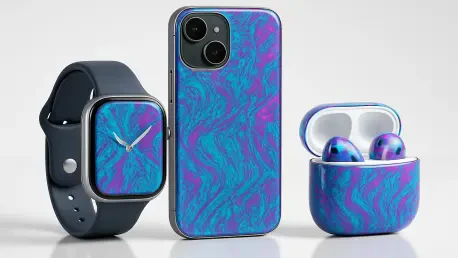
One of the most immediate and compelling applications of this technology is in the hyper-personalization of consumer products. The ability to apply custom, dynamic color-shifting effects transforms everyday items into unique expressions of personal style. For example, static accessories like phone cases, jewelry pendants, and wearable tech can be adorned with iridescent patterns that change color with the viewing angle, creating a vibrant, eye-catching effect.
This level of customization extends to more novel applications, such as cosmetics. Users have successfully applied the technology to create gemstone-like finishes on fingernails, offering a unique alternative to traditional nail polish. This capability allows individuals to design and wear their own iridescent creations, turning personal accessories into one-of-a-kind art pieces and pushing the boundaries of fashion and self-expression.
Functional and Interactive Objects
Beyond aesthetics, programmable structural color can be used to create functional objects that provide visual feedback to the user. This capability opens up new possibilities for interactive design in areas like training, accessibility, and user interfaces. By programming specific colors to appear only at certain angles, designers can embed visual cues directly into the surface of an object.
A practical example of this is the creation of beginner-friendly training equipment. A golfing glove was augmented with a structural color pattern that shines a specific green hue only when the wearer holds a golf club at the correct angle. This provides immediate, intuitive feedback, helping the user develop proper form without complex electronics. Such applications demonstrate the potential for this technology to create smarter, more responsive physical objects that can guide and inform user behavior.
Current Challenges and Limitations
Material and Color Fidelity
Despite its innovative approach, the technology faces technical hurdles related to the material properties and the resulting color output. The holographic photopolymer film exhibits varying sensitivity to different wavelengths of light. Consequently, achieving full saturation for each primary color requires different exposure times; for instance, blue light needs a significantly longer exposure than red or green. This discrepancy complicates the process of creating accurately mixed colors like magenta or cyan and can affect the overall fabrication speed.
Furthermore, efforts are ongoing to improve the overall color gamut and luminosity of the final product. While the primary colors are vibrant, mixed colors can sometimes appear less bright, limiting the expressive range of the system. Enhancing the performance of the photopolymer or refining the light exposure algorithms will be crucial for achieving a broader and more consistent palette, allowing for more nuanced and vivid designs.
Hardware and Scalability
The physical hardware, while functional, also presents certain limitations that challenge its widespread adoption and scalability. The current prototype’s housing is 3D-printed, which can result in minor light leakage from the device during operation. While this does not prevent fabrication, it represents an area for engineering refinement to improve the precision and efficiency of the light exposure process.
A more significant challenge is scaling the technology for applications beyond small personal objects. The handheld form factor is ideal for detailed work on items like jewelry or small accessories, but it is not practical for coloring larger surfaces such as automotive panels, architectural elements, or full garments. Developing a scalable version of the fabrication hardware, perhaps through automated gantries or larger projection systems, will be essential for expanding the technology’s impact into industrial design and manufacturing.
Future Outlook and Potential Breakthroughs
Advanced Holographic and 3D Light Fields
Looking ahead, the holographic nature of the polymer film offers possibilities that extend far beyond simple color shifting. The same material properties that allow for the creation of structural color can also be leveraged to encode entire 3D light fields. This could enable the fabrication of objects with holographic images or messages embedded directly onto their surfaces, viewable only from specific angles or with special lighting.
This capability has profound implications for applications in security and authentication. For example, a product could be marked with an invisible holographic seal that, when illuminated correctly, reveals a 3D checkmark or a manufacturer’s logo, providing a counterfeit-proof method of verification. Such advancements would transform structural color from a purely aesthetic feature into a functional one with high-value applications in brand protection and secure documentation.
Bio Inspired Adaptive Materials
In the long term, the development of programmable structural color is deeply inspired by adaptive mechanisms found in nature. Many organisms use structural color for dynamic camouflage or communication, altering their appearance to blend into their surroundings or signal to others. Integrating this technology into flexible and responsive materials could lead to the creation of bio-inspired adaptive systems.
This vision could have a transformative impact on fields like soft robotics and smart textiles. Imagine a soft robot designed for environmental monitoring that could change its color to match the terrain, or a garment that could alter its pattern in response to environmental conditions or user input. Achieving this level of dynamic reprogrammability would mark the next frontier for the technology, creating materials that are not just visually programmable but truly adaptive and interactive.
Conclusion
The development of programmable structural color marked a significant milestone, effectively transitioning a complex natural phenomenon from the laboratory to the hands of designers and creators. By integrating accessible software with novel hardware and materials, this technology has unlocked the ability to digitally design and physically fabricate custom iridescence on a wide array of objects. Its applications in personalizing consumer goods and creating functional, interactive surfaces demonstrated its immediate value and versatility.
While challenges in material fidelity and hardware scalability remained, the trajectory of the technology pointed toward a future of increasingly sophisticated and integrated systems. The potential to encode full holographic light fields and develop bio-inspired adaptive materials suggested that programmable structural color was not merely a new aesthetic tool but a foundational technology for the next generation of smart materials. It has laid the groundwork for a new era where the physical appearance of our world is as dynamic and programmable as the digital one.