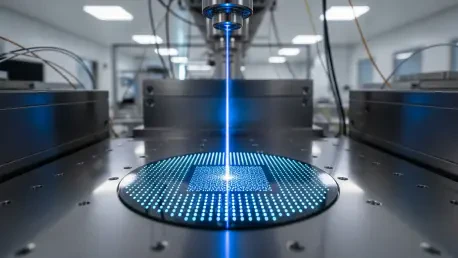

The pursuit of practical, fault-tolerant quantum computing has historically been constrained by the physical inability to manage the vast number of qubits necessary for error correction, a challenge often referred to as the scalability bottleneck. Researchers at Tsinghua University have recently navigated this obstacle by successfully trapping 78,400 neutral atoms using a single, high-precision optical metasurface, setting a new global benchmark for the field. This achievement, led by physicists Zhongchi Zhang and Xue Feng, represents a significant departure from existing experimental prototypes that typically struggle to exceed the 10,000-trap threshold. By utilizing nanostructured surfaces rather than conventional optical arrays, the team demonstrated that it is possible to generate the massive physical qubit counts required for complex, logical-level operations. This development signals a shift from laboratory-scale experiments toward robust, industrial-grade quantum architectures capable of supporting the next generation of information processing tasks.
Overcoming the Limitations of Traditional Optical Components
Standard quantum computing platforms currently rely on Spatial Light Modulators and Acousto-Optic Deflectors to manipulate and organize the neutral atoms that serve as the foundation for qubits. While these instruments have facilitated early progress, they are inherently limited by their optical resolution and physical dimensions, which creates a ceiling on the density of atoms that can be effectively managed. For a quantum computer to achieve true fault tolerance, it must utilize logical qubits composed of hundreds of individual physical qubits to identify and mitigate internal errors. The constraints of traditional hardware mean that reaching the necessary scale for advanced computation remains difficult without a fundamental change in how light is directed. The Tsinghua research team addressed this limitation by engineering two-dimensional metasurfaces made from silicon nitride, which utilize tens of thousands of microscopic pillars to function as a dense array of flat lenses.
To ensure that these sophisticated optical structures could be produced reliably and at scale, the researchers utilized standard CMOS-compatible manufacturing techniques, including electron-beam lithography and reactive ion etching. This strategic choice allows the production of quantum hardware to leverage the established infrastructure of the modern semiconductor industry, ensuring high levels of consistency across the fabricated components. The resulting metasurface is not only more compact than the heavy microscope objectives traditionally used in physics laboratories but also exhibits a significantly higher degree of resilience under operational stress. Unlike conventional light modulators that often suffer from thermal degradation or failure when exposed to high-intensity laser light, these nanostructured surfaces are designed to withstand significantly higher power levels. This robustness is essential for maintaining the stability of nearly 80,000 individual atom traps simultaneously over extended periods of operation.
Precision Engineering and Global Benchmarking of Metasurfaces
The operational effectiveness of this massive array is grounded in the principle of optical tweezing, where highly focused points of light create a potential well to pin individual atoms in a specific location. Ensuring that each of the 78,400 traps functions with the same degree of reliability required the application of a weighted Gerchberg-Saxton algorithm to the design of the nanopillars. This algorithmic approach resulted in an impressive 90.6% uniformity in light intensity across the entire 280 x 280 grid, which is vital for consistent qubit manipulation. Each trap was specifically engineered to possess an Airy disk-like profile with a tight radius of approximately 1.017 micrometers. Such a high level of spatial precision allows for the isolation of single atoms without interference from neighboring sites, which is a prerequisite for maintaining the high-fidelity operations necessary for quantum logic gates and information storage.
This breakthrough reflects a growing international consensus among physicists that flat metasurfaces represent the definitive successor to aging optical technologies in the quantum sector. While a concurrent project conducted at Columbia University demonstrated the ability to generate up to 360,000 optical tweezers, the Tsinghua team chose to focus on a different balance of robustness and pixel efficiency. By allocating 1,354 pixels per individual tweezer, as opposed to the 300 pixels used in the Columbia study, the researchers at Tsinghua prioritized the power-handling capabilities and the long-term structural integrity of the trapping array. These independent but complementary studies confirm that metasurfaces are capable of meeting the diverse requirements of different quantum architectures. This collective progress indicates that the scientific community is rapidly converging on a scalable solution that will allow neutral-atom processors to expand beyond the limitations of previous hardware generations.
Future Trajectory: Integration and the System-on-a-Chip Architecture
Building on this foundational success, the Tsinghua research team has already initiated work on the next iteration of their technology, focusing on a larger metasurface designed for external configuration. This approach involves placing the optical metasurface outside the vacuum chamber that houses the neutral atoms, which significantly simplifies the experimental setup and eases maintenance requirements. By moving toward an external arrangement, the researchers can maintain high-capacity trapping while reducing the complexity of the internal vacuum environment. This transition represents a critical step in the effort to move quantum processors out of highly specialized laboratory settings and into more versatile, integrated environments. The refinement of these optical stacks is expected to reduce the overall physical footprint of quantum hardware, making it more compatible with the standards of modern data centers and allowing for easier integration with existing high-performance computing infrastructure.
The researchers established a definitive blueprint for a fully integrated system-on-a-chip architecture, where metasurfaces handled every critical optical task from atom trapping to state readout. By substituting bulky fluorescence imaging microscopes with compact nanostructured optics, the team demonstrated how to streamline the entire quantum processor into a more manageable form factor. This shift allowed for the creation of a more stable and portable platform that bypassed the physical limitations previously imposed by traditional bulky lenses and modulators. The successful synthesis of semiconductor-grade manufacturing with advanced light-manipulation algorithms ensured that optical hardware no longer functioned as a primary bottleneck for scaling. These findings provided actionable pathways for developers to implement high-density qubit arrays in practical settings, moving the industry closer to a reality where large-scale quantum processors are both accessible and reliable for complex computational demands.