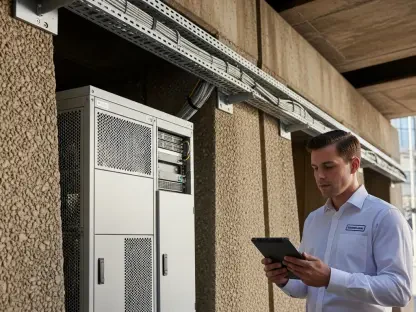

The quest for absolute spatial certainty has moved beyond the clouds and into the very fabric of our terrestrial cellular networks, marking a definitive end to the era of satellite dependency. While the Global Positioning System once defined the boundaries of navigation, its inherent limitations in dense urban environments and indoor facilities created a vacuum that only a more robust, ground-based infrastructure could fill. ZaiNar is currently leading this transition by harnessing the latent power of 5G signals to achieve tracking precision that was previously considered impossible without specialized, power-hungry hardware.
The Evolution of Geolocation from Satellite Dependency to 5G Infrastructure
The transition from traditional GPS to network-based spatial awareness represents a fundamental shift in how machines perceive their surroundings. Unlike satellites that sit thousands of miles away, 5G New Radio nodes provide a dense, high-frequency layer of connectivity that serves as a foundational grid for hyper-precise positioning. This shift allows the network itself to become an observer, calculating coordinates based on the signals a device already sends to stay connected.
For mobile network operators and industrial enterprises, this evolution is more than a technical upgrade; it is a significant market opportunity. By transforming the network into a positioning engine, carriers can offer high-value services to the “Physical AI” ecosystem. This includes providing the spatial data required for automated guided vehicles and autonomous drones, making chipset manufacturers and automation developers key stakeholders in a new economy of location-based services.
Technological Shifts and the Surge in Real-Time Spatial Data
Emerging Trends in Distributed Sensing and Hardware-Agnostic Tracking
Current trends are moving away from the need for specialized chips and toward a hardware-agnostic approach that leverages standard uplink signals. ZaiNar has demonstrated that sub-10cm accuracy is achievable without modifying the internal components of a device. By extracting location data from the signals already being transmitted, the industry is effectively eliminating the notorious “GPS battery drain” that has long plagued mobile sensors and wearable technology.
The integration of this tracking capability is already reshaping logistics and smart city planning. In a warehouse or a bustling urban center, 5G signals provide a constant stream of high-frequency data that vision-based systems or Bluetooth simply cannot match. This allows for the seamless management of autonomous robotics and complex supply chains, where every centimeter of movement is accounted for in real time.
Market Projections and the Valuation of High-Precision Location Services
Growth forecasts for the indoor and urban positioning market suggest a massive expansion through 2030 as industries abandon fragmented solutions for a unified 5G standard. When comparing performance benchmarks, the advantages of 5G become clear: it offers a signal range of up to 1.5 kilometers, dwarfing the reach of Ultra-Wideband or Bluetooth. This vast coverage area, combined with centimeter-level precision, meets the rigorous demands of industrial automation.
Data-driven insights reveal an increasing demand for this accuracy in environments where safety and efficiency are paramount. As enterprises seek to digitize their physical operations, the ability to track assets with such high fidelity becomes a prerequisite for operational success. Consequently, the valuation of location services is expected to skyrocket as more organizations recognize the strategic importance of precise spatial intelligence.
Technical Obstacles and the Complexity of Network-Side Integration
One of the most persistent technical hurdles involves overcoming signal multipath interference, which occurs when radio waves bounce off buildings in dense urban canyons. These reflections can confuse standard tracking algorithms, leading to significant errors. However, by utilizing advanced signal processing on the network side, it is possible to filter out this noise and maintain a stable lock on a device’s true position even in the most challenging indoor environments.
Another significant challenge is the “Gatekeeper” dynamic established by major mobile operating systems. Historically, Apple and Google have restricted how and when location data is shared, often requiring specific app-level permissions that create friction for industrial users. Bypassing these OS-level restrictions by focusing on network-side tracking allows for a more direct relationship between the carrier and the enterprise, ensuring low-latency data processing in high-density environments.
The Regulatory Landscape and Data Sovereignty in the 5G Era
Navigating the complex world of privacy frameworks is essential as network-side tracking becomes more prevalent. Because this technology does not rely on traditional application permissions, it raises new questions about how to manage consent and data sovereignty. Industry leaders must work toward strict 3GPP compliance to ensure that location-based services remain secure and transparent, protecting the privacy of the end-user while still delivering critical functionality.
Establishing clear protocols for data ownership is a primary concern for carriers and enterprises alike. As spatial data becomes a valuable commodity, the legal frameworks governing its use must evolve to prevent unauthorized surveillance or data misuse. A collaborative approach to standardizing these protocols will be necessary to build trust across the ecosystem and ensure that the benefits of 5G positioning are realized without compromising ethical standards.
The Future of Spatial Intelligence and Autonomous Ecosystems
The transformation of 5G into a distributed sensing platform marks the next frontier for “Physical AI.” In this future, the network acts as a global nervous system, providing the spatial intelligence needed for truly autonomous ecosystems to thrive. As development begins to look toward the 6G era, the precision of global positioning will only increase, potentially reaching a level where every moving object on the planet is synchronized within a unified digital twin.
Future growth areas will extend far beyond simple logistics, reaching into automated construction sites where heavy machinery operates with surgical precision and healthcare facilities where asset management happens in real time. These advancements will turn every 5G-connected device into a point of data that contributes to a larger, more efficient world. The potential for innovation is limited only by the density of the network and the creativity of the developers utilizing it.
Summary of 5G Positioning Prospects and Strategic Recommendations
ZaiNar’s impact on the telecommunications landscape has redefined the capabilities of existing infrastructure, proving that centimeter-level tracking does not require a hardware overhaul. Carriers were encouraged to view spatial intelligence as a core network function rather than a secondary feature, allowing them to monetize their spectrum in entirely new ways. This shift enabled a more scalable approach to geolocation, providing a robust alternative to both satellite-based and short-range tracking technologies.
Moving forward, the focus must remain on the deployment of these capabilities across diverse industrial sectors to validate their reliability at scale. Strategic investments in software-defined radio and edge computing were necessary to handle the increased processing load required for real-time tracking. Ultimately, the successful integration of hardware-free, high-precision positioning set the stage for a new era of global automation, where the physical and digital worlds are perfectly aligned.