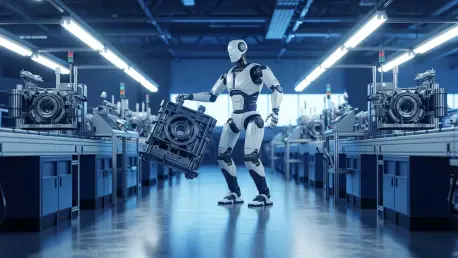

The sight of a humanoid robot executing a flawless backflip once felt like the pinnacle of engineering, but the era of the mechanical gymnast has officially given way to the age of the industrial powerhouse. In a recent demonstration that blurred the lines between high-tech innovation and deadpan comedy, the newest iteration of the Atlas robot was asked to provide a drink, only to respond by effortlessly hoisting a 50-pound mini-fridge and hand-delivering the entire appliance to a researcher. This display of “Hulk-like” strength is not merely a viral stunt; it represents a fundamental pivot in how the world’s most famous robotics company views the future of autonomous labor. By trading the high-flying acrobatics of its hydraulic predecessor for the grounded, raw power of an all-electric system, Boston Dynamics is signaling that the laboratory experiments are over and the real work is about to begin.
Delivering a Refrigerator Instead of a Soda
This transition from nimble athlete to heavy-duty laborer is best exemplified by the sheer physical presence of the new Atlas. While previous models were celebrated for their ability to navigate parkour courses with human-like grace, the electric Atlas is designed to dominate the physical constraints of a warehouse. When it moved that 50-pound refrigerator, it did so with a level of stability and whole-body coordination that makes traditional automation look fragile. The robot does not just use its arms to lift; it shifts its entire chassis, leveraging its center of gravity to manage awkward, heavy loads that would typically require a team of humans or specialized heavy machinery.
This shift in capability matters because it addresses the most pressing needs of modern industry: reliability and sheer utility. In environments where moving heavy crates or repositioning industrial equipment is the daily norm, a robot that can “put its whole body into a task” is infinitely more valuable than one that can perform a somersault. By focusing on high-torque electric actuators, engineers have created a machine that is quieter, cleaner, and significantly more powerful than the prototypes of the past. The mini-fridge demonstration serves as a functional proof of concept, showing that the robot can handle the unpredictable, top-heavy, and bulky items that define real-world logistics.
The Strategic Shift: From Research Curiosity to Industrial Tool
For a long time, the robotics industry treated humanoid forms as a “moonshot” research project, a way to test the limits of balance and computation. However, the emergence of the “Atlas Product” model marks a definitive move toward commercial viability. Boston Dynamics is no longer just chasing the “wow factor”; they are solving the “dull, dirty, and dangerous” problems that plague global supply chains. As labor shortages continue to impact manufacturing sectors from 2026 to 2030, the demand for a robot that can slip into human-centric spaces without requiring a total overhaul of the existing infrastructure has never been higher.
Moving to an all-electric platform is the cornerstone of this commercial strategy. Unlike hydraulic systems, which are prone to leaks and require intensive maintenance, the electric Atlas is built for the high-uptime requirements of a 24-hour factory. It is a tool designed for the long haul, featuring a simplified mechanical structure and a user-replaceable battery system that ensures minimal downtime. This evolution moves humanoid robotics out of the speculative “lab phase” and positions it as a practical solution for the modern workforce, where mechanical reliability and functional output are the only metrics that truly count.
Engineering a Post-Human Range of Motion and Power
One of the most fascinating aspects of the electric Atlas is that it has stopped trying to be a perfect replica of a human and has instead embraced its mechanical nature. The robot features 56 degrees of freedom, including an upper torso capable of a full 360-degree rotation. While a human worker must turn their entire body or shuffle their feet to change direction, Atlas can simply spin its upper half to orient toward a new task. This “post-human” range of motion allows it to operate in cramped quarters and navigate industrial layouts that would be physically taxing or impossible for a biological worker to manage efficiently.
This mechanical efficiency is paired with a staggering 110-pound lifting capacity, a feat enabled by advanced whole-body control software. The robot perceives its own mass and the mass of the object it is carrying in real-time, allowing it to maintain perfect balance even as it moves across uneven surfaces. By prioritizing “humanoid-adjacent” design over anatomical mimicry, the engineers have created a machine that can fold itself like an accordion or twist in ways that maximize leverage. This design philosophy ensures that Atlas can perform heavy lifting tasks with a level of mechanical advantage that far exceeds human capabilities, reducing the risk of equipment damage and increasing overall throughput.
Bridging the Reality Gap Through Massive AI Simulation
The fluid, intuitive movements seen in the physical world are the product of a grueling digital training regimen. Before the electric Atlas ever touched a physical mini-fridge, it performed the task millions of times within a high-fidelity simulation. This “simulation-to-reality” pipeline allows AI models to experiment with billions of variables—such as shifting centers of gravity, varying floor textures, and unexpected obstacles—at speeds impossible in the physical world. This massive scale of training ensures that when the robot finally encounters a real-world object, it already possesses a deep, intuitive understanding of the physics required to move it.
This methodology has dramatically shortened the development cycle for complex robotic behaviors. Traditionally, programming a robot to handle an irregular object required months of rigid, manual coding; today, the robot learns through a process of trial and error in the virtual realm. Experts at Boston Dynamics have noted that this AI-driven approach allows the robot to adapt to the “messiness” of the real world. If a box is slightly heavier than expected or a floor is slicker, the robot’s neural networks adjust its stance and grip instantaneously. This bridge between digital intelligence and physical labor is what allows Atlas to function as a general-purpose worker rather than a single-use machine.
Implementing Atlas in the Modern Industrial Workforce
The final hurdle for humanoid robotics is not just how they move, but how they fit into the existing human world. The electric Atlas is designed to be “infrastructure-agnostic,” meaning it can operate in warehouses designed for people rather than robots. Its ability to navigate stairs, squeeze through standard doorways, and reach shelves designed for human heights makes it a versatile asset. Instead of building a factory around a robot, companies can now drop an Atlas into an existing workflow to take over the most strenuous or repetitive tasks, allowing human supervisors to focus on higher-level coordination and quality control.
To ensure success in these high-output environments, the robot’s design focuses on modularity and ease of repair. The transition to electric power has simplified the “under the hood” components, making it easier for technicians to keep the fleet running. As these machines move from pilot programs to full-scale deployment, the focus will shift toward fleet management and the orchestration of multiple humanoids working alongside humans. By utilizing its unique 360-degree joints and high-torque motors, Atlas provides a practical framework for the future of autonomous physical work, proving that the most effective humanoid is the one that can do what humans do—and then some.
The successful transition of the Atlas platform into a high-powered electric humanoid provided a clear roadmap for the next decade of industrial automation. As companies began to integrate these machines into their daily operations, the focus shifted from mechanical feasibility to the nuances of human-robot collaboration. Decision-makers were encouraged to look beyond the novelty of humanoid forms and instead evaluate these robots based on their ability to reduce workplace injuries and bridge the gap in manual labor availability. The evolution of Atlas demonstrated that the future of robotics lay in machines that possessed both the intelligence to navigate the human world and the mechanical strength to transcend human limits. Moving forward, the industry turned its attention toward refining the software ecosystems that allowed these robots to learn new tasks autonomously, ensuring that the physical labor force of the future remained as adaptable as the digital world that powered it.