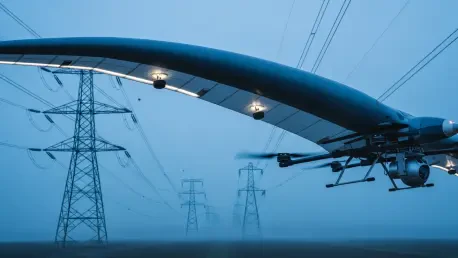

Aerial technology often hits a wall where the convenience of a portable frame meets the brutal reality of limited battery endurance and heavy aerodynamic drag. Current drone technology faces a frustrating stalemate: compact consumer models lack the endurance for serious work, while high-performance fixed-wing aircraft require heavy trailers and specialized launch crews. Most professionals are forced to choose between a drone that fits in a backpack but dies in 30 minutes, or a massive system that necessitates complex logistics. The Celeste Ecoflyers daS10 aims to break this cycle by utilizing a pressurized textile envelope, proving that the future of long-distance flight might not be rigid, but pneumatic.
The Efficiency Gap in Contemporary Unmanned Aviation
The disparity in the drone market remains a significant hurdle for commercial and industrial expansion. While multi-rotor drones offer incredible hovering precision, their energy consumption limits them to small-scale tasks. Conversely, traditional fixed-wing platforms excel in distance but demand a massive footprint for storage and transportation. This gap has left industries like agriculture and energy searching for a middle ground that provides the range of a plane with the portability of a handheld device.
Furthermore, the operational costs of maintaining a fleet of heavy, rigid-wing drones can be prohibitive for smaller enterprises. The requirement for specialized vehicles and highly trained ground crews to handle assembly and launch limits the flexibility of these tools. Pneumatic technology addresses these economic barriers by reducing the mechanical complexity of the airframe, allowing for a more streamlined approach to fleet management and long-range data collection.
Solving the Conflict: Deployment Speed and Flight Range
In the world of remote logistics and infrastructure, the “last mile” of deployment is often the most difficult. Traditional long-range drones are cumbersome, making them nearly impossible to use in disaster zones or rugged terrain where large vehicles cannot pass. By prioritizing a lightweight, inflatable architecture, the industry is moving toward a model where high-endurance aerial surveillance is accessible to small teams. This shift is critical for real-world applications like pipeline monitoring and search-and-rescue, where the time spent setting up equipment can be the difference between success and failure.
The ability to launch a high-performance aircraft without a runway or catapult system changes the tactical landscape for field technicians. Small teams can transport these systems to remote ridges or densely forested areas, inflating the wing on-site to gain immediate eyes in the sky. This democratization of long-range flight removes the technical barriers that once kept advanced aerial data in the hands of only the largest corporations.
The daS10 Architecture: Engineering Ten-Hour Flight on a Textile Wing
The core innovation of this new class of UAV is an 8-meter (24-foot) pneumatic wing that provides massive lift without the structural weight of carbon fiber or aluminum. This design allows the daS10 to stay airborne for over 10 hours and cover a 500-mile range on a single charge—stats that dwarf the capabilities of standard rigid-wing drones. Because the wing is essentially a pressurized fabric tube, the entire aircraft can be deflated and stowed in the trunk of a standard passenger car, offering a unique combination of high-tier performance and consumer-level portability.
Aerodynamic efficiency is achieved through the internal pressure of the wing, which maintains its shape even under the stress of high-altitude winds. The propulsion system works in tandem with the light frame to minimize energy draw, allowing the battery to power the drone for a full workday. This architectural choice effectively solves the weight-to-power ratio that has plagued electric aviation for years, enabling missions that were previously only possible with combustion engines.
Industry Consensus: The Resilience of Pneumatic Structures
While flight tests have demonstrated the viability of inflatable wings, aerospace experts remain focused on the long-term durability of pressurized textiles in extreme weather. Early research findings suggest that pneumatic designs offer surprising resilience against impact, as the flexible nature of the wing can absorb energy that would typically snap a rigid structure. However, the next phase of development will require rigorous data on payload capacity and the degradation of textile materials under constant UV exposure and high-pressure cycles to prove these drones can survive years of industrial use.
Maintaining structural integrity during rapid temperature fluctuations also remains a key area of study. Because internal air pressure changes with temperature, the daS10 must utilize smart sensors to regulate inflation automatically during flight. Engineers are currently refining these feedback loops to ensure the wing stays rigid during high-speed maneuvers while preventing over-pressurization during the heat of the day.
A Field Strategy for High-Endurance Remote Monitoring
Adopting inflatable wing technology required a specific operational framework to maximize its advantages in the field. Teams prioritized a “rapid-inflation” protocol, utilizing portable compressors to move from a parked vehicle to active flight in minutes. For large-scale inspections, operators leveraged the 500-mile range to conduct “point-to-point” missions, where the drone was launched from one location and recovered hundreds of miles away, drastically reducing the need for ground-based relay stations.
This streamlined approach made the daS10 a practical tool for surveying remote utility lines and provided persistent oversight in areas where traditional aircraft were too expensive to operate. Future considerations suggested that integrating autonomous docking stations could further enhance these systems, allowing pneumatic drones to self-inflate and launch from remote hubs. By establishing these networks, industries found a path toward truly global, low-impact aerial monitoring that bypassed the limitations of traditional aviation.