
Oscar Vail is a titan in the world of emerging technology, renowned for his deep dives into quantum computing and the intricate logic of high-level robotics. However, his expertise extends far beyond the lab; he possesses a refined eye for how cutting-edge hardware integrates into our daily lives, transforming static environments into responsive, living ecosystems. As a frequent commentator on the intersection of open-source projects and luxury automation, Vail understands that true innovation is not just about raw power, but about the seamless orchestration of software and hardware to create an emotional experience. Today, he joins us to dissect the Buzzards Road Home Cinema, a project that has redefined the boundaries of sports-focused entertainment. By analyzing this award-winning installation, Vail provides a unique perspective on how reference-grade audio-visual equipment can be harnessed to recreate the visceral energy of a live stadium within the sanctuary of a private home.
This discussion explores the intricate technical layers of the Buzzards Road project, focusing on the sophisticated 9.4.4-channel Dolby Atmos configuration that delivers sound more powerful than a live crowd. We examine the revolutionary “Football Mode,” a smart automation feature that synchronizes the viewing experience across an entire property with a single touch, ensuring that not a second of the action is missed even when guests arrive. The conversation also highlights the vital role of interior design, where hidden speaker arrays and custom architectural elements like fiber-optic star ceilings and stone-finished bars blend high-tech utility with social comfort. Furthermore, we touch upon the premium hardware choices, from Sony 4K projection to the Kaleidescape Strato 4K UHD player, illustrating why this setup serves as a benchmark for modern home theaters.
When designing a 9.4.4-channel Dolby Atmos system, what are the primary technical considerations for balancing such an immense amount of audio power with the nuances of a live sporting event?
The technical challenge of a 9.4.4 configuration lies in the sheer volume of data and physical air displacement that must be managed to create a cohesive soundstage. In the Buzzards Road Home Cinema, the integration of nine floor-level speakers, four subwoofers, and four overhead channels requires massive processing power, which is why the choice of an Anthem MRX 1140 v2 receiver and an Anthem MCA 325 v2 power amplifier is so critical. These components provide the headroom necessary to drive the Artcoustic Spitfire A10 wall speakers and SL 2-1 three-way monitors without distortion, even when the volume exceeds the decibel levels of a real stadium crowd. Sports audio is uniquely demanding because it combines the sharp, directional sounds of a referee’s whistle or a ball hitting the post with the low-frequency, ambient roar of thousands of fans. To handle the low end, the team utilized a heavy-hitting combination of two Artcoustic Spitfire Sub 3 and two Sub 2 units, ensuring that the bass is felt in the chest as much as it is heard. By using an Artcoustic CPH1000D digital amplifier to dedicatedly drive the subwoofers, the system maintains a tight, rhythmic response that prevents the stadium atmosphere from becoming a muddy wall of sound. This level of control allows a viewer to hear the individual chants of Newcastle United fans while simultaneously feeling the earth-shaking impact of a goal, creating a sensory immersion that a standard soundbar could never replicate.
The integration of a “Football Mode” suggests a move toward highly specialized smart home presets; how does this specific automation change the way a viewer interacts with their environment?
Automation in the Buzzards Road project, powered by Control4, moves away from the “boring regular setup” of typical media rooms and into the realm of true environmental choreography. The “Football Mode” is more than just a simple input switch; it is a complex macro that triggers a chain reaction across the entire property, ensuring that the match becomes the pulse of the home. When the owner activates this mode with a single button, the system doesn’t just turn on the Sony 4K projector; it also begins broadcasting the live match feed to other units throughout the house, allowing guests to move to the stone-finished bar or other rooms without losing track of the game. Perhaps the most “magical” element of this smart integration is the gate intercom synchronization, where the content on the 145-inch screen automatically pauses the moment someone calls from the house entrance. This ensures that the host can welcome guests without the anxiety of missing a crucial play or a last-minute goal, effectively removing the common stresses of hosting a major viewing party. It reflects a deep understanding of human behavior, where the technology serves the social experience rather than forcing the people to adapt to the tech. This kind of thoughtful programming, which Paul Laventure of IndigoZest highlighted as a way to bring people together effortlessly, transforms the room from a mere theater into a responsive social sanctuary.
High-end cinemas often prioritize isolation, but this project emphasizes a social atmosphere; how do elements like the 145-inch acoustically transparent screen and the hidden speaker arrays facilitate this?
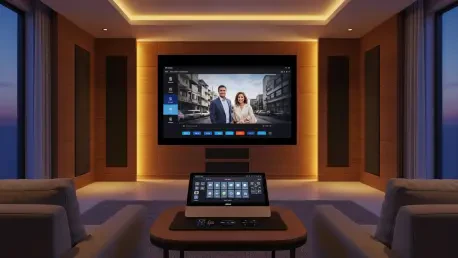
The Buzzards Road cinema breaks the traditional mold of a dark, isolated “black box” theater by using interior design to hide the complexity of the AV equipment, making the space feel like a welcoming lounge rather than a laboratory. By utilizing a 145-inch Control4 Dragonfly Fixed Ultra AcoustiWeave projection screen, the installers were able to hide the LCR (Left, Center, Right) speakers directly behind the visual plane without sacrificing audio clarity or picture quality. This allows the front of the room to remain clean and uncluttered, preventing the massive Artcoustic speakers from dominating the visual aesthetic of the space. Interior designer Sinead Kelly Herbert further enhanced this social vibe by incorporating bronze lighting fixtures, CNC-cut paneling, and a stunning fiber-optic star ceiling that provides a soft, ambient glow rather than the harshness of standard overhead lights. The seating layout was also intentionally designed to be more sociable than the rigid, tiered rows found in most home theaters, encouraging conversation and interaction among fans. Even the bulkier components, such as the Artcoustic SL Architect PAS SPL in-ceiling speakers, are tucked away to maintain the clean lines of the room, ensuring that the technology is invisible until the moment it is needed. This synergy between Cinema Luxe and the design team ensures that the room remains the most-used space in the house, serving as both a high-performance cinema and a refined area for entertaining friends.
With the inclusion of a Kaleidescape Strato 4K player and Sony projection, what does this setup offer that a standard high-end consumer OLED and soundbar simply cannot match?
While modern consumer OLEDs are impressive, they cannot compete with the sheer cinematic scale and bit-rate fidelity provided by a dedicated reference setup like the one found at Buzzards Road. The Sony 4K projector paired with the Kaleidescape Strato 4K UHD Movie Player offers a level of visual depth and “real deal” performance that surpasses even the best 4K Blu-ray players available to the general public. Kaleidescape provides a high-bitrate delivery system that ensures every frame of a film or a high-definition match broadcast is rendered with absolute precision, free from the compression artifacts often seen in standard streaming services. When you project that image onto a 145-inch screen, the field of view is completely occupied, creating a level of immersion where the viewer no longer feels like they are watching a screen, but rather looking through a window into the stadium. The sound system further separates this from a consumer setup; whereas a soundbar uses psychoacoustic tricks to simulate surround sound, this 9.4.4 system uses actual physical placement of 17 different audio sources to move sound through three-dimensional space. This results in a “sanctuary” of sound where the roar of the crowd is physically localized around the listener, providing a tactile and auditory experience that is leagues beyond the capabilities of all-in-one consumer hardware. This project is a testament to what happens when you prioritize the quality of the source material and the physical acoustics of the room, resulting in a setup that won two CEDIA awards for its excellence.
What is your forecast for the future of specialized home theater environments as high-end hardware becomes increasingly integrated with smart home ecosystems?
I believe we are entering an era where the distinction between a “media room” and the rest of the home will continue to blur, as the intelligence of the system becomes just as important as the resolution of the screen. We will see more “one-button” environments like the one at Buzzards Road, where the home theater is no longer a static destination but a dynamic hub that communicates with security, lighting, and even kitchen appliances to create a frictionless lifestyle. The trend of hiding the “tech” will also accelerate; as speakers become thinner and projection screens more integrated into the architecture, we will see high-performance theaters in rooms that look like standard living spaces. I expect to see more AI-driven automation that learns a user’s viewing habits—perhaps a “Movie Night” mode that automatically orders pizza or a “Morning News” mode that adjusts the acoustics for speech clarity while the sun rises. The Buzzards Road project is a blueprint for this future, showing us that the ultimate luxury isn’t just having the loudest speakers or the biggest screen, but having a home that understands exactly how you want to experience the world. As we look toward the next decade, the focus will shift from the specs on the box to the quality of the “shared experience,” using technology as a bridge to bring people together in increasingly immersive and emotionally resonant ways.