
Dealers can now retain long-term access for troubleshooting and maintenance without compromising a client’s privacy through a sophisticated multi-user management framework. This development marks a significant milestone at the CEDIA Expo, where Bond has demonstrated its evolution as a key player under the Somfy Group umbrella. By bridging the gap between massive corporate resources and an agile, brand-agnostic philosophy, the company remains a preferred partner for professionals who value flexibility above all else. This balance allows for the support of diverse motor technologies and automation protocols, ensuring that the platform serves as a universal translator in an often fragmented industry. As the line between indoor and outdoor living continues to blur, the demand for unified control systems has skyrocketed, prompting a shift toward more integrated architectural solutions. Rather than operating in isolation, these technologies now converge to form a comprehensive ecosystem that prioritizes the user experience while maintaining the technical robustness required for high-end residential and commercial projects alike.
Breakthrough Hardware and Intelligent Control
Advancing Lighting: The Firefly Series and Hardware Innovation
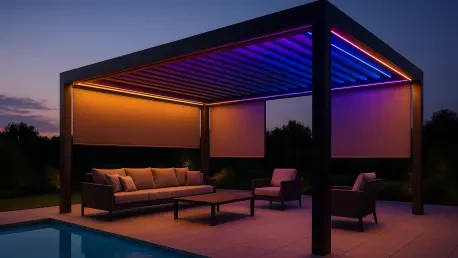
The introduction of the Firefly LED Controller series represents a bold move into the lighting sector, specifically targeting the high-performance requirements of modern outdoor environments. Featuring the Aura and Pixel models, these 12/24VDC in-line controllers are engineered to drive high-capacity RGBWC LED strips with precision and reliability. While the Aura model is tailored for straightforward single-zone installations, the Pixel model offers sophisticated control over addressable lighting, allowing for intricate multi-zone configurations that were previously difficult to manage. Direct integration with the Bond Bridge Pro ensures that these lighting solutions do not exist as separate silos but are instead fully incorporated into the existing control architecture used for shades and ceiling fans. This hardware expansion effectively doubles the utility of the bridge for many users, providing a streamlined path for adding atmosphere and safety lighting to patios, walkways, and pergolas without requiring redundant gateways or complex wiring schemes.
A deeper dive into the Firefly Aura and Pixel controllers reveals a commitment to high-voltage stability and thermal management, which are critical factors in the longevity of outdoor electronics. These units were specifically tested to withstand the voltage fluctuations common in expansive residential landscapes, where long wire runs can often lead to performance degradation. By utilizing 12/24VDC standards, the brand ensures that its lighting solutions are compatible with a vast array of existing LED strip architectures, providing integrators with the flexibility to choose the best lumen output for their specific environment. The Pixel model, in particular, has revolutionized how lighting designers approach complex animations by providing granular control over every individual light point on a strip. This level of detail allows for the creation of sophisticated running lights or subtle gradients that can mimic natural environmental shifts, such as a sunset or the gentle movement of water. Furthermore, the compact form factor of these in-line controllers allows them to be tucked away discreetly.
Intelligent Environmental Management: AI-Driven Scene Programming
Complementing this new hardware is a suite of AI-powered features within the Bond Home application designed to lower the barrier to entry for complex scene programming. Homeowners can now utilize natural language processing to generate custom lighting animations or specific color palettes through simple voice or text commands, bypassing the need to navigate deep settings menus. For example, a user hosting a dinner party can request a warm, flickering amber glow across their outdoor living space, and the system automatically generates the logic required to synchronize every connected LED strip. This intelligence extends to proactive energy management and predictive scheduling, where the system learns the habits of the household and suggests adjustments to optimize both comfort and efficiency. By making high-end customization accessible through an intuitive interface, the platform empowers users to fully realize the creative potential of their lighting systems. This democratization of advanced control ensures that the technology serves the lifestyle of the occupant effectively.
Beyond simple voice commands, the integration of generative AI into the application allows the system to analyze environmental data to suggest optimal lighting and climate settings. For instance, the system can monitor local weather forecasts and automatically suggest a storm prep scene that retracts motorized awnings and shifts lighting to a high-visibility safety mode. This proactive approach takes the guesswork out of home management, transforming the smart hub from a passive tool into an active assistant that anticipates the needs of the household. Integrators have noted that this reduces the number of service calls, as the system can self-adjust based on real-time conditions rather than relying on static schedules that may become obsolete as seasons change. Additionally, the AI can assist users in troubleshooting their own setups by providing natural language explanations for device statuses, further empowering the homeowner while reducing the burden on dealer support teams. This focus on intelligent automation ensures that the technology remains an asset rather than a frustration for the occupant.
Empowering the Professional Industry
Enhancing Dealer Workflows: Tools for Long-Term Maintenance
Professional integrators face unique challenges when deploying large-scale outdoor automation, which is why the launch of Shared Access and the Live Showroom Display Kit is so significant for the channel. Shared Access provides a secure method for dealers to configure a client’s system on their own equipment before seamlessly transferring primary ownership to the homeowner. This handover process ensures that the professional maintains the necessary permissions for remote troubleshooting and firmware updates without intruding on the user’s personal data or daily privacy. Simultaneously, the Live Showroom Display Kit offers a tangible, interactive way for dealers to illustrate the benefits of motorized screens, sensors, and lighting in a real-world context. These tools are designed to reduce the friction often associated with the sales and installation phases of a project, allowing dealers to focus on delivering high-quality craftsmanship. By streamlining these workflows, the brand is helping to ensure that the transition from a concept to a smart home is efficient.
The Live Showroom Display Kit further bolsters the dealer’s ability to demonstrate value by providing a portable yet powerful demonstration of how different sensors and motors interact. Dealers used these kits to show prospective clients how wind and rain sensors can trigger automated responses, protecting expensive outdoor furniture and structures without human intervention. This hands-on experience is often the deciding factor for homeowners who may be hesitant about the complexity of automated screens or louvers. By providing a clear, visual representation of the if-this-then-that logic, the kit simplifies the sales process and helps set realistic expectations for the final installation. Moreover, these tools are integrated with the brand’s back-end management portal, allowing dealers to track the performance of their installed base across multiple properties from a single dashboard. This macro-level view of system health enables proactive maintenance, where a dealer might identify a failing motor or a connectivity issue before the homeowner even notices it.
Strategic Partnerships: Building a Sustainable Open Ecosystem
Taking a leadership role in the outdoor automation sector requires more than just innovative hardware; it necessitates a deep commitment to industry-wide interoperability and collaboration. At recent high-level summits, company leadership emphasized the importance of engaging integrators early in the architectural design phase to prevent technical conflicts later in the build. The ecosystem is frequently described as the connective tissue that allows disparate brands of outdoor hardware, such as radiant heaters from one manufacturer and motorized louvers from another, to function as a single, cohesive unit. This approach is particularly vital in the luxury market, where clients expect a premium experience that is free from the glitches typically associated with mismatched components. By fostering a collaborative environment, the brand ensures that complex outdoor projects can be executed with a level of precision that was previously unattainable. This focus on harmony across different platforms not only benefits the end-user but also elevates the reputation of the professionals involved.
The strategic acquisition by the Somfy Group successfully provided the capital and logistical support needed to scale operations while allowing the brand to remain operationally independent. This independence was crucial for maintaining partnerships with major players like StruXure, Renson, and Big Ass Fans, ensuring that the platform stayed truly brand-agnostic even as it grew. Throughout this period of expansion, the primary focus remained on refining the open-ecosystem philosophy, which allowed dealers to select the best hardware for each specific task without worrying about compatibility issues. To move forward, stakeholders implemented more rigorous testing for emerging protocols like Matter to ensure long-term stability across all outdoor deployments. Professionals recognized the importance of diversifying their expertise into lighting and climate control to provide a truly holistic service. By prioritizing platforms that offered both deep local control and robust cloud-based management, the industry moved toward a more reliable and user-centric future during this era of rapid technological advancement.