
The global push toward carbon neutrality has accelerated the deployment of utility-scale solar projects to a degree that traditional construction methods can no longer sustain effectively or economically. Across the vast deserts of the American Southwest and the sun-drenched plains of Australia, thousands of acres are being converted into massive energy hubs, yet the physical logistics of installing millions of individual solar panels remain a daunting barrier to rapid expansion. Manual labor, while once the backbone of the industry, now faces severe limitations in the form of safety risks, rising costs, and a diminishing workforce willing to endure extreme outdoor conditions. To meet the aggressive energy targets of 2026, developers have turned to specialized robotics that integrate high-precision hardware with advanced spatial intelligence. These systems are no longer experimental prototypes; they are now operational necessities that bridge the gap between ambitious renewable goals and the practical realities of large-scale infrastructure.
Streamlining Solar Farm Construction and Field Assembly
Automated Site Development: The Rise of Portable Factories
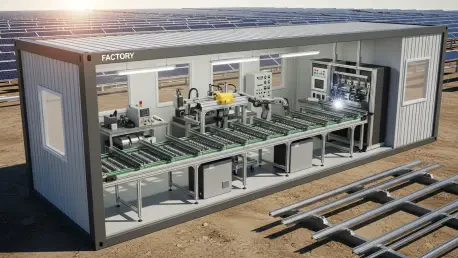
The industry is currently witnessing a profound transition from traditional on-site manual assembly to robotic manufacturing through the deployment of portable factories. These mobile units are transported directly to construction sites, where they function as self-contained assembly lines capable of converting raw steel and components into finished structural sections. By centralizing the fabrication process within a controlled environment on the field, developers can bypass many of the logistical delays associated with transporting pre-assembled parts over long distances. These heavy structural sections are then positioned by autonomous or semi-autonomous robotic vehicles, which utilize GPS and sensor arrays to ensure every component is placed with millimeter accuracy. This approach significantly reduces the physical strain on human workers, who previously had to lift and secure heavy materials in the heat. The result is a much faster foundational phase that sets a consistent standard of quality across the entire installation site for years.
Beyond the foundational structural assembly, robotic pick-and-place technology is currently revolutionizing how individual solar modules are integrated into racking systems. Specialized robotic arms, often mounted on tracked chassis, can now identify, lift, and secure solar panels multiple times faster than standard human crews could ever achieve manually. These systems use sophisticated suction mechanisms to handle fragile glass panels without the risk of micro-cracks, which often occur during manual handling. By ensuring that modules are aligned with perfect precision from the start, these robots prevent long-term mechanical stress on the frames. This collaborative model does not eliminate the need for human expertise; instead, it allows skilled workers to focus on more nuanced electrical configurations and the final mechanical securing of the systems. Such a shift in labor dynamics not only improves overall site safety but also drastically lowers the labor-related expenses of the project in the modern economic landscape.
Precision Mechanical Integration: High-Speed Robotic Racking
The precision required for modern tracking systems, which follow the sun throughout the day to maximize energy yield, necessitates a level of accuracy that is difficult to maintain at a massive scale with manual labor alone. Robotic systems are now being used to install torque tubes and drive systems with extreme consistency, ensuring that the entire row of panels moves in perfect synchronization. Any minor deviation in the alignment of these tracking components can lead to mechanical wear or reduced energy output over the twenty-five-year lifespan of a solar farm. Machines equipped with laser-guidance systems can verify the level and plumb of every post and beam before the panels are even attached. This preventative approach to quality control ensures that the structural integrity of the farm is robust enough to withstand high wind loads and other environmental stresses. Consequently, the reliance on automated alignment tools has become a standard requirement for developers seeking to minimize long-term maintenance costs and maximize energy assets.
Electrical integration represents another significant frontier where robotics are making substantial gains in efficiency and safety. In a typical utility-scale project, thousands of miles of cabling must be managed and connected to inverters and transformers with zero tolerance for error. Robotic wire-management systems are now capable of trenching, laying, and even terminating high-voltage lines with minimal human intervention. These machines use specialized sensors to detect underground obstacles and ensure that cables are buried at the precise depths required by local electrical codes. Furthermore, automated testing units can verify the continuity and insulation resistance of every circuit as it is installed, providing immediate feedback to site managers. This real-time validation prevents the costly re-work that often plagues projects when wiring errors are discovered only after the entire system is energized. By streamlining these tasks, robotics allow projects to reach the commissioning phase much sooner than traditional construction schedules would permit.
Maximizing Operational Efficiency and Asset Longevity
Intelligent Diagnostics: Autonomous Monitoring Systems
Once a utility-scale solar farm is fully operational, the management focus shifts from construction speed to long-term efficiency across hundreds of thousands of individual panels. Autonomous robots, including ground-based rovers and specialized drones, are now equipped with high-resolution thermal cameras and lidar to map sites with incredible detail. These machines can identify micro-issues, such as hot spots on individual cells or loose wiring connections, that would be nearly impossible for human inspectors to find in a reasonable timeframe. By scanning the entire array on a regular schedule, these robots provide a level of granular monitoring that is essential for preventing cumulative energy loss over the lifespan of the farm. Thermal anomalies are often the first sign of a failing component, and identifying them early allows for targeted repairs before a minor fault leads to a significant outage. This proactive monitoring strategy ensures that the facility operates at its maximum efficiency, maximizing the financial return for energy providers.
The integration of diagnostic data into a centralized management platform allows site operators to maintain a comprehensive view of asset health without being physically present on-site. Every scan performed by a robotic unit is time-stamped and geolocated, creating a historical record of how each panel and inverter is performing over time. This data-driven approach enables the identification of patterns that might indicate a systemic issue, such as a batch of modules that are degrading faster than expected or a specific racking section that is prone to mechanical vibration. By synthesizing this information, operators can move away from rigid, calendar-based maintenance schedules toward a more dynamic, on-demand model. This ensures that resources are only deployed when and where they are actually needed, reducing the waste of labor and materials. As the scale of solar installations continues to grow, this level of automated oversight becomes the only viable way to manage the sheer complexity of the modern energy grid, where every production unit is critical.
Sustainable Maintenance: Waterless Cleaning and Predictive Data
Cleaning and resource management have undergone a significant transformation through the use of waterless cleaning platforms designed for arid and semi-arid environments. In regions where water is a scarce and expensive resource, the traditional method of washing solar panels with truck-mounted sprayers is both environmentally unsustainable and financially burdensome. Autonomous cleaning robots now utilize specialized brushes and airflow systems to remove dust and debris without a single drop of water. These systems can be permanently installed on the racking or deployed as mobile units that travel from row to row, operating primarily during the night to avoid interfering with energy production. By maintaining a clean surface, these robots ensure that the panels can absorb the maximum amount of sunlight, which can increase the total energy yield by fifteen percent in high-dust areas. This shift toward automated, waterless maintenance is a critical component of making solar energy a sustainable solution that does not compete with local communities for water.
The integration of robotics into the solar sector proved to be the most significant catalyst for achieving the ambitious decarbonization targets set for the latter half of the decade. Industry leaders moved beyond simple automation and instead built comprehensive ecosystems where machines and data became the foundation of every operational decision. To capitalize on these gains, developers invested heavily in cross-platform software that allowed different robotic brands to communicate within a single site-management interface. They also established rigorous training programs to transition traditional construction workers into roles as robotic fleet managers and data analysts. These actions ensured that the workforce remained relevant in an increasingly automated environment while enhancing the overall productivity of the sector. By treating robotics as a strategic pillar, the industry successfully lowered the levelized cost of energy to record lows. The transformation provided a clear roadmap for other renewable sectors to follow in pursuit of a stable global power network.