
The traditional boundaries separating stationary office environments from mobile productivity are dissolving as professionals demand hardware that matches the versatility of their workflows. Acer’s latest pivot toward professional-grade hardware represents a significant departure from the standard consumer electronics cycle that has dominated the market for years. Instead of iterating on existing tablet designs, the company is developing a cohesive ecosystem that prioritizes specialized utility over general accessibility. This strategic shift is visible in the recent launch of several high-performance devices that bridge the gap between portable convenience and desktop-level reliability. By targeting the specific needs of modern experts, such as high-resolution color accuracy for designers and robust data management for analysts, the manufacturer is establishing a new benchmark for what mobile tools should accomplish. This approach suggests a paradigm where professional mobility is no longer defined by the limitations of the device, but by the seamless integration of hardware into a high-stakes professional environment.
Evolution of the Tablet Workspace: The Iconia Duo Series
Central to this transformation is the introduction of the Iconia Duo tablet series, which moves away from the widescreen formats common in entertainment-focused devices. By adopting a 3:2 aspect ratio, Acer has optimized the viewing area for vertical content, making it significantly easier to review long legal documents, edit spreadsheets, or write code without constant scrolling. The entry-level D12 model serves as a foundation for this series, providing a high-utility display that mirrors the experience of using a standard laptop screen. Beyond the physical dimensions, these devices prioritize longevity and data security, incorporating extended battery life that supports full workdays and expandable storage options for massive project files. This design philosophy acknowledges that a professional tablet is not merely a secondary screen for casual consumption, but a primary workstation that must handle intensive multitasking and sustained performance under demanding conditions in various locations.
For professionals who require more sophisticated visual capabilities, the flagship Iconia Duo S14 and S12 models incorporate advanced display technologies that were once reserved for high-end studio monitors. The S14 features a substantial 14.2-inch OLED panel that delivers exceptional color precision and deep contrast ratios, essential for photographers and video editors working on the move. Furthermore, its unique connectivity suite allows it to serve as a high-fidelity external monitor for other computers, enhancing its value within a multi-screen setup. In contrast, the S12 utilizes a specialized nano-texture glass coating designed to minimize reflections and glare in brightly lit environments, such as outdoor construction sites or glass-walled corporate offices. These hardware refinements, combined with high refresh rates and pressure-sensitive stylus support, ensure that the tablets function as precision instruments capable of handling complex digital illustrations and intricate data visualizations with ease.
Seamless Intelligence: Integrating Wearable AI in the Workplace
Diversifying its professional portfolio, Acer has also introduced spatial computing solutions that aim to redefine how users interact with information in high-mobility scenarios. The AR Vision GR0 augmented reality glasses represent a significant leap in wearable display technology by providing a lightweight alternative to bulky headsets. These glasses project a virtual 172-inch screen using micro-OLED components, allowing users to maintain a private workspace even while traveling in public spaces or commuting. Because the system is built on a foundation of cross-platform compatibility, it functions effortlessly with Windows, iOS, and Android ecosystems, making it a versatile tool for various professional software environments. This hardware allows for the creation of an expansive digital desktop that exists entirely within the user’s field of vision, effectively eliminating the physical constraints of traditional monitors. It provides a solution for those who need to manage multiple windows or high-definition visual assets without being tethered to a desk.
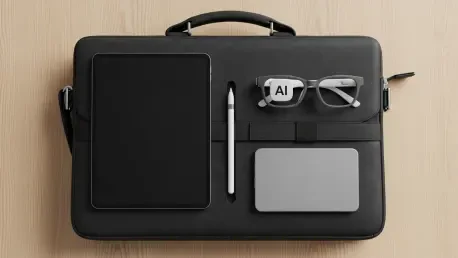
Complementing the visual immersion of augmented reality were the GI0 AI glasses, which functioned as a hands-free intelligent assistant for professionals in the field. These wireless frames integrated the capabilities of Google Gemini, enabling real-time language translation and automated meeting transcription that simplified complex communication tasks. The built-in camera allowed the AI to analyze visual data instantly, providing users with contextual information about their surroundings or specific project components. This integration of wearable intelligence proved that Acer shifted its focus toward tools that reduced cognitive load rather than just increasing screen time. By prioritizing devices that automated documentation and streamlined connectivity, the company successfully established a blueprint for the next phase of professional mobile technology. Decision-makers were encouraged to evaluate these tools based on their ability to integrate into existing digital workflows. The transition toward intelligent wearables ensured that productivity remained high regardless of the user’s physical location.