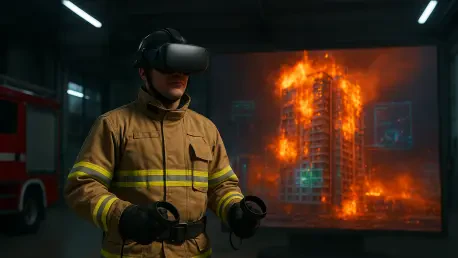

The growing legitimacy of virtual training is evidenced by organizations like the Quebec provincial safety board, which has officially recognized digital simulations as a valid continuous training program. This official endorsement highlights a fundamental shift in how emergency services approach professional development, moving away from a total reliance on physical drills that are often limited by weather, site availability, and high operational costs. Fire departments currently face an increasing difficulty in securing appropriate facilities for live-fire exercises, which often involve significant environmental permits and the destruction of physical assets. Digital environments offer a versatile alternative, enabling personnel to engage in complex hazard scenarios that would be too dangerous or expensive to replicate in the real world. By utilizing these advanced simulations, agencies are successfully bridging the gap between theoretical knowledge and practical application, ensuring that their teams remain proficient in an era where urban environments are becoming increasingly complex and hazardous.
Specialized Training Platforms and Their Unique Contributions
The integration of Virtual Reality and Artificial Intelligence is not merely a logistical convenience but a strategic upgrade to the traditional training pipeline. As municipal fire departments deal with shrinking budgets and higher personnel turnover, the ability to provide consistent, high-quality instruction without the overhead of physical fuel and property damage is invaluable. These digital systems allow for a much higher frequency of training, ensuring that essential skills do not degrade over time. Furthermore, the use of immersive technology reduces the environmental footprint of training programs, which is a growing concern for city planners and safety boards alike. By creating a no-fault learning environment, departments can foster a culture of experimentation and improvement where firefighters are encouraged to push their limits and learn from their mistakes without the fear of real-world injury. This transition is redefining the standard of readiness for modern emergency services, providing a scalable solution to the evolving challenges of public safety.
Refining Leadership and Tactical Precision
Advanced digital platforms like Tactik 360 have fundamentally transformed the way company officers and incident commanders prepare for the unpredictable nature of fireground operations. These systems provide a highly immersive environment where leadership personnel can practice critical command functions without the logistical constraints of live-fire drills. By utilizing AI-generated scenarios, these platforms simulate complex incidents that require immediate tactical size-ups and the precise deployment of virtual resources. The ability to pause, rewind, and review decisions in real-time allows for a level of pedagogical depth that traditional training simply cannot match. This learning environment encourages officers to explore different strategies and observe the consequences of their actions in a safe space. Consequently, fire departments are seeing a marked improvement in the confidence and tactical precision of their leadership, ensuring that they are better equipped to handle high-pressure environments in their daily service.
The integration of sophisticated voice recognition within systems like Fire Ground Sim has further enhanced the realism of these simulations, allowing for a more natural interaction between the trainee and the virtual environment. Instead of relying on manual inputs, officers use verbal commands to direct virtual fire crews, mirroring the actual communication protocols used during real emergencies. This technological advancement ensures that the training exercise remains focused on the cognitive and communicative skills essential for effective incident management. Furthermore, the AI-driven engines behind these simulations create dynamic fire behavior that reacts realistically to the tactical decisions made by the firefighter. If a ventilation error is made, the virtual fire responds accordingly, providing immediate visual feedback that reinforces standard operating procedures. This high level of fidelity is crucial for building the muscle memory and rapid decision-making capabilities required in modern firefighting, where seconds can make the difference between a successful rescue and a catastrophic outcome.
Scalability and Data-Driven Metrics
Scalability and objective data analysis have become the hallmarks of modern training programs, with companies like XpertVR leading the way in performance tracking. These platforms allow department leadership to monitor every movement and decision made by a trainee during a virtual exercise, providing a wealth of data that was previously impossible to capture. This objective feedback loop enables instructors to identify specific areas where a firefighter may be struggling and tailor future training sessions to address those individual needs. By moving away from subjective evaluations, departments can ensure a consistent level of competency across the entire organization, regardless of the size or location of the station. The portability of modern VR hardware also means that high-quality training is no longer confined to a central academy. Instead, individual firehouses can maintain their operational readiness by conducting immersive drills during downtime, significantly reducing the logistical burden on department resources.
Beyond professional development, immersive technologies are playing a vital role in recruitment and public safety education through specialized tools like Darley’s Flashgroup. These platforms offer entry-level simulations, such as fire extinguisher training and basic hazard recognition, that engage a younger, tech-savvy generation in the possibilities of a career in the fire service. By providing a low-stakes yet exciting introduction to the industry, departments are able to attract a more diverse pool of candidates who might not have otherwise considered a future in emergency services. Additionally, these tools are being used to improve public safety awareness by allowing community members to experience the challenges of a fire scenario in a controlled virtual environment. This immersive approach to education is far more effective than traditional lectures, as it allows participants to see the immediate consequences of fire safety decisions. By fostering a deeper connection with the community, fire departments are ensuring their long-term viability and building a safer environment.
Core Trends Driving the Digital Transformation
Artificial Intelligence has transitioned from a supplemental feature to a core component of the modern fire service’s digital infrastructure, driving the next wave of training innovation. Today’s AI engines are capable of generating unique, non-repetitive scenarios that prevent trainees from simply memorizing the layout of a simulation. This unpredictability is essential for developing true tactical proficiency, as it forces firefighters to rely on their training and standard operating procedures rather than familiarity with a specific exercise. AI also powers the automated quiz generation and feedback systems that follow each virtual drill, providing trainees with an immediate assessment of their performance and actionable advice for improvement. This level of automation allows smaller departments with limited instructional staff to maintain a high standard of training without the need for constant supervision. Moreover, the ability of AI to simulate realistic fire spread and smoke dynamics based on environmental factors ensures that every virtual encounter provides a scientifically accurate representation.
Integration of Artificial Intelligence and Realistic Simulations
The decentralization of training through virtual reality has fundamentally changed the operational rhythm of fire departments, allowing for a more efficient use of personnel and equipment. In the past, conducting a large-scale drill often required taking multiple units out of service and moving them to a centralized training facility, which could compromise emergency response times. Now, the portability of VR headsets and the availability of cloud-based simulation platforms allow crews to train directly at their stations while remaining fully available for calls. This at-station model maximizes the productive use of downtime and eliminates the travel costs and fuel consumption associated with traditional training methods. Furthermore, this approach allows for more frequent, shorter training sessions that have been shown to improve information retention and skill proficiency. By integrating training into the daily routine of the firehouse, departments are creating a culture of continuous learning and readiness that is essential for meeting the demands of modern emergency response.
As we look toward the further integration of these technologies, the expansion of multiplayer functionality and global connectivity is set to redefine inter-agency collaboration. Modern virtual environments now support dozens of participants from different geographical locations, allowing for large-scale incident command drills that involve multiple fire departments, police agencies, and emergency medical services. This capability is particularly valuable for preparing for mass-casualty incidents or large-scale natural disasters where coordinated response is critical. Trainees can work together in a shared virtual space, practicing communication protocols and resource management in a way that would be prohibitively expensive and logistically impossible to organize in the physical world. Developers are also focusing on creating standardized virtual firegrounds that allow departments from different regions to train on identical scenarios, facilitating the development of universal best practices. This move toward a more connected training environment ensures that when a real disaster occurs, agencies are already cohesive.
Assessing Long-Term Organizational Resilience
Fire departments successfully shifted their focus toward sustainable, long-term competency models that relied heavily on these digital frameworks. The industry recognized that the key to maintaining a prepared workforce was the continuous integration of specialized data analytics into every training session. Leadership took decisive action by implementing standardized performance reviews based on virtual metrics, which allowed for a more objective assessment of firefighter readiness than traditional methods ever provided. These organizations also prioritized the development of cross-functional teams that could operate seamlessly across different jurisdictions, using virtual reality as the primary bridge for multi-agency cooperation. This holistic approach ensured that firefighters were not only technically proficient but also mentally resilient in the face of increasingly complex urban emergencies. As a result, the fire service established a robust foundation for ongoing innovation, making high-quality instruction accessible to every member, regardless of their physical location.
The transition to a technology-driven training paradigm provided actionable insights that reshaped the future of emergency response. Departments optimized their resource allocation by identifying specific skill gaps through the granular data collected during immersive simulations. This evidence-based approach allowed for the creation of highly personalized professional development paths, which increased personnel retention and overall job satisfaction. Moreover, the move toward decentralized, at-station training modules successfully reduced the operational strain on municipal budgets while improving total departmental readiness. Looking back, the adoption of VR and AI was a critical turning point that allowed the fire service to evolve alongside the technological advancements of the modern world. Agencies that prioritized these digital tools were able to maintain superior safety standards and response capabilities, ultimately saving more lives and protecting more property. The lessons learned during this period of digital transformation became the new standard for the next generation of first responders.