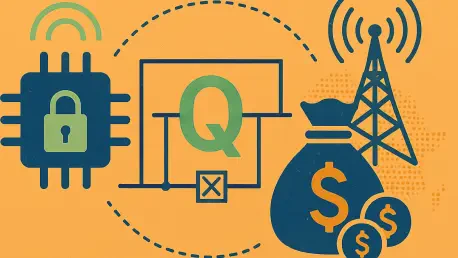

Research indicates that the primary cost of post-quantum security in LPWANs stems from radio airtime rather than the CPU cycles required for complex mathematical computation. This revelation arrives at a critical juncture in 2026, as the proliferation of the Internet of Things has deeply embedded Long Range technology into the fabric of modern industrial and agricultural operations. For years, the appeal of LoRa has rested on its ability to maintain connectivity across miles of terrain using only a fraction of the energy required by cellular or Wi-Fi alternatives. However, as these networks are increasingly tasked with transmitting high-value data processed by edge-based artificial intelligence, the looming shadow of quantum computing poses a significant existential threat. Protecting these low-power nodes with quantum-resistant encryption is no longer a theoretical exercise but a technical necessity. This shift creates a massive engineering conflict, as the very architectural choices that make LoRa efficient—such as its narrow bandwidth and strict duty cycles—now act as bottlenecks for the large cryptographic payloads required by post-quantum standards like CRYSTALS-Kyber.
Comprehensive Evaluation of Wireless Network Constraints and the Efficiency of Modern Data Compression Techniques
Understanding LoRa Payload Limitations
The fundamental challenge of implementing any robust security protocol on a LoRa network begins with the physical layer of the radio protocol itself. Utilizing chirp spread spectrum modulation, LoRa provides an impressive link budget that allows signals to penetrate deep into urban environments or across vast rural landscapes, but this resilience comes at the cost of extremely limited throughput. In a standard configuration, the physical-layer payload is capped at a maximum of 255 bytes per frame, a tiny window that was originally intended for simple sensor readings such as temperature or humidity. Furthermore, the regulatory landscape for license-free sub-gigahertz bands imposes strict duty-cycle limitations, often restricting a device to transmitting for only one percent of the time. This means that if a security protocol increases the size of a message, it does not just drain the battery; it physically prevents the device from sending data for longer periods, potentially leading to critical delays in time-sensitive industrial applications.
Beyond raw byte limits, the relationship between the spreading factor and the data rate further complicates the deployment of modern encryption. In 2026, many long-range deployments use higher spreading factors to ensure connectivity in challenging environments, which naturally slows transmission speeds. When a cryptographic signature or an encrypted key exchange is added to this slow data stream, the airtime required for a single transmission can balloon from a few hundred milliseconds to several seconds. This extended occupation of the radio frequency spectrum increases the probability of interference from other devices, as license-free bands become more crowded every year. Engineers must therefore navigate a reality where the physical constraints of radio waves dictate the boundaries of digital security, forcing a complete rethinking of how we wrap sensitive data in protective cryptographic layers without breaking the network’s operational functionality.
Utilizing Neural Networks for Compression
To mitigate the severe bandwidth restrictions inherent in LoRa, researchers have increasingly turned to advanced Edge AI solutions, specifically convolutional variational autoencoders. These neural network models are designed to compress complex data, such as high-resolution images or multi-dimensional sensor streams, directly on the edge node before any transmission occurs. In recent field tests, these autoencoders achieved a compression ratio of 99.98%, effectively turning a 5.5-megabyte image into a compact 1,016-byte bitstream. This level of reduction is not merely a convenience; it is the essential “resource cushion” that makes the addition of security overhead even remotely possible. By shrinking the primary data payload to a fraction of its original size, developers can “buy back” the bandwidth necessary to include the cryptographic metadata required for modern security, such as message authentication codes or public-key infrastructure components.
The implementation of these neural compression models represents a significant shift in how edge devices operate in 2026. Instead of acting as simple pass-through sensors, these nodes now function as intelligent processors that understand the importance of data density. However, the use of variational autoencoders also introduces its own set of trade-offs, as the reconstruction of compressed data at the gateway or cloud level requires significant computational resources. Furthermore, the bitstream produced by such extreme compression is highly sensitive to errors; a single flipped bit in a 99.98% compressed file can render the entire resulting image unrecognizable. This high sensitivity creates a secondary dependency on the cryptographic layer, which must not only encrypt the data to maintain privacy but also ensure its integrity during the long journey across the airwaves. This synergy between Edge AI and cryptography is becoming the new standard for industrial IoT, though it remains a delicate balancing act.
Measuring the Cost of Security
Establishing a Controlled Testing Environment
In order to accurately quantify the impact of post-quantum cryptography on these networks, recent studies have utilized highly controlled environments involving Faraday cages to block all external radio interference. By using a shielded enclosure, engineers can ensure that every milliwatt of power consumed and every millisecond of airtime measured is a direct result of the device’s internal processing and radio activity, rather than environmental noise or signal retransmissions. The hardware typically used for these benchmarks includes high-performance edge nodes like the Raspberry Pi paired with specialized LoRa transceivers such as the Semtech SX1262. This combination allows for a precise separation of concerns, where the CPU energy used for mathematical calculations can be measured independently from the energy consumed by the radio during the transmission of the resulting encrypted packets.
Standardizing these tests is crucial because even minor changes in radio settings can lead to vastly different conclusions regarding security costs. For instance, the spreading factor, bandwidth, and coding rate must be held constant to determine how much overhead a specific cryptographic algorithm truly adds. In these 2026 experiments, researchers have focused on the 868 MHz band with a spreading factor of 7, which represents a common real-world balance between range and speed. By monitoring the power rail with high-precision digital modules, the engineering community has confirmed that the power-hungry nature of the radio is the dominant factor in the energy budget. This data-driven approach has shifted the focus away from the “computational cost” of lattice-based math and toward the “transmission cost” of the resulting large ciphertexts, providing a much clearer picture of where optimization is actually needed.
Comparing Lightweight and Post-Quantum Protocols
The most striking findings in recent security audits come from the direct comparison between lightweight symmetric encryption and modern post-quantum architectures. For example, the use of ChaCha20, a lightweight stream cipher, combined with Poly1305 for authentication, has shown almost zero impact on the operational profile of LoRa devices. Because the overhead of these ciphers is minimal, the airtime for an encrypted message remains nearly identical to that of an unencrypted one, making it an ideal choice for defending against traditional, non-quantum threats. However, when the focus shifts to future-proofing against quantum computers using CRYSTALS-Kyber, the performance metrics tell a very different story. The lattice-based approach required for quantum resistance generates significant amounts of metadata, often adding hundreds of bytes to each session establishment.
The transition from ChaCha20 to a hybrid Kyber architecture reveals the physical breaking point of the LoRa protocol. In experimental runs, the Kyber-512 ciphertext alone added approximately 800 bytes to the transmission payload. Since this exceeds the 255-byte limit of a single LoRa frame, the system was forced to fragment the security data into four separate packets. This fragmentation is where the “post-quantum tax” becomes most apparent, as it causes the mean transmission time to surge from five seconds to over nine seconds. While the edge processor can handle the complex lattice math in a few hundred milliseconds, the radio must stay active for nearly twice as long to push those extra packets through the air. This stark contrast emphasizes that the primary obstacle to quantum-safe IoT is not the intelligence of the sensor, but the physical capacity of the wireless link to carry the “heavy” keys of the future.
Analysis of the Significant Impact of System Variables on Overall Network Reliability and Long-term Service Life
The High Price of Packet Fragmentation
The necessity of fragmenting large post-quantum ciphertexts into multiple LoRa frames introduces a dangerous level of fragility into the communication chain. In a standard transmission, if a single packet is lost due to a sudden burst of interference or a physical obstruction, the system might only lose a small piece of data that can be interpolated or ignored. However, when the fragmented packets contain the cryptographic keys for the entire session, the stakes are significantly higher. If the specific packet containing the Kyber-encrypted session key is dropped, the entire subsequent stream of data—no matter how many dozens of packets follow—becomes completely unreadable at the gateway. This “all-or-nothing” failure mode means that as we increase security through PQC, we may inadvertently decrease the overall reliability of the network in noisy real-world environments.
This increase in transmission time also has a devastating effect on the energy budget of remote, battery-powered sensors. Because the radio transmitter is the single most power-consuming component on a LoRa node, keeping it active for nine seconds instead of five can increase energy consumption by 75% or more. For a device deployed in a remote forest for environmental monitoring or buried at an industrial site for structural sensing, this means a battery that was supposed to last ten years might fail in five. In 2026, where the cost of labor for battery replacement often exceeds the cost of the sensor itself, this energy penalty represents a massive economic hurdle. Engineers are now forced to consider whether the theoretical protection against future quantum attacks is worth the immediate, tangible loss of device longevity and the increased risk of total data loss due to packet fragmentation.
Evaluating Scalability and Gateway Capacity
Beyond the impact on individual devices, the adoption of post-quantum cryptography threatens the fundamental scalability of the entire LoRaWAN ecosystem. A single LoRa gateway is designed to handle thousands of devices by utilizing different channels and spreading factors, but this capacity relies on the assumption that each device occupies the airwaves for only a very short duration. When post-quantum protocols nearly double the airtime for each message, they effectively halve the number of devices that can coexist on the same frequency. This leads to a much higher probability of packet collisions, where two devices transmit at the same time and cancel each other out. As the density of IoT deployments continues to rise throughout 2026, this reduction in network capacity could lead to widespread congestion and a significant drop in the quality of service for all users.
The ripple effect of this congestion extends to the duty-cycle regulations that govern these networks; if every device is forced to stay on the air longer to satisfy the requirements of a quantum-resistant handshake, they will hit their legal transmission limits much faster. This could force system architects to reduce the frequency of data reporting, potentially missing critical events in applications like leak detection or fire monitoring. The trade-off is clear: by choosing the strongest possible “lock” for the data, we may be making the “door” so heavy that it can rarely be opened. This has led to a consensus among network planners that post-quantum cryptography (PQC) cannot be applied blindly to every packet; instead, it must be part of a broader, more intelligent orchestration strategy that considers the health and capacity of the entire radio environment.
Future Engineering for a Secure IoT
1. How Does PQC Affect Battery Life?
The primary drain on battery life caused by post-quantum cryptography is not the computational intensity of the algorithms themselves, but the dramatic increase in radio airtime required to transmit larger ciphertexts. In 2026, modern microcontrollers are efficient enough to perform lattice-based calculations with minimal power, yet the physics of radio transmission remains unchanged. When a post-quantum key exchange requires the transmission of four packets instead of one, the radio remains in a high-power state for a much longer duration. This results in a measured energy increase of up to 85% per transmission cycle, which directly scales to a significant reduction in the total operational lifespan of the device. For organizations managing thousands of sensors, this translates into a higher total cost of ownership and more frequent maintenance cycles.
Furthermore, the indirect energy costs associated with post-quantum cryptography must be considered, such as the power required for retransmissions. Because the larger number of packets increases the statistical likelihood of a collision or a lost fragment, devices are more likely to trigger error-correction routines or resend the entire sequence. Each retransmission attempt multiplies the energy cost of the original message, creating a feedback loop that can rapidly deplete a sensor’s power cell. To combat this, engineers in 2026 are exploring more efficient battery chemistries and energy-harvesting technologies, but these hardware improvements are currently struggling to keep pace with the growing data demands of quantum-resistant security. The most effective current strategy involves minimizing the frequency of PQC handshakes, using them only when absolutely necessary to refresh session keys for long-running connections.
2. Can Existing LoRa Hardware Run Kyber?
While the processors found in many 2026-era edge nodes, such as the ARM Cortex-M series or the Raspberry Pi, are more than capable of executing the mathematical operations for CRYSTALS-Kyber, the physical radio transceivers face a fundamental compatibility issue. The standard LoRa frame size is hard-coded into many older hardware chipsets, and the 255-byte limit is a rigid barrier that cannot be altered. This means that running Kyber on existing hardware requires a sophisticated software-level fragmentation layer to break down the 800-byte ciphertext into smaller chunks. This adds complexity to the firmware and increases the risk of software bugs, especially in resource-constrained environments where memory for buffering large fragments is limited. While the hardware is not strictly incapable of running these protocols, it was not designed for them, leading to significant overhead in terms of both development time and operational efficiency.
The SX1262 and newer transceivers include features that provide assistance, such as improved buffer management and faster switching between transmit and receive modes, yet they cannot bypass the fundamental laws of the radio spectrum. Even with the best hardware, the fragmentation process remains the weak link, as it requires the receiver to perfectly reassemble the packets in the correct order. This has prompted a move toward more integrated “Secure Element” chips that handle both cryptography and fragmentation logic in a single, hardened piece of silicon. Such hardware acceleration can reduce the time the main processor spends managing these tasks, but it does not solve the airtime problem. Ultimately, the question is not just whether the hardware can run the code, but whether the resulting network performance is acceptable for the intended application.
3. What Are the Recommendations for Implementation?
For engineers looking to secure LoRa networks in the age of quantum computing, the most effective approach in 2026 is the implementation of a hybrid, multi-layered security strategy. Instead of using post-quantum cryptography for every single packet, developers should use these heavy protocols only for the initial key exchange and infrequent “re-keying” events. Once a secure session is established using a quantum-resistant method like Kyber, the device should switch to lightweight symmetric ciphers, such as ChaCha20 or AES, for the actual transmission of data. This “best of both worlds” approach ensures that the bulk of the data remains efficient and battery-friendly, while the security foundation remains protected against future quantum threats. This strategy significantly reduces the total airtime used by the device while still maintaining a strong security posture.
Additionally, there is an urgent need for the ongoing development of optimized cryptographic primitives specifically designed for the narrow bandwidth of LPWANs. Research into “short” signatures and more compact lattice-based ciphertexts is essential to reduce the fragmentation overhead that currently plagues PQC adoption. Engineers should also prioritize the use of forward error correction and adaptive data rates to protect the most vulnerable parts of the cryptographic handshake. By making the network “aware” of when it is sending critical security data, the system can temporarily increase the reliability of the link, ensuring that key packets arrive safely, even if it means a short-term increase in power usage. The goal for the coming years is to move away from one-size-fits-all security and toward a more granular, context-aware protection model that respects the physical limits of radio waves.
The assessment of post-quantum security in LoRa networks provided a clear roadmap for the challenges facing the Internet of Things as it evolved through 2026. It became evident that while the mathematical challenges of quantum resistance were largely solved by modern processors, the physical realities of the radio-frequency spectrum required a new level of engineering ingenuity. The data confirmed that any transition to these new standards would necessitate a fundamental shift in how network architects balanced energy consumption against data privacy. Moving forward, the industry prioritized the development of more compact cryptographic standards and smarter, hybrid transmission protocols. These steps ensured that the security of critical infrastructure could be maintained without sacrificing the efficiency that made LoRa a global standard. This period of testing and optimization laid the groundwork for a more resilient, quantum-aware digital landscape where even the smallest sensor could defend itself against the most advanced future threats.