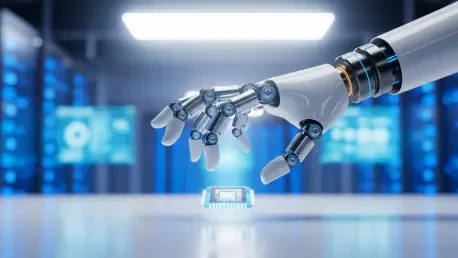

The complex challenge of teaching robotic systems to manipulate delicate objects with human-like precision has long required thousands of hours of manual programming and human-guided simulation data. In the current landscape of autonomous systems, the emergence of ENPIRE marks a significant shift away from these labor-intensive methods by utilizing advanced AI agents to oversee the entire training pipeline. These agents function as intelligent instructors, dynamically adjusting parameters and reward functions to ensure that robotic hands learn complex grip patterns without the need for constant oversight. This architectural shift addresses the bottleneck of dexterity, which has historically trailed behind locomotion and vision in the field of robotics. By 2026, the integration of such automated frameworks has become a standard for manufacturers seeking to deploy versatile robotic fleets capable of handling intricate assembly tasks. This evolution effectively removes the human programmer from the low-level loop, allowing them to focus on high-level tasks.
Algorithmic Innovation: The Path to Precision Coordination
ENPIRE introduces a robust mechanism for policy iteration that significantly reduces the computational overhead typically associated with deep reinforcement learning in high-dimensional spaces. Traditional training often required massive server farms to simulate millions of grasping attempts, many of which were redundant or failed to provide meaningful data for the model to learn from effectively. However, the use of specialized AI agents allows the system to identify high-value training scenarios, focusing the simulation efforts on the most challenging edge cases rather than repetitive basic tasks. This targeted approach ensures that the robotic model develops a generalized understanding of physical interactions, such as friction and weight distribution, much faster than previous iterations. The efficiency of this neural policy iteration means that developers can now train a dexterous robot for a new task in a matter of days rather than weeks, opening the door for rapid prototyping in various industrial sectors that rely on high-precision mechanical movements.
Beyond mere speed, the technical sophistication of ENPIRE lies in its ability to manage multi-fingered coordination through a decentralized yet synchronized learning architecture. Each finger or joint can be treated as a sub-component of a larger policy, allowing the AI agent to optimize individual movements while maintaining the overall stability of the hand’s grip. This hierarchical reinforcement learning model prevents the system from becoming overwhelmed by the degrees of freedom inherent in dexterous hardware, which often include over twenty individual actuators working in concert. As the agent navigates through the training environment, it utilizes a curiosity-driven exploration strategy, prompting the robot to try unconventional solutions that a human programmer might not have considered. This leads to the discovery of highly efficient manipulation techniques that maximize the utility of the hardware. The result is a more resilient robotic control system that can adapt to unexpected changes in an object’s center of gravity or surface texture.
Industrial Integration: Scaling Dexterity Through Digital Environments
One of the most persistent hurdles in robotics has been the simulation-to-reality gap, where a model that performs flawlessly in a virtual environment fails when confronted with the unpredictability of the physical world. ENPIRE addresses this by incorporating domain randomization and real-time sensor fusion into the agent’s training cycle, ensuring that the robotic policy is conditioned to handle noise and physical inaccuracies. The AI agents simulate a vast array of environmental conditions, ranging from varying lighting to fluctuating hydraulic pressures, forcing the robot to develop a robust control scheme that does not rely on perfect conditions. In high-stakes environments like microelectronics manufacturing or pharmaceutical laboratory automation, this reliability is non-negotiable. Companies have begun implementing these trained agents to manage assembly lines where components are too small or too fragile for traditional vacuum-based grippers. This success highlights how automated training frameworks provide a scalable solution for organizations globally.
Organizations that successfully navigated this technological shift prioritized the creation of high-fidelity digital twins to serve as the training grounds for their ENPIRE-driven agents. These digital environments provided the necessary data density to feed the hungry neural networks, ensuring that every edge case was explored before a single physical motor was activated. Decision-makers invested heavily in standardized data formats to ensure that the insights gained during the training of one robotic hand were applicable to other models in their fleet. This collaborative approach to data management helped break down silos between different departments, fostering an ecosystem where hardware limitations were mitigated by algorithmic intelligence. By adopting a proactive stance toward these automated training frameworks, the industry moved away from the trial-and-error methods of the past. The focus shifted toward fine-tuning the reward structures that guided the AI agents, ensuring that the final robotic behavior aligned with safety standards.