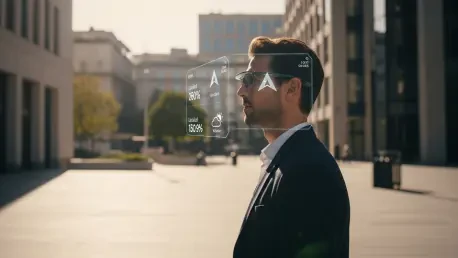

Walking through any major urban center today reveals a landscape where the traditional smartphone is no longer the sole arbiter of our digital interactions and experiences. The evolution of augmented reality from clunky, experimental prototypes into sleek, everyday eyewear has reached a critical tipping point in 2026, marking a significant departure from the era of distracted, downward-looking screen usage. This technological shift relies on the seamless integration of digital layers into the physical world, allowing users to maintain eye contact and environmental presence while accessing real-time data. Manufacturers have finally moved beyond the constraints of limited field-of-view and excessive weight, delivering devices that resemble high-fashion spectacles rather than bulky industrial equipment. This progression indicates that the digital interface is migrating from the palm of the hand to the bridge of the nose, signaling a profound change in how information is consumed and perceived in a spatial context for many users.
Optical Advancements: The Path to Visual Comfort
The primary hurdle to widespread adoption has always been the visual quality of the digital overlays, which often suffered from low brightness or a ghost-like transparency. Recent advancements in holographic waveguides and MicroLED display technologies have successfully addressed these limitations, providing vibrant and opaque graphics that remain visible even under direct sunlight. These optical engines are now small enough to fit within the temples of standard-sized frames, eliminating the need for the oversized visors that once characterized the augmented reality landscape. Companies are increasingly moving toward localized dimming layers within the lenses, which allow digital objects to cast realistic shadows and maintain a sense of physical weight in the user’s environment. This level of visual fidelity is essential for creating a convincing daily interface, as it prevents the cognitive dissonance that occurs when digital elements feel disconnected from reality.
Thermal management and power consumption represent the other half of the hardware equation, as the intense processing required for spatial mapping generates significant heat. In response, the industry has shifted toward a distributed computing model where the heavy computational lifting is offloaded to a nearby smartphone or a dedicated wearable puck via ultra-low latency wireless protocols. This architectural decision allows the glasses themselves to remain cool and lightweight, ensuring they can be worn for extended periods without discomfort or the need for frequent recharging. High-density solid-state batteries have also started to replace traditional lithium-ion cells, offering higher energy capacity in a smaller footprint while improving safety and longevity. These power solutions, combined with energy-efficient spatial sensing chips, mean that the current generation of devices can now last through a full workday of intermittent use.
Strategic Implementation: Privacy and the Path Forward
Beyond the physical hardware, the success of a daily augmented reality interface depends heavily on software that can intelligently interpret the surrounding environment. Modern spatial operating systems utilize advanced computer vision algorithms to perform semantic labeling, which allows the device to recognize specific objects and understand their functional context. For example, a pair of AR glasses can now identify a kitchen appliance and automatically display a digital manual or timer overlay based on the user’s intent. This level of environmental awareness is powered by compact neural processing units that handle sensor fusion from multiple cameras and depth sensors in real-time. This allows the digital interface to be pinned to specific physical locations, ensuring that a virtual calendar remains on a specific wall or a digital notepad stays on a desk regardless of the user’s movement. This persistence of digital content is the foundation of a reliable spatial interface and everyday user utility.
The successful adoption of this interface ultimately depended on the industry’s commitment to prioritizing user agency and data sovereignty during the initial rollout phases. Privacy frameworks were established to ensure that cameras and sensors operated under strict local processing rules, which mitigated many of the early societal anxieties regarding constant surveillance. Developers focused on creating open standards that allowed for cross-platform functionality, ensuring that digital assets could be moved between different hardware ecosystems without loss of fidelity. To maintain this momentum, stakeholders were encouraged to implement transparent data policies and provide users with granular control over their digital footprints in the physical world. By addressing these foundational challenges, the technology sector transformed a conceptual novelty into a reliable and indispensable component of the modern information landscape for all participants.