



Oscar Vail has spent years tracking the bleeding edge of hardware, from the intricate mechanics of robotics to the high-stakes world of consumer electronics. As we stand on the cusp of a new era in mobile displays, he joins us to break down the material science that is making foldable devices thinner and more resilient than ever before. This conversation explores how titanium alloys and innovative micro-patterning are solving the industry’s oldest problems, such as the persistent display crease and long-term durability. We dive into the engineering feats behind the latest hinge designs and what these advancements mean for the upcoming generation of mobile devices.
The latest hinge designs have become significantly thinner and lighter compared to previous generations. What specific engineering breakthroughs allowed for such a drastic reduction in size without compromising the device’s structural integrity?
The evolution we are seeing is truly a masterclass in iterative engineering, particularly when you look at how the third generation of the Armor FlexHinge managed to be 27% thinner and 43% lighter than its predecessor. This wasn’t achieved through a single “eureka” moment but by meticulously removing air gaps between the display and the supporting plates to create a much tighter, more cohesive bond. By utilizing a new titanium alloy film that is roughly one-third the thickness of a human hair, engineers have replaced bulkier polymer films with something that is 20 times stiffer. This allows the internal architecture to remain incredibly rigid under pressure while occupying a fraction of the physical space. When you hold these devices, you can feel the results of seven generations of refined knowledge, resulting in a hinge that feels like a solid, singular piece of metal rather than a collection of moving parts.
Working with titanium is notoriously difficult due to its strength and weight characteristics. How has the integration of titanium-based layers changed the way these displays handle the physical stress of being opened and closed hundreds of thousands of times?
Titanium is the ideal candidate for foldables because it offers a high strength-to-weight ratio, but shaping it into a flexible component was a massive hurdle for the development teams. The secret lies in the flexible titanium plate that sits beneath the OLED panel, which now features sophisticated micro-patterned holes in the folding section. These tiny, precision-engineered perforations allow the metal to flex like a fabric while maintaining the robust durability required to survive the wear and tear of a daily driver. Because the titanium alloy film is so much stiffer than older materials, it provides a stable foundation that minimizes the internal shifting that usually causes the dreaded screen crease. It’s a sensory upgrade as much as a mechanical one, as the display maintains a flatter, more uniform surface that resists the external shocks of modern life.
With the upcoming event teased under the tagline “A New Shape Unfolds,” there is a lot of speculation about a new form factor. Based on the technical shift toward these new materials, what can we expect from this wide, book-style foldable?
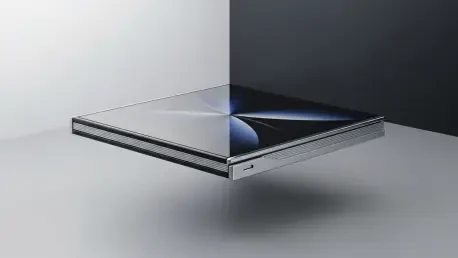
The shift toward Flex Titanium technology suggests that the industry is ready to move beyond the standard “phone-to-tablet” transition and explore something entirely new. This wide book-style foldable, which many suspect will sit somewhere between the existing flip and fold designs, will likely leverage these thinner components to keep the device pocketable despite a larger footprint. By combining high-resolution display architecture with new organic materials that maximize power efficiency, this new shape can afford to be more ambitious with its screen real estate. We are looking at a device that doesn’t just fold, but provides a more refined viewing experience that feels as sturdy as a traditional laptop despite its slim profile. The goal is clearly to create a seamless, gapless design that makes the hinge invisible to the user’s eye and touch.
What is your forecast for the future of foldable technology?
I believe we are entering a phase where the “novelty” of the fold will be replaced by a standard of extreme durability and invisible integration. Within the next few years, the use of titanium and micro-patterned structures will likely become the industry standard, allowing devices to become even slimmer than the current 27% reduction we’ve seen. As these materials become more common, we will see foldables that are indistinguishable from standard smartphones in terms of thickness, yet offer the expansive utility of a tablet. The real breakthrough will be when these organic materials and metal alloys reach a point where the screen crease is completely eliminated, making the foldable display the primary choice for every consumer level. We are witnessing the birth of a “no-compromise” era where your device’s shape is limited only by your imagination, not by the fragility of the glass or the bulk of the hinge.







