
Oscar Vail is a seasoned technology expert at the forefront of the industry’s most ambitious hardware shifts, from the complexities of quantum computing to the intricate world of semiconductor engineering. With a career dedicated to deconstructing emerging technologies, he brings a sharp analytical perspective to the recent breakthroughs in display density showcased at events like Display Week. In this conversation, we explore how packing thousands of pixels into centimeter-scale chips is finally bridging the gap between bulky prototypes and the sleek, daily-wear reality of eXtended Reality.
Developing a 0.28-inch display with 5,131 pixels per inch requires extreme precision. What are the primary engineering hurdles when building a single-chip Micro LED on a silicon substrate, and how does this density specifically improve the clarity of information overlays for users wearing lightweight smart glasses?
Building a single-chip full-color Si-Micro LED at this scale is essentially a feat of semiconductor miniaturization, where the primary hurdle is moving beyond the organic limitations of traditional OLEDs to pack non-organic LEDs tightly enough to reach that 5,131ppi mark. When you are dealing with a resolution of 1,280 x 720px on a surface smaller than a fingernail, the manufacturing tolerance for error becomes microscopic, requiring a perfect marriage between the silicon substrate and the light-emitting layer. For the user, this extreme density eliminates the “screen door effect” entirely, allowing text and navigation markers to appear as solid, crisp objects floating in the real world rather than pixelated ghosts. Because the display is a 0.28-inch single chip, it allows the glasses to remain lightweight and unobtrusive while delivering a full-color overlay that remains sharp even under varying ambient light conditions.
The shift toward 2.24-inch G-OLED displays offers 1,700ppi and a 120Hz refresh rate. Could you explain the technical advantages of using a glass substrate for “Real RGB” panels, and what specific metrics demonstrate how microsecond response times reduce motion blur during intense XR experiences?
Using a glass substrate, or G-OLED, provides a stable and ultra-smooth foundation that is essential for achieving a “Real RGB” layout, which avoids the sub-pixel compromises often seen in standard OLED masks. By utilizing a 2.24-inch panel with a 1,700ppi density, we are looking at a massive resolution of 2,600 x 2,784px that provides stunning clarity for immersive VR environments. The microsecond response times are the secret sauce here; unlike traditional displays that may lag in the millisecond range, these panels switch states almost instantly, which is vital when you are moving your head rapidly at a 120Hz refresh rate. This nearly instantaneous pixel transition ensures that the image remains rock-solid and smear-free, which is the primary technical requirement for preventing motion sickness in high-fidelity XR.
While Micro LED and OLED are emissive technologies, LCD panels are now reaching densities as high as 2,200ppi for XR applications. What are the cost-to-performance trade-offs between these different display types, and how do their power consumption levels vary when integrated into high-resolution cockpit environments?
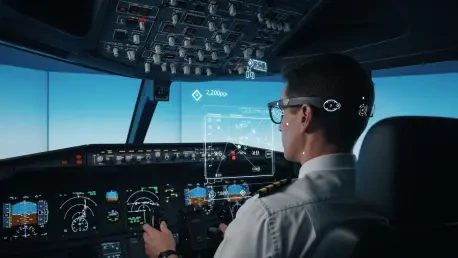
The 2,200ppi LCD panel is a fascinating outlier because it pushes traditional liquid crystal technology to its absolute limit to compete with the 1,512ppi cockpit displays used in advanced simulators. In a cockpit environment, the trade-off is often between the deep, infinite contrast of an emissive Micro LED and the high-brightness, cost-effective scalability of these ultra-dense LCDs. While Micro LED is the gold standard for power efficiency—since each pixel emits its own light and uses zero power for black levels—LCDs still require a backlight, which can be a power drain in high-resolution settings. However, for specialized XR cockpit applications where sustained high-brightness and a specific 3.59-inch form factor are required, the mature manufacturing pipeline of LCD provides a performance-per-dollar ratio that emissive tech is still struggling to match at those higher pixel counts.
High-resolution XR displays often face heat dissipation and battery life issues. When packing over 5,000 pixels into such a small footprint, what step-by-step cooling strategies are necessary, and how do these advancements in pixel density change the manufacturing workflow for next-generation wearable devices?
Packing over 5,000 pixels into a 0.28-inch footprint creates a massive concentration of energy in a tiny area, necessitating a thermal strategy that starts at the silicon substrate level to pull heat away from the Micro LED junctions. First, engineers must optimize the drive circuitry within the single-chip design to reduce parasitic power loss, followed by using the frame of the smart glasses themselves as a passive heat sink to dissipate the thermal load. This density forces a radical change in manufacturing; we are moving away from traditional display assembly and toward a semiconductor-first workflow where the display is treated more like a processor than a screen. This shift allows for more compact internal architectures, enabling the design of wearable devices that look like standard eyewear rather than heavy, heat-venting goggles.
What is your forecast for XR display technology?
I believe we are entering an era where the “display” as a separate component vanishes, replaced by integrated silicon-photonic chips that merge logic and light emission into a single piece of hardware. Within the next few years, the 5,131ppi density we see today will become the baseline, allowing for true “retina” resolution AR where digital objects are indistinguishable from physical ones. We will see a consolidation where Micro LED becomes the dominant architecture for outdoor, high-brightness wearables, while G-OLED refines the high-end immersive VR market with its superior color reproduction. Ultimately, the success of this field will depend on our ability to maintain these 120Hz refresh rates and microsecond response times while shrinking the entire optical engine to a size that fits comfortably on the bridge of a user’s nose.