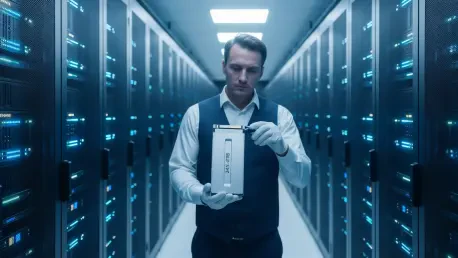

The relentless expansion of artificial intelligence is currently colliding with the hard physical limits of power grids and real estate across the globe, forcing a radical rethink of infrastructure. The commercial release of the Micron 6600 ION signals a significant turning point, as it provides a robust answer to the soaring data requirements of modern hyperscalers and enterprise entities. This 245TB solid-state drive is currently the largest capacity drive of its kind, offering a path forward for facilities that are literally running out of room to expand their traditional storage arrays. By utilizing standard form factors like U.2 and E3.L, Micron ensures that this massive leap in capacity does not require a complete redesign of existing server chassis. This technological development comes as traditional hard disk drives reach their functional limits, unable to keep pace with the high-concurrency demands of next-generation AI data lakes and cloud-scale object storage solutions today.
Scaling Capacity and Density
Section 1: The Foundation of G9 QLC NAND
At the core of this massive capacity is the G9 Quad-Level Cell NAND technology, which represents a leap in engineering that is at least one generation ahead of current industry competitors. By packing an unprecedented number of bits into every single memory cell, the design pushes the boundaries of what is possible within a single drive, effectively achieving a quarter-petabyte scale in a compact device. This high bit density is exactly what enables modern data centers to store and process enormous datasets within a significantly smaller physical footprint than was previously considered achievable with conventional NAND. The innovation here lies in the stability and reliability of the cells even at this density, ensuring that data integrity remains uncompromised during intensive read and write cycles. As organizations transition away from mechanical storage, this specific technology provides the necessary foundation for managing the massive influx of unstructured data generated by AI.
Section 2: Implementation of High Bit Density
Achieving a quarter-petabyte scale in a single device fundamentally changes the architecture of modern storage clusters by allowing for much higher levels of data consolidation. This shift is critical because the sheer volume of information being generated by autonomous systems and large language models requires a level of density that older NAND generations simply could not support without massive physical expansion. By maximizing the usable capacity per unit of volume, the 6600 ION allows engineers to design systems that are more responsive and less prone to the mechanical failures associated with traditional spinning disks. Moreover, the integration of high-density QLC memory ensures that the cost per gigabyte remains competitive, making it a viable alternative for bulk storage that was previously the sole domain of hard drives. This marks the beginning of an era where high-speed flash memory becomes the standard for all levels of the data hierarchy, rather than just the performance tier.
Section 3: Revolutionary Rack-Scale Efficiency
One of the most immediate benefits of this high-capacity storage is the profound impact it has on the physical space requirements within a standard enterprise data center. Utilizing these 245TB drives allows operators to use roughly 82% fewer racks to reach the same raw storage capacity as traditional hard drive deployments, which is a staggering reduction in infrastructure. In a standard 36U rack, these solid-state drives can house nearly 177 petabytes of data, representing a density that is more than five times higher than a similar setup using the latest high-capacity mechanical drives. This consolidation is not just a matter of convenience; it is a necessity for metropolitan data centers where expansion is physically impossible due to land constraints. By packing more data into fewer cabinets, operators can significantly increase the total storage potential of their existing facilities without having to break ground on new construction or invest in expensive new real estate.
Section 4: Impacts on Physical Footprint
The reduction in physical footprint translates directly into operational agility, as fewer racks mean less cabling, fewer networking ports, and simplified maintenance schedules for the hardware teams. When a single rack can do the work of five, the complexity of the internal network fabric is drastically reduced, allowing for higher reliability and easier troubleshooting when issues inevitably arise. This shift toward high-density storage also enables a more efficient distribution of weight and cooling resources within the data center floor, preventing the “hot spots” that often plague densely packed mechanical arrays. Furthermore, the ability to store nearly 177 petabytes in a single cabinet allows companies to scale their data lakes much faster than they could if they were tethered to the slower rollout of traditional rack expansions. This move toward ultra-density is effectively future-proofing the infrastructure against the exponential growth of datasets that will define the rest of this decade.
Performance Gains in High-Speed Environments
Section 5: Accelerating Artificial Intelligence Pipelines
Switching to the 6600 ION is about more than just saving space; it also provides a massive boost in processing power for the specific tasks required by modern machine learning. Testing indicates that these drives can speed up AI preprocessing tasks by more than eight times, while simultaneously providing significantly better ingest throughput for the massive data streams used in training. Perhaps the most important metric is the reduction in latency, which can be up to 29 times lower than that of mechanical alternatives, allowing data pipelines to move information much faster. This performance jump is essential for reducing the time it takes to train complex models, as any delay in data delivery can leave expensive GPU clusters idling while they wait for the next batch of information. By removing the storage bottleneck, researchers can iterate on their models more frequently, leading to faster breakthroughs and more accurate results in fields ranging from natural language processing to computer vision.
Section 6: Redefining Efficiency for Object Storage
Efficiency becomes even more apparent when evaluating object storage workloads, where the drive demonstrates nearly 60 times better aggregate throughput than traditional alternatives. For companies managing massive amounts of unstructured data, the time it takes to access the first byte of information is nearly 100 times faster, which is a transformative improvement for real-time applications. This translates to an incredible increase in throughput per watt, making it one of the most efficient ways to handle large-scale data storage in the modern era of high-speed computing. The high concurrency support of the drive ensures that multiple users or processes can access data simultaneously without the performance degradation typically seen in high-density mechanical systems. This makes the technology ideal for cloud-scale object storage where millions of small files must be served to global audiences with minimal delay, providing a consistent user experience regardless of the total load on the system hardware.
The Sustainable Future of Data Centers
Section 7: Reducing Energy Consumption and Carbon Emissions
Energy consumption remains one of the most pressing issues for the global technology industry, and the 6600 ION addresses this by operating at a maximum of just 30 watts per drive. On a large scale, replacing mechanical drives with these solid-state units can save nearly 1,000 megawatt-hours of energy per year for every exabyte of storage deployed within the facility. This massive reduction in power usage directly lowers the carbon emissions of the data center by hundreds of metric tons annually, helping organizations meet their increasingly strict environmental targets. Furthermore, the lower heat output of these drives significantly cuts down on the cooling costs needed to keep hardware from overheating, creating a secondary wave of energy savings across the entire facility. In an era where power availability is a major constraint, moving to a storage solution that uses roughly half the power of a comparable hard drive setup is a critical step toward ensuring long-term operational sustainability.
Section 8: Navigating the New Economics of Storage
Industry experts are witnessing a major shift in how companies calculate the cost of storage, moving away from the purchase price of individual drives toward the total cost of the rack. As AI datasets grow at an exponential rate, the ability to pack more usable capacity into a single rack becomes the primary way to lower long-term expenses and improve the return on investment. This shift helps reduce the operational overhead associated with floor space, cooling, and power, which are becoming increasingly scarce and expensive resources for hyperscalers and enterprises alike. By focusing on the total cost of ownership over the lifecycle of the hardware, it becomes clear that the higher initial investment in high-density SSDs is offset by the massive savings in infrastructure and energy. This economic reality is driving the rapid adoption of quarter-petabyte drives as organizations realize that the cost of maintaining obsolete mechanical systems is far higher than the cost of upgrading to modern flash.
Section 9: Overcoming the Power Availability Bottleneck
The strategic implementation of high-density storage proved to be a critical maneuver for organizations that were previously facing a hard ceiling on their power availability. By integrating the 6600 ION, engineers successfully bypassed the traditional constraints of physical rack space and electrical overhead that once threatened to stall the momentum of generative AI development. This shift in hardware strategy allowed data center operators to prioritize sustainable growth without sacrificing the raw performance necessary for complex model training and real-time inference. It became evident that the transition toward quarter-petabyte units offered the most viable pathway for maintaining operational continuity in an increasingly power-constrained world. For those looking to the next phase of infrastructure evolution, the focus shifted toward maximizing the value of every existing rack through similar high-efficiency hardware upgrades. This proactive approach ensured that computational power remained scalable even as external resources became scarce across the industrial landscape.