
Building a scalable quantum computer requires a holistic system where CPUs, GPUs, and FPGAs work together to handle the housekeeping tasks that keep quantum processors functional. This realization sits at the heart of a transformative alliance between AMD, IBM, and Oak Ridge National Laboratory. By establishing a dedicated codesign platform, these entities are moving beyond the era of isolated quantum experiments to create a unified computing architecture. The initiative addresses the fundamental challenge of quantum advantage by colocating IBM’s advanced superconducting qubits with the massive classical power of AMD-driven supercomputers at ORNL. This synergy is designed to facilitate the real-time interaction necessary for complex scientific discovery, ensuring that the quantum processing unit is not a standalone curiosity but an integrated component of a broader high-performance computing environment. This shift from theoretical exploration to systems engineering is essential for solving intractable problems in chemistry and physics. It establishes a roadmap for practical utility by 2028.
Bridging the Divide: The Role of Integrated Hardware
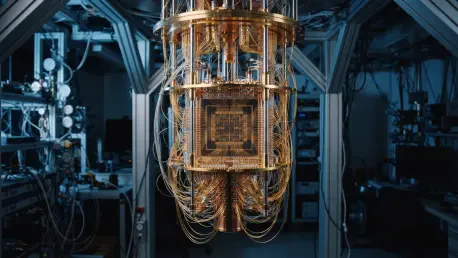
At the core of this infrastructure lies the IBM Quantum Nighthawk, a 120-qubit processor representing the current state of superconducting technology. However, the quantum processor does not operate in isolation; it is tethered to the Umbra high-performance computing system at Oak Ridge. Umbra utilizes 5th Gen AMD EPYC CPUs and AMD Instinct MI355X GPUs to provide the necessary computational muscle for managing quantum data streams. This hardware arrangement allows for a level of parallel processing that was previously unattainable, enabling researchers to run massive scientific simulations alongside quantum workloads. The integration of these disparate technologies creates a feedback loop where classical systems manage the calibration and environment of the quantum bits. By utilizing AMD’s latest silicon innovations, the partnership ensures that the classical backbone is fast enough to keep pace with the volatile nature of quantum states. This is a crucial step in building a machine that can actually perform useful work.
This collaborative project serves as a cornerstone for the Department of Energy’s Quantum Genesis Mission, an ambitious multi-year strategy aimed at delivering a scientifically relevant quantum computer by 2028. The mission recognizes that reaching this goal requires more than just increasing qubit counts; it necessitates a complete rethink of how data moves between quantum and classical domains. By testing these hybrid configurations today, researchers at ORNL are identifying the bottlenecks that could impede future scaling. The use of the AMD Instinct platform provides a unique advantage in this regard, as its memory bandwidth and throughput are optimized for the heavy lifting required in AI and scientific computing. As the mission progresses from 2026 to 2028, the codesign platform will evolve to incorporate even more advanced classical nodes. This iterative process ensures that when the quantum hardware reaches its full potential, the surrounding infrastructure will be mature enough to support high-fidelity research and industrial-scale applications.
Navigating the Complexity: Error Correction and Software Openness
Quantum error correction remains the most daunting technical hurdle in the path toward widespread adoption. Because qubits are notoriously fragile and susceptible to noise from their surroundings, they require constant monitoring to ensure the accuracy of calculations. This process involves a high-speed classical control loop that must identify and correct errors in a matter of microseconds. AMD’s Versal adaptive SoCs play a vital role here, offering the low-latency processing needed to decode quantum errors near the processor itself. By offloading these housekeeping tasks to specialized classical hardware, the system preserves the integrity of the quantum state without slowing down the overall computation. This architecture allows for a more resilient system that can withstand external interference, which is a prerequisite for moving beyond small-scale proofs of concept. The ability to perform real-time error correction at scale will ultimately determine whether quantum systems can solve the complex equations found in modern materials science and pharmaceutical development.
Software integration is equally critical in this hybrid environment, and the use of the ROCm open software ecosystem provides a standardized platform for developers. ROCm allows researchers to bridge the gap between AI, traditional high-performance computing, and quantum algorithms through a unified interface. This openness is essential for the scientific community, as it prevents the fragmentation that often plagues emerging technologies. By providing a common set of tools, AMD ensures that code written for classical supercomputers can interact seamlessly with quantum instructions. This flexibility encourages broader experimentation across different research institutions and private industries. Furthermore, the ability to orchestrate complex workflows across CPUs, GPUs, and QPUs minimizes the time researchers spend on manual configuration and maximizes the time spent on actual discovery. As the platform matures, this software-defined approach will likely become the industry standard for managing hybrid quantum-classical clusters, fostering an ecosystem where innovation is driven by collaboration.
To capitalize on these advancements, researchers and industry leaders looked to standardize the integration of heterogeneous hardware to ensure future compatibility. The partnership between AMD, IBM, and ORNL demonstrated that a holistic architectural approach was the only viable path toward a functional quantum future. Moving forward, the focus shifted toward refining the latency of error-correction loops and expanding the library of quantum-ready scientific applications. Organizations seeking to participate in this evolution should prioritize the adoption of open-source software frameworks like ROCm to facilitate cross-platform development. By establishing these foundational structures between 2026 and 2028, the partners successfully prepared the scientific community for the arrival of fault-tolerant quantum systems. The next phase involved deploying these hybrid systems in diverse sectors, ensuring that the benefits of quantum acceleration reached beyond the laboratory. This strategic alignment transformed quantum computing from an experimental pursuit into a reliable pillar of modern high-performance computing.