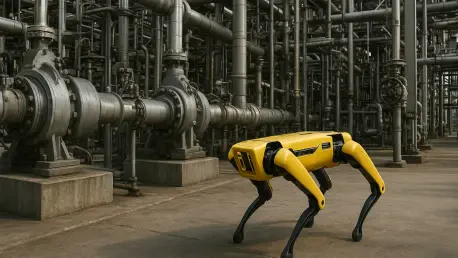

Orbit software now supports the direct importation of asset hierarchies from enterprise management systems to align robotic data with existing maintenance workflows. This development represents a monumental shift in how industrial facilities perceive and utilize autonomous quadrupeds. Rather than treating the robot as a standalone gadget that follows a hard-coded path, the latest 5.2 software update transforms Spot into a sophisticated physical agent capable of deep integration with the enterprise IT stack. This change arrives at a time when industrial environments are increasingly saturated with data, yet often lack the physical mobility required to verify digital insights. By bridging the gap between high-level AI models and the mechanical reality of the factory floor, Boston Dynamics has enabled a ecosystem where robots do not just observe, but actively participate in the operational logic of the site. The quadruped now acts as a dynamic link, ensuring that the wealth of digital information generated by various sensors is translated into tangible, real-world actions.
Redesigning Orbit: The Shift to Asset-Centric Management
The transition from mission-based logic to an asset-centric architecture marks a significant turning point for the Orbit fleet management platform. Historically, robotic deployments were defined by the routes they traveled, forcing maintenance teams to adapt their workflows to the robot’s navigation capabilities. With the new update, the software hierarchy now mirrors the actual physical organization of industrial plants, focusing on critical equipment such as pumps, motors, and transformers. This allows for a more intuitive categorization of data, where every reading or image captured is automatically tagged to a specific asset within the facility’s registry. By aligning robotic operations with the existing organizational structure of the plant, the system removes the friction traditionally associated with integrating mobile robotics into established industrial environments. This approach ensures that data collection is not a secondary activity but a core component of the facility’s overarching maintenance strategy, improving accuracy.
Furthermore, the ability to filter and distribute alerts based on the criticality or type of asset significantly improves the response time of maintenance teams. When Spot identifies a potential issue, the information is no longer just a generic notification; it is a prioritized data point that can be routed directly to the specialist responsible for that specific class of machinery. For example, a vibration anomaly on a high-pressure pump can be flagged immediately for the hydraulic engineer, while a thermal spike on an electrical transformer is escalated to the power systems team. This level of granular control is made possible by the seamless integration with existing Computerized Maintenance Management Systems and Enterprise Asset Management platforms. By ensuring that the right information reaches the right person at the exact moment it is needed, the system reduces the cognitive load on plant managers. This streamlined communication loop between the robot and the staff facilitates a proactive maintenance culture, where minor issues are addressed early.
Autonomous Response: Integrating AI Agents with Industrial Sensors
The introduction of the Model Context Protocol layer within the Orbit API has fundamentally changed the relationship between mobile robots and fixed industrial infrastructure. Spot is no longer confined to a rigid, pre-programmed schedule that requires manual initiation or simple time-based triggers. Instead, the robot now functions as a reactive intelligence, capable of responding to real-time signals from a vast array of external sources, including programmable logic controllers and dedicated security systems. This capability creates a synergistic environment where fixed sensors act as the eyes and ears of the facility, while Spot provides the mobile hands and presence needed to investigate anomalies. For instance, if a stationary acoustic sensor detects an unusual sound signature in a remote corner of the warehouse, it can automatically dispatch the robot to that exact location. This removes the need for human operators to manually intervene for every alarm, allowing the robot to perform the initial assessment and provide high-fidelity visual confirmation.
This autonomous dispatch capability extends beyond simple maintenance tasks and into the realm of comprehensive site security and safety management. By integrating with existing CCTV systems and motion detectors, Spot can be programmed to investigate unauthorized activity or safety breaches the moment they are detected. When a third-party security camera identifies movement in a restricted area during off-hours, the enterprise management system can immediately route the quadruped to the scene. The robot can then utilize its onboard sensors to provide a live 360-degree stream of the situation, allowing remote security personnel to assess the risk without putting themselves in potential danger. This transformation of the robot into a site-wide guardian demonstrates the power of the AI agent model, where robotic action is dictated by the actual needs of the business environment. The ability to close the loop between a digital alert and a physical investigation ensures that no anomaly goes unverified, significantly enhancing the overall resilience and safety of the industrial site.
Visual Intelligence: Advanced Monitoring and Predictive Sensing
The integration of Google Gemini-powered visual intelligence has bestowed Spot with a level of situational awareness that was previously unattainable in industrial robotics. The new Artificial Intelligence Visual Inspection system allows the robot to interpret its environment with a degree of nuance that goes far beyond simple pattern recognition. It can now read and analyze analog gauges, interpret the status of complex 5S boards, and monitor sight glasses with high precision. This leap in capability means the robot can navigate the analog gaps that still exist in many modern facilities where digital sensors have not yet been installed. By leveraging large language and vision models trained on specific industrial datasets, Spot can understand the context of what it sees, recognizing not just that a valve is in a certain position, but whether that position is appropriate for the current operational state of the machine. This contextual understanding is vital for performing high-stakes inspections where accuracy is vital for the facility.
The implementation of these autonomous sensors and video learning models marked a shift in industrial philosophy. By moving toward a model of continuous verification, facilities moved away from the risks of manual oversight and toward a more reliable, data-driven framework. Spot’s ability to detect dynamic hazards like fluid leaks or conveyor slippage demonstrated that visual AI had finally matured into a practical tool for real-world environments. Moving forward, organizations should prioritize the standardization of their asset metadata to ensure that robotic agents can seamlessly navigate these complex digital and physical landscapes. By investing in integrated robotic ecosystems today, companies established a foundation for future advancements in automation and predictive maintenance. This proactive approach ensured that facilities remained efficient and safe, turning the vast quantities of industrial data into actionable physical results that drove long-term productivity for the modern enterprise.