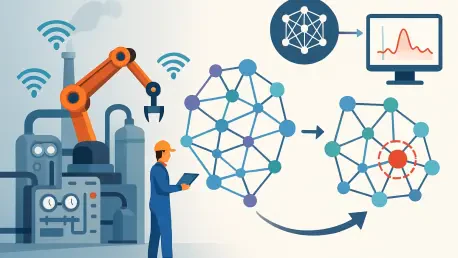

Modern manufacturing facilities face the critical challenge of detecting system failures when labeled anomaly data for training predictive models is exceedingly rare. This scarcity of annotated datasets creates a significant barrier for traditional supervised learning approaches, which require clear examples of both normal and abnormal operations to function effectively. In the complex ecosystem of the Industrial Internet of Things, or IIoT, thousands of interconnected sensors constantly stream multivariate time-series data. While this abundance of information offers a wealth of potential insights, the sheer volume and complexity make manual labeling practically impossible for human operators. Moreover, many existing anomaly detection frameworks struggle to interpret the subtle, nonlinear relationships that exist between different physical components within a cyber-physical system. Without a way to accurately model these spatial dependencies alongside temporal trends, industrial facilities remain vulnerable to undetected failures or overwhelmed by the noise of frequent false alarms.
Innovative Hybrid Graph Construction Techniques
A foundational innovation of the GraphContrast-IoT framework is its sophisticated approach to modeling sensor relationships through a specialized hybrid adjacency matrix. Most historical models in this domain suffered from a binary limitation: they either ignored the physical layout of the manufacturing facility entirely or relied solely on statistical correlations that can be incredibly volatile under shifting operational loads. By contrast, the hybrid model integrates the physical topology of the system—representing the hardwired connections and geographic proximity of sensors—with learned statistical dependencies. This ensures that the model understands that a pressure sensor on a specific pipe is naturally linked to a flow meter further down the same line. By anchoring statistical patterns in the physical reality of the hardware, the framework creates a more stable and reliable representation of the entire industrial environment, which is essential for identifying when a specific subsystem begins to drift away from its designed parameters.
Furthermore, this hybrid graph is estimated exclusively from normal training data and remains static during both the training and inference phases. This architectural decision was made to address the heavy computational burden that typically plagues dynamic graph neural networks, which often try to recompute relationships in real time. By fixing the graph structure once the baseline of “normalcy” is established, the researchers eliminated significant overhead, allowing the system to focus its processing power on analyzing incoming sensor observations. This consistency ensures stable message passing within the neural network, meaning that information about a potential fault can propagate through the graph in a predictable manner. The result is a grounded structural framework that does not fluctuate based on transient noise, providing a dependable foundation for detecting even the most subtle deviations in complex sensor networks across a factory floor.
Multi-View Contrastive Learning: Enhancing Robustness
Because industrial systems must operate without constant human supervision, GraphContrast-IoT utilizes a self-supervised learning strategy known as multi-view contrastive learning. This method allows the system to learn the inherent characteristics of “normal” behavior by comparing different versions of the same data window. During the training process, the framework takes an input of time-series data and transforms it into two distinct but semantically similar versions through stochastic perturbations. These transformations are not merely mathematical abstractions; they are specifically engineered to mimic real-world industrial disturbances, such as temporary communication dropouts or slight timing jitters in data transmission. By forcing the model to recognize that these varied views represent the same underlying operational state, the framework develops a deep and resilient understanding of what constitutes standard behavior, even when the data is partially obscured by environmental interference.
Building on this robustness, the framework incorporates graph-level augmentation by temporarily removing certain edges in the communication graph during the training cycle. This strategy compels the model to identify redundant pathways for information flow, ensuring that the detection system does not collapse if a single sensor fails or provides corrupted data. In a typical manufacturing setting, a sensor might go offline due to a hardware malfunction or a localized power issue; a model that relies too heavily on a single data stream would likely trigger a false alarm or miss a critical event. Through this contrastive approach, the system learns to triangulate the health of the entire operation using overlapping data points. This creates a high level of resistance to Gaussian noise and other common measurement errors, allowing the anomaly detection system to remain sharp and effective in “messy” data environments that would baffle less sophisticated algorithms.
Spatial and Temporal Fusion: The GCT-ADNet Engine
The technical core of this technology is the GCT-ADNet, an architecture that fuses Graph Convolutional Networks with Temporal Convolutional Networks to provide a three-dimensional view of industrial health. The spatial component, handled by the graph convolution layers, is responsible for monitoring how different sensors interact with one another across the network. This is particularly vital for identifying “contextual” anomalies—events where a single sensor reading might appear to be within a safe range when viewed in isolation but is clearly problematic when compared to the readings of its immediate neighbors. For instance, if a temperature sensor reports a stable value while all surrounding cooling sensors indicate a massive spike in heat, the spatial analysis can flag the discrepancy as a potential sensor failure or a localized thermal event that requires immediate investigation by maintenance teams.
Simultaneously, the temporal convolutional component of the engine tracks how sensor data evolves over varying timescales. Unlike older recurrent models that often struggle with long-term memory or training stability, this temporal approach captures both immediate fluctuations and gradual trends that might indicate wear and tear on a machine. The features extracted from these two distinct perspectives are then fused into a compact latent embedding space. Rather than relying on traditional reconstruction error—which can be misleading in noisy environments—the system calculates the Euclidean distance between a current data window’s position in this latent space and a predefined “normal” reference center. This provides a direct and mathematically rigorous measure of abnormality, as any data point that strays too far from the central cluster of normal operations is immediately flagged as a potential risk, simplifying the decision-making process for operators.
Deployment and Efficiency: Real-Time Edge Computing
One of the most significant advantages of the GraphContrast-IoT framework is its suitability for deployment on edge hardware, such as local industrial gateways or SCADA monitoring servers. In modern manufacturing, sending massive streams of raw data to a distant cloud server for processing is often impractical due to bandwidth costs and the inherent latency of long-distance data transmission. The framework addresses this by performing the computationally heavy tasks of graph construction and contrastive training offline. Once the model is deployed for active monitoring, it only requires a single forward pass through the encoder to generate an anomaly score. This streamlined architecture results in an inference latency of just a few milliseconds per sample, which is critical for safety-critical applications where a delay of even a few seconds could lead to catastrophic equipment failure or environmental hazards.
The efficiency of this approach is further evidenced by its minimal storage and memory requirements, making it accessible for facilities that may not have the budget for high-end server clusters. Testing revealed that the model could handle a throughput of nearly two hundred data windows per second while maintaining a storage footprint of just over ten megabytes. This high-speed processing allows for real-time monitoring of vast sensor arrays without slowing down the primary control systems of the factory. By operating at the edge, the system also improves cybersecurity by keeping sensitive operational data within the local network. This combination of speed, low resource consumption, and localized processing makes it an ideal solution for a wide range of industries, from water treatment plants to automated automotive assembly lines, where reliability and rapid response times are non-negotiable requirements.
How Can Systems Handle Missing Sensor Data?
The resilience of the GraphContrast-IoT framework is largely derived from its ability to maintain high detection accuracy even when a portion of the sensor network becomes unavailable. This is achieved through the integration of the hybrid graph and the contrastive training process, which together teach the model the underlying physics of the system. Because the model understands the redundant relationships between sensors, it can effectively “fill in the blanks” when a specific data stream is interrupted. If a flow meter stops transmitting, the model utilizes data from the surrounding pressure and temperature sensors to infer whether the system is still functioning within normal parameters. This prevents the entire monitoring framework from crashing due to a localized hardware issue, providing a layer of operational continuity that is often missing from simpler deep learning models.
In addition to handling missing data, the framework proved to be highly effective at generalizing across different industrial environments through zero-shot learning. During experimental phases, a model trained on one type of water treatment facility was able to maintain over ninety percent of its accuracy when applied to a completely different distribution system without any additional training. This suggests that the framework is not merely memorizing the specific patterns of a single dataset but is instead learning universal characteristics of industrial fluid dynamics and sensor behavior. For companies that are commissioning new plants or upgrading older facilities, this capability is invaluable. It allows for the immediate deployment of a high-quality anomaly detection system even before a large amount of site-specific historical data has been collected, significantly reducing the “warm-up” period required for modern digital twins and monitoring tools.
Strategic Evolution: Future Directions in Anomaly Detection
The researchers identified that the implementation of a fixed hybrid graph provided an excellent balance between accuracy and computational speed, though they noted that the system required periodic manual reviews during significant facility reconfigurations. They found that while the model resisted common noise, any physical changes to the factory floor—such as the installation of new machinery or the rerouting of pipelines—necessitated a brief retraining phase to update the spatial map. To address this, the team suggested that future iterations could incorporate a semi-adaptive graph learning mechanism. This proposed evolution would allow the network to slowly adjust its internal representation of the sensor hierarchy over time, effectively learning to account for the natural aging of equipment and minor structural changes without requiring a full system reset or extensive downtime for the facility.
The investigation also highlighted the importance of domain-aware augmentation policies, as the current study showed that the optimal amount of injected noise varied between different industries. They determined that while Gaussian noise was a perfect proxy for electronic interference in water treatment plants, more complex perturbation models might be needed for high-vibration environments like aerospace manufacturing. Consequently, the research paved the way for more specialized versions of the framework tailored to specific heavy industries. The researchers concluded that by making the underlying architecture open and scalable, they had provided a robust blueprint for the next generation of industrial cybersecurity. They recommended that organizations looking to improve their operational reliability should focus on integrating these self-supervised tools into their existing edge computing infrastructure to maximize both safety and economic efficiency.