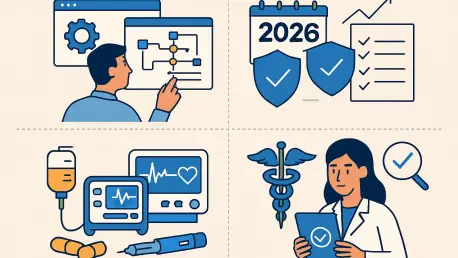

Software developers in the medical field face the constant challenge of generating a defensible product that survives the scrutiny of international regulatory audits. The medical device industry in 2026 is defined by a sophisticated intersection of rapid software innovation and rigorous regulatory oversight. Application Lifecycle Management (ALM) has shifted from simple project tracking to serving as a specialized ecosystem that ensures safety while accelerating time-to-market. Modern development teams no longer view compliance as a final hurdle but as a functional requirement woven into every stage of the lifecycle. By automating documentation and traceability, these tools allow engineers to focus on technical excellence without sacrificing the defensibility of the final product. Regulatory frameworks have reached a new level of international harmonization, primarily driven by the FDA’s Quality Management System Regulation (QMSR), which aligns with ISO 13485. Developers must now navigate a complex landscape.
Specialized ALM Solutions for Industry Leaders
Matrix Req has solidified its position as a market leader by treating requirements, risks, and verification tests as a singular, unified structure. This philosophy ensures that any modification to a requirement automatically flags all associated risks and tests, eliminating the documentation gaps that lead to audit failures. Its ability to integrate seamlessly with standard developer tools like Jira and GitHub allows engineering teams to remain in their preferred environments while the ALM silently captures the data necessary for the Design History File. This balance of flexibility and rigor makes it a top choice for teams prioritizing both speed and accuracy. In the current market, this integration is not just a luxury but a necessity for maintaining a live traceability matrix that updates in real-time as code is committed. The seamless background operation reduces the cognitive load on developers, ensuring that compliance documentation becomes a natural byproduct of development.
For organizations seeking a comprehensive approach, Orcanos offers a “single pane of glass” that combines ALM functions with a Quality Management System (QMS). This integrated model is particularly effective for managing corrective actions (CAPA) and complaint handling alongside product development, providing a holistic view of the device lifecycle from conception to post-market surveillance. Meanwhile, Aligned Elements caters to those focused on design control management, offering automated consistency checks that act as a continuous internal audit. These tools ensure that design records stay synchronized in real-time, providing a specialized environment for high-stakes medical-grade risk analysis. By automating the cross-referencing of requirements and risk mitigation measures, these platforms prevent common pitfalls where a change in hardware specifications fails to trigger a necessary software update, maintaining the integrity of the technical file throughout the entire cycle.
Emerging Trends: Artificial Intelligence and Integration
The integration of Artificial Intelligence, such as “Matrix Mind,” has revolutionized how requirements and test cases are drafted within the medical device sector. In 2026, the industry adopted a strict “Human-in-the-Loop” model to ensure that while AI can suggest content based on historical templates and regulatory patterns, human experts must verify and approve every entry. This approach successfully mitigates the risk of AI-generated errors or “hallucinations” in safety-critical documentation, which could otherwise lead to disastrous consequences during the certification process. These AI tools are particularly proficient at identifying missing links in traceability or suggesting potential hazards based on similar previous projects, significantly reducing the manual labor involved in risk identification under ISO 14971. By leveraging machine learning to parse vast amounts of historical data, companies are finding that the time required to draft initial requirements has decreased.
There is a clear shift toward “compliance engines”—modular tools that pull data from various sources to organize it into an audit-ready format rather than forcing teams into a single, rigid platform. This trend reflects the growing demand for interoperability between best-of-breed software tools used by different departments. Instead of a monolithic suite, organizations are increasingly opting for ALM solutions that act as a central nervous system, connecting version control systems, automated testing frameworks, and quality management platforms. This ecosystem approach allows for greater agility, as teams can swap out specific components of their tech stack without needing to overhaul their entire compliance infrastructure. The ability to aggregate data from disparate sources into a cohesive Design History File or Technical File is now a benchmark of a high-performing ALM. Consequently, the focus has shifted from internal features to the ability to synchronize external data streams reliably.
Operational Realities and Validation Processes
Implementing a specialized ALM solution is a strategic process that requires more than just software installation; it demands a cultural shift within the engineering and quality departments. Success depends on establishing a clear owner for the requirements structure and performing a thorough pre-mapping phase to clean existing data before migration. Without this foundational work, teams often find themselves importing legacy errors into a new system, which can complicate the transition and delay project timelines. In 2026, the most effective implementations involve cross-functional teams that include both software architects and regulatory affairs specialists from the start. This collaborative approach ensures that the ALM configuration reflects the actual workflow of the developers while meeting the stringent documentation needs of the quality team. Moreover, from 2026 to 2028, organizations project that structured data mapping will pay dividends in reduction.
Under 21 CFR Part 11, the software used in medical device development must itself be validated for its intended use, a requirement that historically consumed significant resources. To address this, top-tier vendors now provide comprehensive validation packages, including pre-written scripts and automated reports, which have reduced the validation timeframe from weeks to just a few hours. These packages allow companies to execute automated test protocols that verify the software’s functionality within their specific environment, ensuring that electronic signatures and audit trails are operating correctly. This shift has democratized access to high-end ALM tools, enabling smaller startups to achieve the same level of regulatory compliance as large multinational corporations without needing an army of validation engineers. The focus has moved from tool validation to product acceleration, ensuring that the primary efforts remain on safety and efficacy rather than the burden of tool qualification.
Frequently Asked Questions: Impact and Selection
How did the transition to the FDA QMSR impact ALM selection? The full incorporation of ISO 13485 into FDA regulations meant that ALM tools had to support globally harmonized design controls and documentation standards. This change required software that could handle international quality requirements within a single interface to simplify cross-border compliance. In practice, organizations sought platforms that could automatically map FDA requirements to EU MDR standards, reducing the need for duplicate documentation for different markets. The shift toward a unified global standard simplified the regulatory landscape, but it also raised the stakes for data integrity within the ALM. Systems that provided a single source of truth for both domestic and international audits became the industry standard. This evolution helped companies streamline their global market entry strategies, as a single, well-structured Design History File could be leveraged for multiple submissions.
Which ALM tool proved best for teams already using Jira? SoftComply remained the premier choice for Atlassian-centric teams, providing a specialized compliance layer that functioned directly within the Jira environment. This allowed teams to maintain their existing agile workflows while adding the necessary traceability and electronic signature capabilities required for medical device development. The focus for 2026 and beyond shifted toward even tighter integration between developer tools and compliance platforms. The conclusion of this evolutionary period saw the total disappearance of manual paper-based tracking, replaced by automated, real-time digital systems. Organizations that embraced these specialized ALM solutions found themselves better positioned to handle the increasing complexity of software-as-a-medical-device (SaMD). The path forward involved continuous monitoring of regulatory updates and the adoption of modular compliance engines. This bridge between innovation and safety was established.