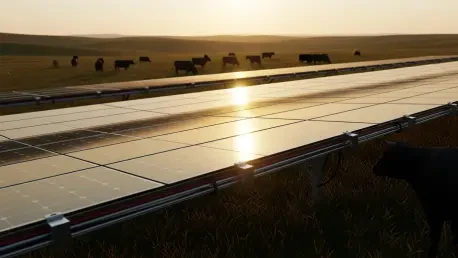

The traditional landscape of American agriculture is undergoing a profound transformation as energy producers and cattle ranchers find common ground beneath the sprawling glass canopies of modern solar arrays. This evolution represents a significant departure from the smaller-scale sheep grazing programs that once defined the agrivoltaic niche. By integrating massive bovine livestock into utility-scale energy zones, these dual-use strategies allow for the simultaneous harvesting of solar power and high-quality food products. Such a transition is vital for meeting carbon-free energy targets while ensuring that rural economies remain anchored in their agricultural roots.
Introduction to Integrated Solar-Grazier Systems
The core principle of agrivoltaics involves the symbiotic relationship between land and technology, but the shift from small-ruminant management to large-scale cattle integration marks a new era of complexity. Sheep are naturally suited to solar sites due to their size, yet they lack the market weight and economic impact that cattle bring to the American ranching sector. The emergence of these systems reflects a broader strategy to prevent the displacement of productive farmland by energy infrastructure, effectively turning solar farms into active, multi-functional pastures.
By adopting a dual-use approach, land managers can address the rising global demand for renewable energy without sacrificing the nutritional security provided by livestock. This technology is particularly relevant in the current energy landscape, where land-use conflicts often stall green initiatives. Integrating cattle ensures that the land remains in agricultural production, satisfying both environmental advocates and local farming communities who fear the loss of their traditional way of life.
Technical Innovations for Livestock Compatibility
Automated Tracker Adjustment Software: Precision Control
Managing half-ton animals around sensitive electronics required a departure from standard solar racking logic. Developers have introduced proprietary software that adjusts panel angles specifically to accommodate the physical presence of cattle. When the sensors detect livestock movement or during scheduled grazing periods, the system stows the panels in a near-horizontal position. This maneuver creates sufficient clearance for the animals to move freely and prevents them from leaning on or rubbing against the edges of the modules, which could lead to costly equipment failure.
Robust Infrastructure: Resilience in the Field
Engineering requirements for these systems are significantly more stringent than those for standard solar installations. The physical impact of a large bull or the curiosity of a heifer requires reinforced hardware and shielded wiring. Engineers have focused on making the tracker motors and racking systems more resilient to vibration and pressure. By strengthening these specific components, the industry has minimized the need for excessive steel supports that would otherwise make the projects financially unfeasible, maintaining high operational efficiency while ensuring animal safety.
Economic Drivers and Industry Shifts
Modern ranchers are navigating a landscape characterized by trade volatility and rising operational costs, making traditional farming increasingly precarious. The financial pressure has led many to seek diversified income streams that offer more stability than animal product receipts alone. When comparing the revenue potential of traditional grazing against solar land-lease agreements, the disparity is stark. Solar leases can yield approximately $1,000 per acre, providing a guaranteed check that acts as a hedge against the unpredictable nature of agricultural markets and climate-driven disasters.
Real-World Applications and Environmental Outcomes
Utility-Scale Power Generation: Grid Integration
Active implementations, such as the 40-acre facility in Tennessee, demonstrate that high-density grazing can coexist with 5-megawatt power production. These sites support local energy cooperatives and help meet the surging power demands of regional data centers without requiring new, dedicated land. The integration ensures that the energy produced is truly green, as the maintenance of the vegetation is handled by the livestock, reducing the carbon footprint associated with mechanical mowing and herbicide application.
Ecological Synergies: Welfare and Moisture
Beyond the financial and energy gains, the cattle themselves experience physiological benefits from the shaded environment. The solar panels act as a massive canopy, significantly reducing heat stress and lowering the animals’ water consumption. Preliminary data suggests that cattle grazing in these environments maintain better weight gain during peak summer months compared to those in open fields. Furthermore, the shade helps the soil retain moisture, creating a drought-resistant pasture that remains lush even when surrounding areas have turned brown.
Critical Challenges and Implementation Barriers
Despite the technical progress, protecting delicate sensors and complex wiring from heavy livestock remains a persistent hurdle. Cattle are naturally curious and strong, meaning any exposed component is a potential point of failure. High initial capital expenditure is also required for the specialized software and reinforced hardware, which can deter smaller developers. Additionally, the regulatory landscape is still catching up, with many regions lacking the land-use laws necessary to streamline the permitting process for these hybrid industrial-agricultural zones.
Future Outlook and Global Scalability
Looking ahead, cattle-integrated systems are positioned to become the standard for rural solar deployments across the globe. Potential breakthroughs in AI-driven herd management could allow for even more precise coordination between grazing rotations and energy production cycles. As panel materials become more resilient and tracking technology more affordable, the model will likely scale to much larger territories. This modernization ensures that the ranching identity is preserved, providing a viable path for the next generation of farmers to stay on the land while contributing to the global energy transition.
Conclusion and Summary of Advancements
The integration of cattle into solar landscapes proved to be a pivotal shift in maximizing land efficiency. Developers successfully demonstrated that livestock and photovoltaics could coexist without sacrificing yield or safety. This model established a framework for future investments that balanced the industrial appetite for energy with the essential preservation of rural economies and agricultural heritage. Moving forward, the focus shifted toward refining sensor durability and standardizing dual-use zoning to ensure these systems reached their full global potential.