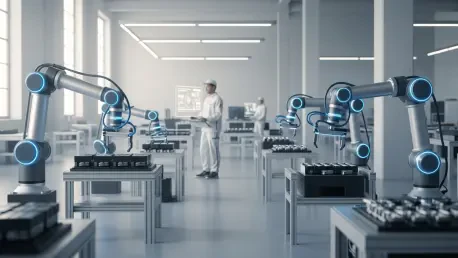

The manufacturing sector is currently navigating a significant transition fueled by shifting consumer expectations and a growing demand for customized products that standard machinery struggles to accommodate. While industrial success was once defined by the ability to mass-produce identical goods at high speeds, today’s market rewards agility and the capacity to pivot between diverse product lines without extensive downtime. This shift has exposed a growing divide between legacy automation systems, which rely on fixed, uncompromising processes, and adaptive robotics designed to thrive in high-mix, low-volume environments. As efficiency benchmarks continue to evolve throughout 2026, the limitations of traditional hardware have become increasingly apparent. Legacy systems are now viewed as potential liabilities because they cannot easily accommodate the rapid fluctuations of the contemporary supply chain. The industry is moving away from the “set it and forget it” mentality toward a future where robotic systems sense and react to real-time changes.
The Structural Flaws of Legacy Hardware
Architectural Constraints: The Problem of Isolation
Legacy automation was engineered for an era of stability, characterized by isolated production cells and siloed equipment that rarely communicates across stages. In these traditional setups, machines operate independently, meaning a minor change in one stage of the assembly line can trigger a complete system failure or require a total overhaul that stops production for weeks. Because these machines are physically and digitally isolated, manufacturers find themselves trapped in a rigid workflow that actively discourages innovation and prevents the integration of new technologies that require cross-platform data sharing. This lack of interconnectivity creates a locking effect where the existing infrastructure dictates the product design rather than the market needs. Engineers often find that adding even a single sensor to an old line requires a complete reconfiguration of the electrical and software architecture, which often proves too costly to justify in the short term.
Architectural Constraints: The Rigidity of Physical Design
Beyond software limitations, the physical layout of legacy hardware serves as a permanent constraint on operational efficiency and facility throughput. Traditional assembly lines are typically bolted to the factory floor, utilizing heavy-duty conveyors and fixed-path movement that cannot be altered without significant construction and downtime. When a manufacturing facility needs to pivot to a new product variant with a different footprint, the rigid nature of these installations becomes a massive bottleneck that prevents a fast response. The inability to rearrange equipment on the fly means that valuable floor space is often wasted on underutilized machinery that cannot be repurposed for other tasks. This structural inflexibility forces companies to choose between running outdated, inefficient lines or investing millions in entirely new installations, creating a cycle of waste that hampers long-term profitability. Manufacturers are increasingly recognizing that physical permanence is no longer a strategic asset.
Technical Debt: The Burden of Hard-Coded Logic
The locking effect is further compounded by hard-coded control logic, which makes even simple adjustments to a robotic arm’s movement a technical and logistical nightmare. When a product design changes, engineers must manually rewrite complex software code within proprietary environments that often lack modern debugging tools or intuitive interfaces. This process is both expensive and prone to human error, as a single line of incorrect code can result in mechanical collisions or defective products that ruin entire batches of inventory. This technical debt creates a formidable barrier to incremental improvement, as the sheer difficulty and risk of updating old systems often outweigh the perceived benefits of modernization, leaving factories stuck with outdated methods. As these legacy systems age, the pool of experts who understand the original code shrinks, making maintenance even more precarious and expensive. Consequently, reliance on rigid logic prevents the implementation of real-time optimizations.
Technical Debt: Programming Barriers to Innovation
Manufacturers often find that the software architectures governing their legacy robots are so specialized that they cannot easily integrate with modern data analytics or cloud-based management platforms. This isolation prevents the use of predictive maintenance tools that rely on continuous data streams to identify potential failures before they occur. Without the ability to export high-frequency telemetry data, these machines remain “black boxes” that provide little insight into their own health or performance metrics. The result is a reactive maintenance culture where repairs only happen after a breakdown has already occurred, leading to significant production losses and emergency service costs. Furthermore, the lack of standardized programming interfaces means that training new staff to operate these machines takes months, rather than the days required for modern systems. This labor-intensive approach to system management drains human resources away from more value-added activities, such as process optimization.
The Real-World Costs of Inflexibility
Operational Disruptions: The Price of Unplanned Downtime
The financial impact of maintaining rigid automation extends far beyond the initial purchase price, primarily manifesting as massive amounts of unplanned downtime. When a production line is built using fixed hardware, it lacks the resilience to handle unexpected shifts in demand or even minor mechanical issues that could be bypassed in a more modular setup. Industry data suggests that the manufacturing sector loses tens of billions of dollars every year due to these interruptions, highlighting the extreme risk of relying on systems that cannot adapt to change. Every hour a line sits idle while technicians struggle to reprogram a legacy controller represents not just lost revenue, but also a hit to the company’s reputation for reliability. These disruptions often ripple through the entire supply chain, causing delays for downstream partners and ultimately increasing the cost of goods for the end consumer. Modern adaptive systems are specifically designed to avoid these types of catastrophic failures.
Operational Disruptions: Mechanical Fragility and Safety Risk
Legacy systems often operate at the edge of their physical and digital tolerances, meaning that any deviation from the programmed norm can lead to catastrophic mechanical failure. These machines are typically blind to their surroundings, relying on precision that is entirely dependent on every part being in the exact same position every time. If a single component is slightly misaligned, the robot continues its pre-programmed path, often crashing into the workpiece or the surrounding tooling. This mechanical fragility necessitates the use of expensive, high-precision fixtures that add further cost and complexity to the production environment. Modern facilities are finding that the cost of maintaining this artificial level of precision is becoming unsustainable when compared to adaptive systems that use sensors to compensate for minor variations. The risk of major hardware damage remains a constant threat, leading to higher insurance premiums and the need for a massive surplus of spare parts and inventory.
Strategic Bottlenecks: Analyzing the Flexibility Gap
Beyond immediate revenue losses, system rigidity creates a significant flexibility gap that hinders long-term growth and prevents companies from entering new, lucrative markets. In a competitive global market where trends can change in a matter of weeks, the speed at which a company can bring a new product to market is a critical competitive advantage. Fixed systems act as a bottleneck, lengthening development cycles by months as engineers struggle to adapt old hardware to new requirements. When the cost of modifying an existing line approaches the cost of building a new one, manufacturers face a strategic crisis that limits their ability to compete with more agile startups. This lack of agility also prevents companies from taking advantage of small-batch production opportunities, which are increasingly common in the medical and aerospace sectors. By being locked into high-volume, low-variety production, traditional manufacturers are essentially ceding the most profitable and innovative segments of the market.
Strategic Bottlenecks: Diminished Return on Investment
The return on investment for rigid automation is increasingly difficult to justify when the total cost of ownership is viewed across the entire lifecycle of a manufacturing plant. While the initial capital expenditure for a fixed line might seem lower than a flexible alternative, the long-term costs associated with retooling and upgrades quickly bridge that gap. Every time a product reaches its end-of-life, the manufacturer is often forced to scrap large portions of their automation hardware because it is too specialized to be reused. This throwaway culture of industrial equipment is not only environmentally unsustainable but also a massive drain on corporate capital that could be better spent on research and development. In contrast, adaptive systems offer a sustainable financial model where the same robotic arms and mobile platforms can be redeployed across multiple product generations. By failing to account for the cost of future changes, many organizations find themselves stuck with depreciating assets that offer no path toward modernization or expansion.
Pioneering the Era of Adaptive Systems
Collaborative Integration: Human-Robot Synergy
To solve the problems of rigidity, a new generation of collaborative robots, or cobots, has been introduced to work alongside human operators without the need for traditional safety barriers. Unlike legacy robots that require massive cages and interlocked gates, cobots use advanced force-sensing technology to share a workspace safely with people, stopping instantly if they detect an unexpected touch. This ability to integrate robots directly into existing manual assembly lines allows for a hybrid approach to automation where humans handle complex, tactile tasks while robots take over repetitive or strenuous motions. The intuitive interfaces of these systems allow floor staff to reprogram them for new tasks in minutes rather than days, making them the perfect solution for factories that need to switch between different product variants frequently throughout a single shift. This democratization of robotics means that automation is no longer the exclusive domain of specialized programmers.
Collaborative Integration: Mobility via Autonomous Systems
Similarly, autonomous mobile robots (AMRs) are replacing fixed conveyor belts and manual forklifts to streamline internal logistics and provide a level of modularity previously thought impossible. By using onboard LiDAR sensors and dynamic mapping algorithms, AMRs can navigate busy factory floors safely without the need for permanent magnetic tracks, wires, or expensive floor modifications. This mobility allows manufacturers to reorganize their facility layouts on the fly, ensuring that materials are moved efficiently even as production requirements and product designs evolve. If a particular workstation becomes a bottleneck, additional AMRs can be deployed to that area instantly to increase throughput without any physical changes to the building’s infrastructure. This decoupled approach to material handling means that the failure of a single transport unit does not stop the entire line, providing a level of operational resilience that fixed conveyors simply cannot match in high-demand scenarios.
Intelligent Sensing: Managing Production Variability
The integration of sophisticated artificial intelligence and high-speed machine vision has enabled robots to handle natural production variability, a feat that was once considered impossible for machines. Modern sorting and assembly systems use deep learning models to identify objects by shape, color, or texture, allowing them to process diverse and disorganized inventories without the need for custom hardware fixtures. This intelligence ensures that robots can detect and account for slight differences in part orientation or lighting conditions, reducing errors and increasing the overall quality of the finished product. By mimicking the human ability to recognize patterns, these systems can handle delicate materials or irregularly shaped items that would have jammed a traditional rigid feeder system. This capability is particularly valuable in industries like food processing and electronics recycling, where the input materials are rarely uniform and require constant adjustment by the robot.
Intelligent Sensing: Generative AI and Quality Control
The rise of generative AI and reinforcement learning is revolutionizing the fields of quality control and strategic scalability by allowing systems to improve themselves over time. These modern robotic controllers learn from every cycle, identifying subtle correlations between machine settings and product defects that would be invisible to even the most experienced human inspectors. By constantly optimizing their own parameters, adaptive robots can maintain peak performance even as mechanical components begin to wear or environmental conditions like temperature and humidity change. This proactive approach to quality management significantly lowers false reject rates and improves overall equipment effectiveness across the entire facility. Furthermore, the ability to simulate millions of production scenarios in a digital twin environment before a single physical part is moved allows for rapid testing of new configurations. By investing in this level of digital intelligence, manufacturers gain a resilient operational framework.
Strategic Recommendations: Transitioning to Adaptive Frameworks
The transition from rigid automation to adaptive robotics represented a fundamental shift in how industrial value was created and maintained across the global supply chain. Manufacturers that successfully embraced these flexible technologies moved away from the fragile, high-volume models of the past and toward a more resilient, data-driven operational strategy. By prioritizing modularity and intelligent sensing, organizations were able to reduce their exposure to market volatility while simultaneously improving their ability to deliver customized solutions at scale. The move toward collaborative environments where humans and robots shared tasks proved that automation could be a tool for empowerment rather than labor replacement. Moving forward, the focus should remain on building interoperable systems that integrate with emerging AI frameworks. Decision-makers should evaluate current infrastructure for rigidity risks and begin the phased implementation of autonomous mobile platforms. This proactive investment in adaptability ensured that the factories of the present remained capable of meeting the unforeseen challenges of the decade.