
The transition from large language models confined to screens to embodied agents capable of interacting with the physical world marks a definitive shift in the current technological landscape. Diden Robotics stands at the forefront of this evolution by leveraging NVIDIA’s massive computing stack to bridge the gap between abstract reasoning and physical execution. By utilizing specialized foundation models, the company has successfully transcended the limitations of traditional robotic programming, which relied heavily on rigid scripts. Instead, these new systems learn through observation and simulation, allowing machines to understand the nuances of human environments without constant manual intervention. This synthesis of high-performance hardware and sophisticated software enables a level of dexterity and spatial awareness that was once considered purely theoretical. As industries demand more versatile automation, the partnership provides a robust framework for deploying systems.
Foundation Model Strategy
Embodied Intelligence
NVIDIA Isaac provides the essential infrastructure for Diden Robotics to develop foundation models that are specifically designed for humanoid and industrial robots. These models allow robots to understand natural language and emulate human movements by observing demonstrations. This process involves processing massive amounts of multimodal data, including video and tactile sensing, to create a generalized understanding of physical tasks. By tapping into NVIDIA’s DGX systems, Diden can accelerate the training of these neural networks, reducing the time required to refine motor skills. This rapid iteration cycle is crucial for developing robots that can perform non-repetitive tasks in unstructured environments. The result is a system that does not just follow a path but perceives its surroundings and adapts its behavior in real-time. This level of intelligence ensures that machines can operate safely alongside humans while maintaining high productivity levels across the global supply chain.
Virtual Development
The use of NVIDIA Omniverse allows Diden Robotics to create hyper-realistic digital twins that mirror every physical property of the real world. In these virtual environments, gravity and friction are modeled with extreme accuracy, enabling robots to undergo millions of training hours without the risk of damaging hardware. This massive parallelization of learning allows the AI to discover optimal solutions for movement that human engineers might never have considered. By simulating various edge cases, such as slippery surfaces or unexpected lighting, the developers ensure that the final product is resilient to the unpredictability of reality. This simulation-first philosophy has become a cornerstone of Diden’s strategy, effectively bridging the sim-to-real gap. Consequently, when a robot is deployed on a physical floor, it already possesses a comprehensive library of experiences that guide its decision-making process. This approach minimizes the need for expensive and time-consuming on-site adjustments.
Hardware Architectures
Edge Computing
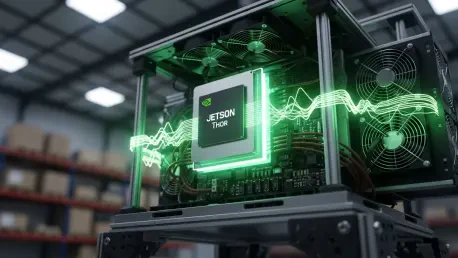
At the heart of Diden’s latest robotic platforms lies the NVIDIA Jetson Thor, a specialized computer designed to handle the heavy workloads of physical AI. This system-on-a-chip provides the necessary performance to run large transformer models and complex computer vision algorithms simultaneously at the edge. By processing data locally, Diden eliminates the latency issues associated with cloud computing, which is vital for maintaining safety in dynamic environments. The architecture of the Thor chip includes dedicated hardware for safety, ensuring that the robot can perform emergency stops in milliseconds. This localized processing power allows the machines to interpret high-resolution sensor data, such as LiDAR and depth cameras, without a significant power drain. The efficiency of the hardware is a key factor in extending battery life, making mobile robots more practical for long shifts. This integration of silicon and code defines the next generation of autonomous robotic agents for the modern world.
Fleet Management
The integration of Diden’s mechanical expertise with NVIDIA’s computational prowess established a new benchmark for what physical AI achieved in the workplace. Organizations that adopted these systems realized that the key to success lay in the continuous refinement of digital twins and the strategic deployment of foundation models. Engineers prioritized the creation of robust data pipelines to ensure that real-world experiences consistently informed virtual training sessions. This strategy allowed companies to overcome the traditional barriers of high deployment costs and rigid automation structures. Furthermore, the focus shifted toward software-defined hardware, where a robot’s capabilities were enhanced through code updates rather than physical modifications. Leaders recommended investing in high-bandwidth edge infrastructure to support the increasing demands of spatial processing. By embracing this holistic ecosystem, industries moved beyond simple automation toward a future of intelligent robotics that adapted to any task.