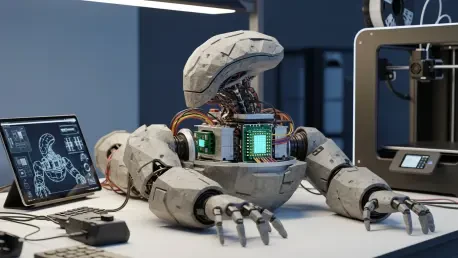

The transition from abstract science fiction concepts to tangible reality represents a significant milestone in modern maker culture, particularly when the subject is a complex extraterrestrial organism. Fans of Andy Weir’s celebrated novel recently witnessed this transition as Leviathan Engineering successfully manifested a functional, interactive version of the Eridian character known as Rocky. This achievement was not merely a matter of aesthetic replication but a sophisticated synthesis of advanced robotics and generative artificial intelligence. By leveraging a combination of modern computational power and modular hardware, the project has effectively bridged the gap between literary imagination and physical engineering. The result is a tabletop companion that does more than just sit on a shelf; it communicates, reacts, and exhibits the quirky personality traits that made the character a fan favorite. This endeavor showcases how 2026-era technology allows individuals to solve high-level design problems that once required the resources of major film studios.
Structural Foundations and Mechanical Design
Engineering a Pentaradial Anatomy: Challenges in 3D Modeling
The development process began with the digital sculpting of a body capable of mimicking the unique pentaradial symmetry of an Eridian. Using digital assets from 3D Totems as a foundation, the project transitioned into more rigorous engineering environments like Fusion 360 and Tinkercad to refine the geometry. The primary challenge resided in the requirement for structural integrity; a five-legged creature with a heavy central chassis must balance its weight perfectly to avoid mechanical strain on the joints. Designers had to reinforce 3D-printed components specifically at the points of rotation, ensuring the thermoplastic materials could withstand the torque generated by high-performance motors. This iterative design phase involved testing various infill patterns and wall thicknesses to find the optimal ratio of weight to durability. By focusing on modularity, the team ensured that individual segments of the limbs could be replaced or upgraded without dismantling the entire assembly.
Powering Locomotion: Precision Hardware and Servo Management
While the exterior design provided the visual identity, the internal mechanical framework required a robust solution for articulating ten distinct limbs and joints. The project utilized ten metal-geared servos, which were selected for their ability to provide high torque in a compact form factor. Managing these servos simultaneously required a sophisticated control layer, implemented via a Raspberry Pi 5 paired with a PCA9685 PWM driver HAT. This hardware configuration allowed for the granular control necessary to replicate Rocky’s signature rhythmic swaying and the precise execution of a fist bump. Earlier development stages explored the use of pulleys and linear actuators to simulate biological movement, but these were eventually discarded in favor of the direct-drive servo system due to the latter’s superior precision and reliability. This pivot ensured that the robot could maintain a consistent range of motion during extended periods of operation without the risk of mechanical slippage or calibration drift.
Cognitive Architecture and Interaction
Implementing Generative Intelligence: Vocal and Linguistic Synthesis
To breathe life into the mechanical shell, the integration of a sophisticated software stack was essential for processing human speech and generating character-accurate responses. The system employed Vosk for local speech recognition, which allowed the robot to operate efficiently without constant reliance on high-bandwidth cloud connections for basic understanding. Once a command or question was recognized, the data was processed through Google’s Gemini AI model, which was specifically prompted to adopt the personality and linguistic constraints of an Eridian. To handle the character’s unique “musical” voice, the Piper text-to-speech engine was utilized, allowing for the generation of rhythmic, melodic vocalizations that mirrored the description in the source material. This multi-layered approach ensured that the communication was not just functional but also immersive, capturing the essence of a species that communicates through chords rather than vowels and consonants.
Dynamic Behavioral Systems: Adaptive Logic and Gesture Selection
Moving beyond simple voice-activated scripts, the project focused on creating a non-linear interaction model that prioritized spontaneity over repetition. Instead of hard-coding specific animations to match specific words, the developers implemented a dynamic system where the AI determines the most appropriate gesture based on the emotional context of the dialogue. The AI coding assistant Claude played a pivotal role in organizing this complex logic, helping to weave together the speech processing and the mechanical control scripts into a unified workflow. This allows the robot to choose between a broad library of movements, such as tilting its body or raising a limb, in real-time. This level of autonomy ensures that the robot feels like a sentient entity rather than a clockwork toy. By decoupling the animations from rigid triggers, the robot can engage in more naturalistic behaviors, adapting its physical presence to the flow of a conversation just as a living creature would in a social setting.
Future Implications for Interactive Robotics
The successful construction of this interactive Eridian demonstrated that the barriers between high-end industrial robotics and enthusiast-led innovation have largely dissolved. By combining open-source tools with cutting-edge generative models, the project proved that complex fictional characters could be localized into physical spaces with remarkable fidelity. The engineer navigated significant technical hurdles, including power distribution for high-draw motors and the reinforcement of 3D-printed joints against mechanical stress. These solutions provided a blueprint for future creators looking to bridge the gap between digital intelligence and physical form. The project ultimately shifted the focus from mere static replicas to dynamic companions that could learn and adapt within their environments. As hardware became more accessible and software more intuitive, the realization of such intricate machines became a practical reality for a wider range of developers. This progress set a new standard for how fans and engineers might interact with their favorite stories in the coming years.