
The professional creative landscape has reached a critical juncture where the raw power of generative pixels often clashes with the meticulous requirements of high-resolution output and physical media production. While Adobe Firefly revolutionized the speed of conceptualization, the lingering challenge remained the inherent lack of structural integrity found in purely synthetic images. By partnering deeply with Topaz Labs, Adobe effectively bridges this gap, moving beyond simple image generation into a realm where artificial intelligence also acts as a master restorer and refiner. This synergy allows designers to take a low-resolution prompt-based concept and transform it into a 300-DPI print-ready masterpiece or a 4K video asset without the typical artifacts associated with traditional scaling. The industry is no longer just looking at how to make something new, but how to make that new thing meet the rigorous technical standards of professional workflows that demand precision and clarity.
The Synergy: Bridging Generation and Restoration
Strategic Integration: Merging Firefly With High-Fidelity Upscaling
The integration of Topaz’s specialized neural networks into the Photoshop environment provides an immediate solution to the hallucination problems often encountered during aggressive upscaling. Traditional bicubic interpolation and early-stage AI upscalers frequently introduced unwanted smoothing or strange geometric distortions that professional retouchers had to spend hours correcting by hand. With the inclusion of Topaz’s Photo AI algorithms, Adobe users can now leverage advanced denoising and sharpening that understands the difference between grain and texture, ensuring that synthetic textures in Firefly-generated content appear grounded in reality. This technological fusion means that a concept artist can work at lower resolutions to save processing time and local machine resources, knowing that the final export process will apply a sophisticated reconstruction layer that identifies edges and recovers lost facial details with incredible accuracy and speed.
Asset Longevity: Revitalizing Legacy Media for Modern Standards
Beyond mere sharpening, this partnership enables a new kind of creative flexibility where legacy assets can be revitalized to match the aesthetic quality of modern high-definition productions. Many agencies maintain vast archives of low-resolution photography from the early digital era that were previously unusable in contemporary large-format advertising campaigns or high-resolution displays. By utilizing the refined Topaz models now natively embedded within the Creative Cloud ecosystem, professionals can upcycle these assets with a level of fidelity that was practically impossible just a few years ago. This process does not simply stretch pixels; it intelligently predicts and redraws lost information based on millions of high-quality training examples, effectively filling in the blanks of history. This capability fundamentally changes the value proposition of archival content, as companies can now repurpose their intellectual property for modern platforms.
Industrial Impact: Redefining Professional Output
Cinematic Precision: Implications for Video Production and Motion Graphics
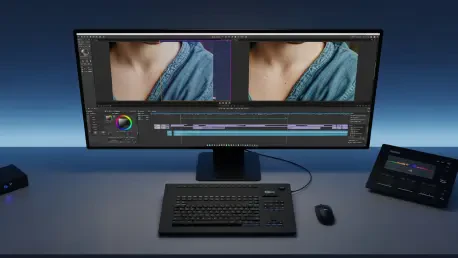
The video production industry stands to benefit perhaps more than any other sector from this strategic alignment, as the demand for high-fidelity content across varying display formats continues to skyrocket. Premiere Pro and After Effects users often struggle with noisy footage shot in low-light conditions or archival video that lacks the crispness required for 8K broadcast standards or IMAX-sized projections. By embedding Topaz Video AI directly into the timeline, editors can perform real-time de-interlacing and motion-compensated upscaling that significantly reduces the visual noise without losing the subtle nuances of human movement. This integration allows for a seamless transition between AI-generated b-roll and live-action footage, creating a cohesive visual narrative that avoids the jarring quality shifts that often break viewer immersion and overall production value.
Tactile Excellence: Advancements in High-End Print and Large-Scale Media
In the realm of high-end print and large-scale environmental graphics, the precision provided by this deal addresses the most significant bottleneck in the digital-to-physical transition. Large-format printing requires a density of information that generative AI has historically struggled to provide, often resulting in visible artifacts when viewed from a close distance. The combined power of Adobe’s layout tools and Topaz’s sharpening engines ensures that large-scale posters, billboards, and wrap-around advertisements maintain a sharpness that mimics optical reality. This shift empowers creative directors to experiment more freely with composite images and AI-assisted backgrounds, knowing that the final output will not crumble under the scrutiny of professional printing presses. Moreover, the automation of these enhancement tasks within the standard Adobe workflow reduces the need for third-party plugins, streamlining the entire production pipeline.
Future Readiness: Building Sustainable and Scalable Creative Pipelines
The strategic move by Adobe to integrate Topaz Labs’ sophisticated enhancement technology successfully addressed the critical need for technical excellence in an era dominated by synthetic media. Professionals who transitioned their workflows to embrace these new tools found that they could achieve a level of polish and detail that was previously reserved for boutique studios with massive render farms. Moving forward, the industry prioritized the development of standardized quality benchmarks that accounted for AI-enhanced resolution, ensuring that visual integrity remained a primary focus alongside creative speed. Creative teams were encouraged to audit their existing asset libraries and began the process of upscaling key historical content to meet current display requirements. By investing in training for these specialized AI modules, organizations ensured their staff could effectively navigate the nuances of restorative tools to create a more resilient production ecosystem for the years ahead.