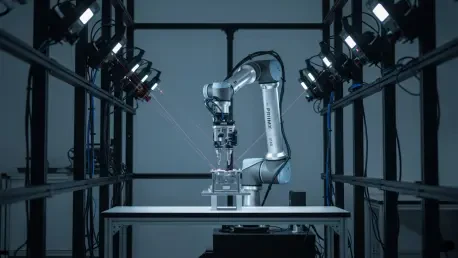

The relentless pursuit of seamless interaction between digital intelligence and the physical world has transformed Carnegie Mellon University into a pivotal hub for the development of advanced robotic systems capable of navigating complex environments with unprecedented precision and adaptability. This evolution is driven by the necessity to move beyond static algorithms into a realm where Physical Artificial Intelligence can perceive, reason, and act in real time. At the heart of this technological leap lies the integration of OptiTrack high-fidelity motion capture systems, which provide the essential ground-truth data required to bridge the gap between theoretical models and tangible execution. By deploying a network of specialized infrared cameras and reflective markers, researchers at CMU are able to track the position and orientation of robotic agents with sub-millimeter accuracy. This level of granularity ensures that the learning process for autonomous systems is grounded in physical reality, allowing for the rapid refinement of motor skills that were previously difficult to achieve in less controlled settings.
Engineering Precision: High-Fidelity Tracking for Learning Systems
OptiTrack technology utilizes a sophisticated array of PrimeX cameras that capture data at high frame rates, which is crucial for training robots to handle dynamic and fast-paced movements. When a robotic arm or a bipedal walker performs a task, every micro-adjustment must be recorded to understand the relationship between the control signals and the resulting physical change. This data serves as the foundation for reinforcement learning, where an agent receives feedback based on its performance in a 3D space. Unlike onboard sensors that may suffer from drift or occlusion, the external motion capture system provides an objective frame of reference that remains consistent throughout the training duration. This consistency allowed researchers to push the limits of agility in legged robots, enabling them to execute jumps, flips, and complex balancing acts with a high degree of repeatability. The resulting datasets are not only extensive but also incredibly clean, reducing the pre-processing time required before the information can be fed into deep neural networks for further analysis.
Beyond individual motor skills, the integration of these high-precision systems facilitates the complex field of multi-agent coordination where dozens of autonomous drones or mobile robots must operate in close proximity without collisions. In these scenarios, the spatial data provided by OptiTrack acts as a centralized brain, monitoring the relative positions of every participant in real time to ensure safety and efficiency. This setup is particularly valuable for testing swarm intelligence algorithms, where emergent behaviors are studied under rigorous conditions. By having a perfect overview of the environment, developers can identify the exact moment a communication lag or a sensor error occurs, allowing for a more granular debugging process. This approach has led to significant breakthroughs in how autonomous systems manage traffic flow and collaborative lifting tasks. The ability to simulate high-density environments within the lab ensures that when these systems are eventually deployed in the real world, they possess the logic necessary to handle chaotic variables.
Operational Evolution: Strategic Paths for Autonomous Integration
The implementation of advanced tracking protocols facilitated a fundamental shift in how Physical AI was prototyped and validated within university laboratories over the recent cycle of research. It was observed that the reliability of these high-frequency capture systems eliminated the sensory noise traditionally associated with standard computer vision, allowing teams to isolate specific algorithmic weaknesses. This methodical approach ensured that every iteration of a robotic controller was backed by empirical evidence, which led to more robust deployments in increasingly unpredictable settings. By standardizing the use of high-frequency motion capture, the academic community established a new benchmark for precision that accelerated the development cycle of autonomous drones and legged robots alike from 2026 to 2028. The success of these initiatives provided a clear roadmap for scaling laboratory successes into commercial applications, proving that the synergy between sophisticated hardware and machine learning software was essential for the future.
Actionable insights emerged from the data which suggested that the next phase of development required the integration of edge computing with localized motion capture to reduce latency even further. Researchers prioritized the creation of more portable tracking solutions that could be deployed in outdoor environments, extending the reach of high-fidelity ground truth beyond the confines of the lab. The solution to the sim-to-real gap was addressed by using the captured motion data to create more accurate physics engines, which in turn allowed for faster training in virtual spaces. These advancements paved the way for robots to enter human-centric environments, such as hospitals and warehouses, where safety and fluid interaction were paramount. The focus shifted toward long-term autonomy and the ability of Physical AI to learn from its mistakes without constant human intervention. Ultimately, the partnership between high-precision optical tracking and neural network development redefined the boundaries of what machines could accomplish.