
The proposal to encircle the entire lunar equator with a massive belt of solar panels represents the most ambitious engineering feat ever conceived by the human collective. This concept, spearheaded by the Shimizu Corporation under the “Luna Ring” moniker, aims to solve the energy crisis by harvesting constant sunlight from the lunar surface. Unlike terrestrial solar farms that contend with atmospheric filtration and the inevitable rotation of the Earth into darkness, a lunar-based system provides a near-constant stream of photons. This review examines whether this lunar infrastructure is a viable roadmap for planetary decarbonization or merely a high-concept marketing vision for the aerospace sector.
Introduction to the Luna Ring and Lunar Photovoltaics
The fundamental premise of lunar photovoltaics rests on the moon’s lack of an atmosphere, which allows solar cells to operate at peak theoretical efficiency without weather interference. By constructing a continuous belt of solar arrays along the 11,000-kilometer lunar equator, the system ensures that at least half of the infrastructure is always exposed to the sun. This configuration bypasses the intermittency issues that plague Earth-based renewables, offering a stable “celestial battery” that could theoretically provide clean power to the entire world.
The transition from terrestrial to space-based energy collection represents a paradigm shift in how humanity views natural resources. Instead of competing for limited land on Earth, the Luna Ring utilizes the desolate lunar landscape as a permanent industrial platform. This approach moves beyond the limitations of traditional orbital satellites, which are prone to degradation from space debris and orbital decay, by utilizing a solid, geologically stable foundation for power generation.
Core Technical Components of the Lunar Infrastructure
The Equator-Girdling Solar Array
The solar belt serves as the primary energy collector, intended to span up to 400 kilometers in width to maximize surface area. This massive array is not just a collection of panels but a sophisticated network of semiconductor materials designed to withstand extreme temperature fluctuations and cosmic radiation. The scale of this component is unprecedented, requiring millions of individual units to function in a synchronized grid that covers an area larger than several American states combined.
Wireless Energy Transmission Systems
Transferring power from the moon to Earth requires converting electricity into high-frequency microwave or laser beams. These beams are directed toward terrestrial “rectennas”—specialized receiving stations that convert the transmitted frequency back into usable electricity. The efficiency of this process is paramount; any significant dispersion of the beam over the 384,000-kilometer distance would result in massive energy loss and potential safety risks for the Earth’s atmosphere.
In-Situ Resource Utilization: The Role of Robotics
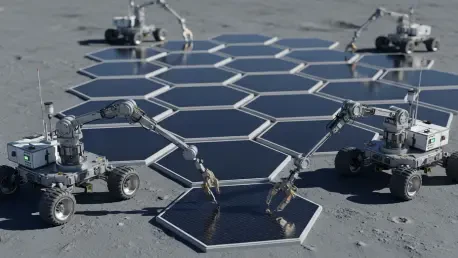
Constructing such a vast array from Earth-shipped materials is economically impossible, making In-Situ Resource Utilization (ISRU) the project’s most critical pillar. The plan involves using lunar regolith to manufacture solar cells, glass, and structural concrete on-site. Autonomous robots would process moon sand, extracting minerals and oxygen while utilizing hydrogen brought from Earth to facilitate chemical reactions. This self-sustaining manufacturing cycle is what differentiates the Luna Ring from previous, less scalable space power concepts.
Recent Innovations and Shifting Energy Paradigms
The urgency for a reliable base-load energy source has intensified as the global community moves toward 2030 decarbonization targets. Recent advancements in modular robotics and teleoperation have significantly reduced the technical gap for lunar construction. Innovations in AI-driven swarm robotics allow for the deployment of thousands of small units that can coordinate complex building tasks without direct human intervention, making the “self-building” moon base a more plausible reality than it was a decade ago.
Real-World Applications and Global Energy Integration
Terrestrial Power Grid Stabilization
The primary goal of the Luna Ring is to act as a stabilizing force for national power grids, providing a steady supply of “rectified” DC electricity. As terrestrial wind and solar power continue to face challenges with storage and grid synchronization, the consistent output from the moon could serve as the ultimate balancing mechanism. This steady flow would eliminate the need for fossil-fuel-burning “peaker” plants, facilitating a complete transition to a carbon-neutral global economy.
Deep Space Exploration Support
Beyond Earth-side benefits, the Luna Ring provides the energy backbone for a permanent human presence in space. The infrastructure can power lunar habitats, oxygen-extraction plants, and fuel depots for missions to Mars. By establishing a high-output power station on the moon, the costs of future deep-space exploration are drastically lowered, as the lunar surface becomes a self-sufficient refueling station rather than a temporary outpost.
Technical Hurdles and Implementation Obstacles
Engineering Complexity: Robotic Readiness
The most glaring challenge is the current lack of operational robotics capable of complex manufacturing in the harsh lunar environment. While laboratory prototypes show promise, the ability to smelt regolith and print solar cells autonomously at an 11,000-kilometer scale is a leap that requires decades of incremental testing. The reliability of these machines in a vacuum, where lubricants fail and radiation degrades electronics, remains the project’s most significant technical bottleneck.
Economic Feasibility and Regulatory Concerns
Critics often point to the astronomical upfront investment required for a project with no immediate return. Unlike geothermal or modular nuclear energy, which offer localized and immediate solutions, the Luna Ring requires a global consensus on space law and energy security. The potential for high-energy microwave beams to be weaponized or accidentally diverted creates a regulatory minefield that international space agencies have yet to navigate.
Future Outlook and Technological Breakthroughs
As launch costs continue to drop due to reusable heavy-lift rockets, the logistical barriers to the moon are slowly eroding. The next decade will likely see the first small-scale pilot programs for lunar ISRU, testing the feasibility of manufacturing solar cells from regolith. These incremental breakthroughs will determine if the Luna Ring remains a conceptual masterpiece or evolves into a tangible cornerstone of the Earth’s energy future.
Summary and Final Assessment
The evaluation of lunar solar power revealed a concept that bridged the gap between science fiction and necessary engineering. While the Luna Ring offered a theoretically perfect solution to terrestrial energy shortages, the practical implementation was hindered by the current state of autonomous manufacturing and the massive capital requirements. The project successfully shifted the global conversation toward space-based resource management, highlighting the potential of the moon as a strategic asset for a sustainable civilization. Ultimately, the development of these technologies provided a foundation for future lunar colonies, even if the full-scale girdling of the equator remained a long-term aspiration rather than an immediate fix.