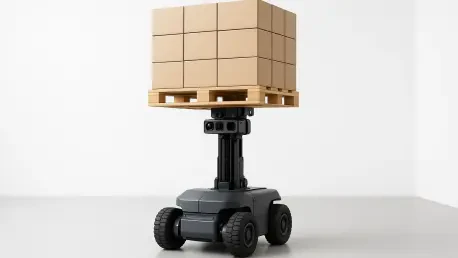

Utilizing edge intelligence and multi-sensor navigation, the PUDU MP2000 creates real-time environmental maps to bypass the limitations of traditional fixed-track automation. The logistics industry is currently facing a massive demand for higher throughput and reduced operational costs, particularly in the heavy-duty segment where manual pallet handling remains a significant bottleneck. By introducing this high-capacity autonomous mobile robot (AMR), Pudu Robotics aims to bridge the gap between flexible light-duty delivery robots and the rigid requirements of heavy industrial transport. Modern facilities now require systems that can operate alongside human workers without the need for physical barriers or specialized floor markings. This transition toward more intelligent hardware represents a significant pivot in how supply chains are structured from 2026 to 2028. The MP2000 is designed specifically to handle payloads up to 2000 kilograms, ensuring that even the most demanding manufacturing tasks are automated with high precision and safety standards.
Revolutionary Navigation: Safety and Sensors
The core strength of the MP2000 lies in its sophisticated perception stack, which integrates dual-LiDAR systems and high-definition depth cameras to ensure 360-degree situational awareness. Unlike older automated guided vehicles that rely on magnetic strips or QR codes, this robot utilizes advanced Simultaneous Localization and Mapping (SLAM) algorithms to navigate dynamic environments. This capability allows the unit to identify and respond to temporary obstructions, such as misplaced pallets or moving personnel, by recalculating its route in milliseconds. The integration of edge computing allows the robot to process vast amounts of sensor data locally, reducing latency and ensuring that safety-critical decisions are made without relying on a central server. This decentralization of intelligence is crucial for maintaining operational continuity in large-scale warehouses where wireless connectivity can sometimes be intermittent. Furthermore, the robot’s ability to recognize various pallet types enhances its versatility in complex industrial settings.
Safety remains a priority for industrial robots, and the MP2000 addresses this through a multi-layered redundancy system. Each unit is equipped with emergency stop buttons, sonic sensors for low-profile object detection, and visual warning signals that communicate the robot’s intentions to nearby workers. These features work in tandem to create a predictive safety model, where the AMR anticipates potential collisions before they occur and adjusts its speed accordingly. In addition to hardware-based safety, the software environment includes geofencing capabilities, allowing operators to define restricted zones or speed-limited areas within the warehouse software. This level of control ensures that the deployment of heavy AMRs does not compromise the safety standards of the facility. As industrial environments become more crowded, the ability of a robot to navigate tight aisles while carrying two tons of material becomes a differentiator. The MP2000 successfully balances high torque and load capacity with delicate maneuvering across various floor types.
Strategic Implementation: The Path to Integration
Operational efficiency in the current industrial landscape is often measured by the seamlessness of equipment integration into existing workflows. The MP2000 features a robust battery management system that supports fast-charging and long runtimes, minimizing downtime during shifts. For facilities operating on a 24-hour cycle, the ability of these robots to autonomously return to charging stations and swap into the workflow ensures that productivity remains constant. The mechanical design is optimized for durability, featuring industrial-grade components that withstand the rigors of continuous operation in dusty or temperature-variable environments. Beyond physical movement, the precision with which the MP2000 interacts with pallet stands and conveyors is vital. By utilizing fine-tuned motor controls and specialized lifting mechanisms, the robot reduces the risk of load shifts or damage to goods. This level of reliability is essential for companies looking to automate high-value inventory transport while maintaining the integrity of their entire stock.
The successful implementation of the MP2000 required a strategic evaluation of facility infrastructure and traffic management. Organizations that prioritized the integration of these autonomous systems found that a phased approach was most effective, starting with high-traffic corridors before expanding to more complex picking zones. It was discovered that the transition required updating internal network protocols to ensure low-latency communication between the robot fleet and the central warehouse management system. Managers focused on training personnel to interact safely with the autonomous units, which significantly reduced the learning curve and improved overall floor morale. Moving forward, businesses should prioritize the adoption of standardized pallet configurations to further streamline robotic interactions. Investing in predictive maintenance scheduling was also a critical step in preserving the longevity of the hardware investment. Ultimately, the adoption of advanced AMRs proved to be a cornerstone of modern industrial resilience for many firms.