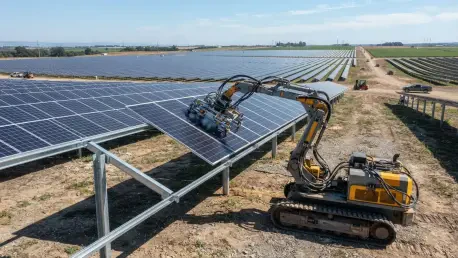

Construction sites for data centers and civil engineering projects may soon adopt the same intelligence layers currently being tested on solar farms. As the demand for renewable energy reaches a fever pitch in 2026, firms like Gritt Robotics are stepping into the fray to bridge a widening gap between climate goals and the physical reality of construction. In a landmark collaboration with engineering giants like Burns & McDonnell, the California-based technology firm is aggressively deploying AI-assisted systems to install six million solar panels over the next two years. This massive undertaking aims to add 2.8 gigawatts of capacity to the power grid, a feat that would be nearly impossible using traditional manual labor alone. By focusing on utility-scale solar, these developers are not just building power plants but are refining an autonomous framework capable of navigating the chaos of the outdoors. The industry is witnessing a pivot where software intelligence becomes as essential as the steel and silicon it assembles.
Mastering the Rhythms: Solar Sites as Technological Proving Grounds
Solar farms provide a unique environment that is simultaneously structured and unpredictable. While the basic layout of a solar site is largely two-dimensional and involves the installation of millions of identical components, the actual conditions on the ground are anything but uniform. Machines must contend with shifting soil, varying light conditions, and environmental obstacles like dust or snow that can obscure sensors. Gritt Robotics addresses these hurdles by implementing an intelligence layer that allows robots to process environmental data in real-time, effectively allowing them to see and understand their surroundings. This capability transforms a chaotic, unstructured construction site into a manageable workspace where autonomous units can operate safely alongside human workers. By mastering the repetitive nature of solar panel placement, the AI systems are proving that high-level automation can thrive outside the sanitized, controlled environments of modern factories and laboratories.
The long-term strategy for these AI systems extends far beyond the immediate need for renewable energy infrastructure. Every project serves as a data-rich training session, where the software identifies patterns and refines its understanding of physical manipulation. Once the AI learns a specific skill, such as securing a fastener or managing delicate cabling, that knowledge is retained and shared across the entire fleet of machines. This cumulative learning process ensures that the technology becomes more proficient with every megawatt installed. As these systems gain competence in 2026 and 2027, the groundwork is being laid for expansion into more complex civil engineering projects. The ability to adapt to new sites with minimal recalibration means that the intelligence layer developed for solar will soon be capable of building data centers or large-scale transportation hubs. This evolution represents a shift from purpose-built robotics to a versatile, scalable form of field intelligence.
Retrofitting Heavy Equipment: The Software-First Revolution
A core pillar of the current technological approach is the decision to retrofit existing, field-proven construction machinery rather than building entirely new robotic hardware from scratch. By integrating advanced AI control systems into standard equipment from manufacturers like Caterpillar, Bobcat, and KUKA, technology firms are leveraging decades of engineering expertise in hardware durability. These machines are already designed to withstand the harshest outdoor elements, from extreme heat to abrasive dust. The digital brain provided by the AI allows a traditional excavator or industrial robotic arm to perform dexterous, high-precision tasks that previously required human hands, such as tying rebar or attaching tracker tubes. This method is significantly more cost-effective and reliable than developing proprietary robotic platforms, as it utilizes a supply chain and maintenance infrastructure that is already well-established within the global construction industry. It effectively turns heavy iron into an autonomous agent.
This transition toward autonomous field operations is being spearheaded by researchers from prestigious institutions like the Robotics Institute at Carnegie Mellon University and MIT. Their primary focus is on moving away from experimental, purpose-built robots that require a team of specialized technicians to operate and maintain. Instead, the goal is to create truly autonomous systems that can be managed by generalist construction operators with minimal technical training. By establishing a common representation layer for diverse types of machinery, these experts are setting a new industry standard for how robots interact with the physical world. This democratization of high-tech tools ensures that the existing construction workforce can transition into new roles as managers of robotic fleets. The focus remains on creating a system that is robust enough for the field while being intuitive enough for the job site, ensuring that the technology serves the workers, ultimately accelerating the pace of modern infrastructure development.
The Path Forward: Sustaining Growth through Automation
The current labor crisis in the construction sector represents one of the most significant barriers to achieving widespread energy independence. With an estimated shortfall of 53,000 workers required for ongoing solar projects, the industry has been forced to look beyond traditional recruitment methods. This challenge is further intensified by the fact that nearly 41% of the existing construction workforce is expected to retire by 2031, taking decades of specialized field knowledge with them. Many large-scale solar projects are located in isolated, sparsely populated areas, making it extremely difficult to source local talent and requiring the logistical complexity of providing housing and transport for traveling crews. By deploying autonomous systems, engineering firms have been able to amplify the productivity of their existing staff, allowing a single human operator to manage multiple robotic units. This approach not only fills the manpower gap but also makes the job site safer by reducing the need for humans to perform repetitive labor.
The successful implementation of AI-assisted systems established a new blueprint for the future of heavy industry. It demonstrated that the most effective way to combat labor volatility was through the rapid adoption of digital intelligence that complemented human expertise rather than attempting to replace it. Companies that integrated these technologies early experienced significant gains in both safety and project timelines, setting them apart from competitors who relied solely on traditional methods. These developers proved that the synthesis of autonomous machinery and human oversight was the only viable path to meeting the aggressive renewable energy goals of the decade. By the time these projects reached completion, the industry had shifted its focus toward the standardization of autonomous software layers across all equipment manufacturers. This transition ensured that the workforce of the future was better equipped, more efficient, and capable of building critical infrastructure in the most remote corners of the world, effectively securing a sustainable energy future.