
The persistent challenge of visual fatigue in augmented reality has long stemmed from the fundamental physiological disconnect between how the brain interprets digital depth and how the eye physically focuses. The implementation of a varifocal display has proven to increase information throughput, a comprehensive measure that balances speed and accuracy during digital interactions. This development addresses the vergence-accommodation conflict, a state where the eyes converge on a virtual object while the ocular muscles are forced to maintain focus on a static, flat display surface. This optical mismatch often results in significant headaches, nausea, and a general degradation of user performance over extended sessions. Researchers from a global consortium have now demonstrated a sophisticated optical see-through system that dynamically recalibrates its focal plane in real-time. By mimicking the natural adaptive mechanisms of human vision, this technology allows the eyes to focus and converge on the same spatial plane, eliminating the discomfort that has hindered the adoption of head-mounted displays for professional use.
Technical Architecture and Global Research Efforts
Collaborative Engineering: Advanced Optical Systems
The development of this advanced varifocal prototype represents a significant milestone in international scientific cooperation, merging distinct technical disciplines into a single project. Led by Assistant Professor Xiaodan Hu, the initiative brought together a diverse range of expertise from institutions across Japan, China, and Canada. The Asian research contingent, comprising specialists from the Shibaura Institute of Technology and the Nara Institute of Science and Technology, spearheaded the core hardware engineering and initial user validation phases. Their work laid the technical groundwork for a display capable of high-speed optical adjustments. Meanwhile, the Canadian partners from the University of Calgary and Concordia University contributed vital insights into human-computer interaction and experimental design protocols. This synergy ensured that the device was not merely an optical triumph but also a tool meticulously tuned to the nuances of human perception. By combining these regional strengths, the team established a framework for future immersive display standards that prioritize efficiency and user comfort.
The project focused heavily on bridging the historical divide between purely clinical optics and the practicalities of interactive software environments. Designers and engineers worked in tandem to ensure that the shift in focal planes occurred with enough speed to remain imperceptible to the human eye, which is a critical requirement for maintaining immersion in augmented reality. This collaborative effort also involved extensive testing of how virtual images interact with the physical backdrop of the real world, ensuring that the transparency and luminosity of the display remained consistent. By integrating these different perspectives, the consortium was able to move beyond the limitations of current commercial headsets, which often neglect the physiological needs of the eye in favor of simple pixel density. The resulting prototype serves as a testament to the idea that the next generation of spatial computing will require a deep, multi-disciplinary understanding of both the machine and the biological systems it serves. This approach has already begun to influence how emerging startups plan their research and development cycles.
Mechanical Foundation: The Varifocal Prototype
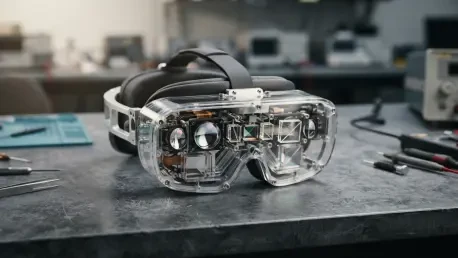
At the core of this innovative display system lies a sophisticated optical assembly that replaces static lens configurations with a dynamic, adjustable mechanism. The prototype utilizes a specialized spherical mirror in conjunction with a high-precision beamsplitter to control the path of light entering the user’s pupil. Unlike traditional headsets that rely on a fixed focal distance, this system can alter the convergence of light rays in real-time, allowing virtual objects to appear at varying depths without losing sharpness. This technical feat is managed by a series of actuators that reposition the optical elements based on the calculated position of the virtual target in the 3D environment. This allows the display to provide the eye with the natural focal cues it expects from the physical world, creating a much more convincing and comfortable illusion of depth. The shift from static to dynamic optics represents a fundamental change in how head-mounted displays are constructed, moving away from simple screen projection and toward a more holistic simulation of the natural light fields that humans encounter daily.
One of the primary advantages of this specific hardware configuration is its ability to blend virtual images seamlessly with real-world light without the typical blurring associated with fixed-focus lenses. When a user looks through the beamsplitter, the system ensures that the accommodation demand—the amount of focusing power the eye must use—matches the vergence demand dictated by the stereoscopic image. This synchronization is what ultimately prevents the onset of visual fatigue and digital motion sickness, which are common complaints among users of existing augmented reality solutions. Furthermore, the use of a spherical mirror helps to minimize optical aberrations that can often plague more compact display designs. By maintaining a high level of image clarity across multiple focal planes, the prototype provides a level of visual fidelity that is essential for tasks requiring high precision, such as surgical overlays or detailed engineering work. This focus on matching biological expectations with mechanical output sets a new benchmark for the industry as it moves toward widespread consumer adoption.
Experimental Outcomes: Speed and Accuracy
To rigorously evaluate the efficacy of the varifocal system, the research team designed a comprehensive series of 3D pointing experiments aimed at measuring the physical performance of users. Participants were tasked with selecting various virtual targets within a controlled stereoscopic environment using a tracked wand that acted as a physical pointer. This setup allowed the researchers to capture high-resolution data on how the brain and motor systems respond to differing focal cues. The experimental design focused on three primary metrics: movement time, error rates, and information throughput. By comparing performance under traditional fixed-focal conditions against the new varifocal mode, the team could isolate the specific impact of focal plane adjustment on manual dexterity and cognitive load. This methodological approach was chosen to move beyond subjective user reports of comfort and toward objective, quantifiable data. The results of these trials provided clear evidence that resolving the vergence-accommodation conflict has a direct and positive impact on the speed at which humans can manipulate digital information.
The experiment successfully demonstrated that the varifocal viewing mode reduced movement time and increased information throughput without causing a rise in error rates. This confirmed that users interacted with virtual objects more efficiently when their visual systems were not hindered by conflicting depth cues. The study also highlighted that performance gains were most significant during deep-space interactions, suggesting that varifocal technology was essential for complex 3D tasks. Moving forward, developers should prioritize the integration of high-speed eye-tracking sensors to automate focal adjustments based on real-time gaze. Furthermore, future systems must be calibrated to individual visual profiles to account for variability in depth perception. By implementing these actionable steps, the industry could finally transition augmented reality from a niche tool into a comfortable, high-performance consumer product. The findings established a definitive technical foundation for the next generation of immersive interfaces, proving that the future of spatial computing depends on a sophisticated understanding of human ocular biology.