
Oscar Vail is a seasoned technology strategist who has spent years analyzing the delicate friction between bleeding-edge hardware and societal adoption. With a deep focus on the evolution of wearables, Vail has tracked the industry’s shift from the early, experimental days of “Project Glass” to the current high-stakes rivalry between social media giants and traditional tech powerhouses. His expertise lies in understanding how custom silicon and advanced optics like waveguide displays are finally bridging the gap between bulky prototypes and fashionable daily accessories.
The following discussion explores the strategic pivot from simple recording devices to sophisticated AR platforms, the technical necessity of in-house hardware manufacturing, and how voice-driven AI is redefining the user interface. We also examine the competitive landscape where Snap and Meta are battling for dominance over our field of vision.
Early smart glasses faced intense public backlash over privacy and unauthorized recording in social settings. How can current designers build hardware that more effectively signals when recording is active, and what specific steps are required to overcome the negative social labels that hindered previous iterations of this technology?
The industry learned a painful lesson from the “Glasshole” era of 2012, where bystanders felt physically vulnerable to surreptitious filming in movie theaters and cafes. To move past that stigma, designers are now prioritizing “explicit signaling,” which involves prominent LED indicators that are hardwired to the camera’s power source so they cannot be disabled by software. Beyond the hardware, there is a massive social rebranding underway where companies are shifting the focus from “recording others” to “capturing personal memories,” much like the original 2016 Spectacles did with their 10-second clips. Overcoming negative labels requires making the technology feel less like a surveillance tool and more like a creative extension of the user’s personality. We are seeing a move toward more transparent communication from brands to ensure that the 43% of users currently opting for non-display AI glasses feel socially accepted rather than scrutinized.
While many wearable devices rely on third-party components, some companies argue that in-house hardware development is essential for a lightweight product. What are the specific technical advantages of custom-built internal parts, and how does this approach improve the intersection between software performance and the overall user experience?
When you rely on off-the-shelf components, you are forced to build your frame around someone else’s thermal and spatial limitations, which often leads to a bulky, unappealing product. By keeping hardware development in-house, a company can optimize the tiny footprint of the device, ensuring that every millimeter of the frame serves a dual purpose for both aesthetics and computing power. This vertical integration allows the software to communicate directly with custom silicon, reducing latency and power consumption which are the two biggest enemies of wearable tech. It is a philosophy famously championed by Steve Jobs and Edwin Land, where the magic happens at the intersection of hardware and software. Ultimately, this control allows for a device that feels like a pair of glasses first and a computer second, rather than a heavy gadget strapped to your face.
Meta currently leads the market with nearly half of all global shipments, often utilizing established fashion brands for their frames. How do engineers solve the challenge of fitting high-resolution displays into traditional eyewear shapes, and what are the primary trade-offs between battery life and maintaining a slim, stylish profile?
Meta’s dominance, holding a 45% share of the global market, stems largely from their partnership with iconic brands like Ray-Ban and Oakley, which masks the technology within a familiar form factor. Engineers face a brutal “war of millimeters” where they must shrink display engines and batteries into the temples of the frame without making the glasses look wide or “techy.” The primary trade-off is that high-resolution displays require significant power, which usually necessitates a larger battery that can ruin the slim profile consumers demand. To solve this, many designs limit the display to a small “heads-up” area or rely on the smartphone to handle the heavy processing via Bluetooth. It is a constant balancing act between giving the user a rich visual experience and ensuring the glasses don’t die after only an hour of active use.
Waveguide displays allow digital images to be projected onto lenses that remain transparent to the wearer. How does this technology achieve higher image sharpness compared to older display types, and what are the engineering requirements for integrating a small projector and a high-performance processor into the frame?
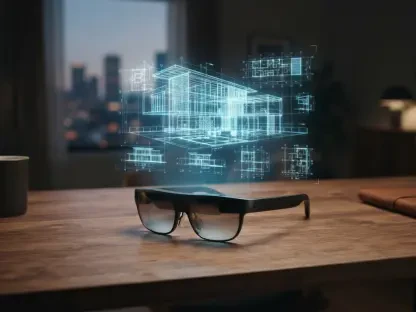
Waveguide technology is a breakthrough because it uses internal total reflection to guide light from a tiny projector through a thin piece of glass or plastic directly into the eye. Unlike older prism-based displays that were chunky and distorted peripheral vision, waveguides allow the lens to remain perfectly clear while overlaying sharp, high-resolution digital imagery. This requires incredibly precise engineering to fit a micro-projector—often powered by platforms like the Snapdragon XR—into the hinge or temple area of the frame. The challenge is managing the heat generated by a high-performance processor sitting so close to the user’s temple. Success depends on using advanced materials that can dissipate heat while maintaining the structural integrity of a stylish, lightweight frame.
Nearly 43% of smart glasses currently shipping lack a display, relying instead on artificial intelligence and audio for navigation. As companies like Apple and Google prepare to enter this space, how will voice-controlled AI change the way users interact with digital information, and what metrics define a successful interface?
The fact that nearly half of the market currently lacks a screen proves that users value “ambient intelligence” over visual clutter. Voice-controlled AI, like a more advanced Siri or Google Assistant, transforms the glasses into a private concierge that can provide directions or identify objects without the wearer ever looking at a screen. A successful interface in this category is defined by “latency and intent accuracy,” meaning the device must understand the user’s request instantly and respond with 100% relevance. If the AI takes too long to process a voice command, the illusion of a seamless digital layer is broken. As these devices evolve, the metric of success will shift from how many pixels are on a screen to how effectively the AI can anticipate a user’s needs through audio cues alone.
Developing features like “Stories” proved that social media platforms can lead significant tech trends before hardware catches up. Given the move toward more sophisticated “Specs,” what specific hardware innovations are necessary to make augmented reality a daily utility, and how will these devices eventually compete with the smartphone?
For smart glasses to transition from a novelty to a daily utility, we need significant leaps in battery density and thermal management so that they can run all day without overheating. We also need “all-day wearable” optics that don’t cause eye strain or social friction, which is where the upcoming 2026 “Specs” aim to innovate. These devices will eventually compete with the smartphone by removing the “pocket-to-face” friction, allowing us to access information instantly in our line of sight. Just as Snapchat pioneered the “Stories” format that revolutionized how we share life, these new hardware iterations will redefine how we consume data. Once the hardware can match the speed and reliability of a phone, the convenience of a hands-free interface will likely make the smartphone a secondary “hub” device.
What is your forecast for smart glasses?
I believe we are entering a “Quiet Revolution” where smart glasses will stop trying to look like sci-fi gadgets and start looking like the $130 beach-vending-machine fun of the original Spectacles, but with the power of a modern computer. By 2026, the market will split into two clear segments: high-end waveguide glasses for professional utility and stylish, display-less AI frames for the mass market. We will see a massive influx of competitors like Samsung and Apple, which will drive prices down and force a standard for privacy signaling. Ultimately, the success of this category won’t be measured by raw specs, but by how naturally these devices fit into our social lives without making us feel like “Glassholes.” The winner won’t be the company with the biggest screen, but the one whose glasses people actually want to wear on their faces all day long.